


Key Takeaways
- Iran halted ceasefire talks on June 1 and threatened to fully close the Strait of Hormuz, sending oil up 7% and breaking Bitcoin’s four-month trendline
- Strategy made its first Bitcoin sale since 2022, selling 32 BTC, adding sell pressure at exactly the wrong moment
- Bitcoin is at $69,550 with RSI at 27.56, now in oversold territory for the first time since the February bottom
- The measured move targets $66,649 first, then $62,800
Yesterday we wrote that the trendline from February had held through every Iran headline since the war began, and that one geopolitical shock could end it. We outlined three specific scenarios. Two of them fired on the same day.
What Broke It
The trendline did not break on ETF outflows or seasonality. It broke on geopolitics, exactly as the original article said it would.
On June 1, Iran suspended indirect ceasefire negotiations with Washington and threatened a complete closure of the Strait of Hormuz in response to what Tehran called ongoing ceasefire violations. Oil surged more than 7% immediately. Every rate cut expectation that oil above $100 had already damaged got worse. Bitcoin dropped to a seven-week low at $71,300 before the trendline gave way entirely overnight.
The same day, Strategy disclosed its first Bitcoin sale since 2022. The company sold 32 BTC for approximately $2.5 million to fund preferred stock dividends due June 30. The amount is negligible relative to Strategy’s 840,000 BTC holdings. But the optics of the most vocal Bitcoin accumulator in history selling any Bitcoin at all, into a market already pricing in Iran escalation, hit sentiment hard.
Those were Scenario 1 and Scenario 3 from the original article. Both triggered within hours of each other.
Where the Chart Points Now
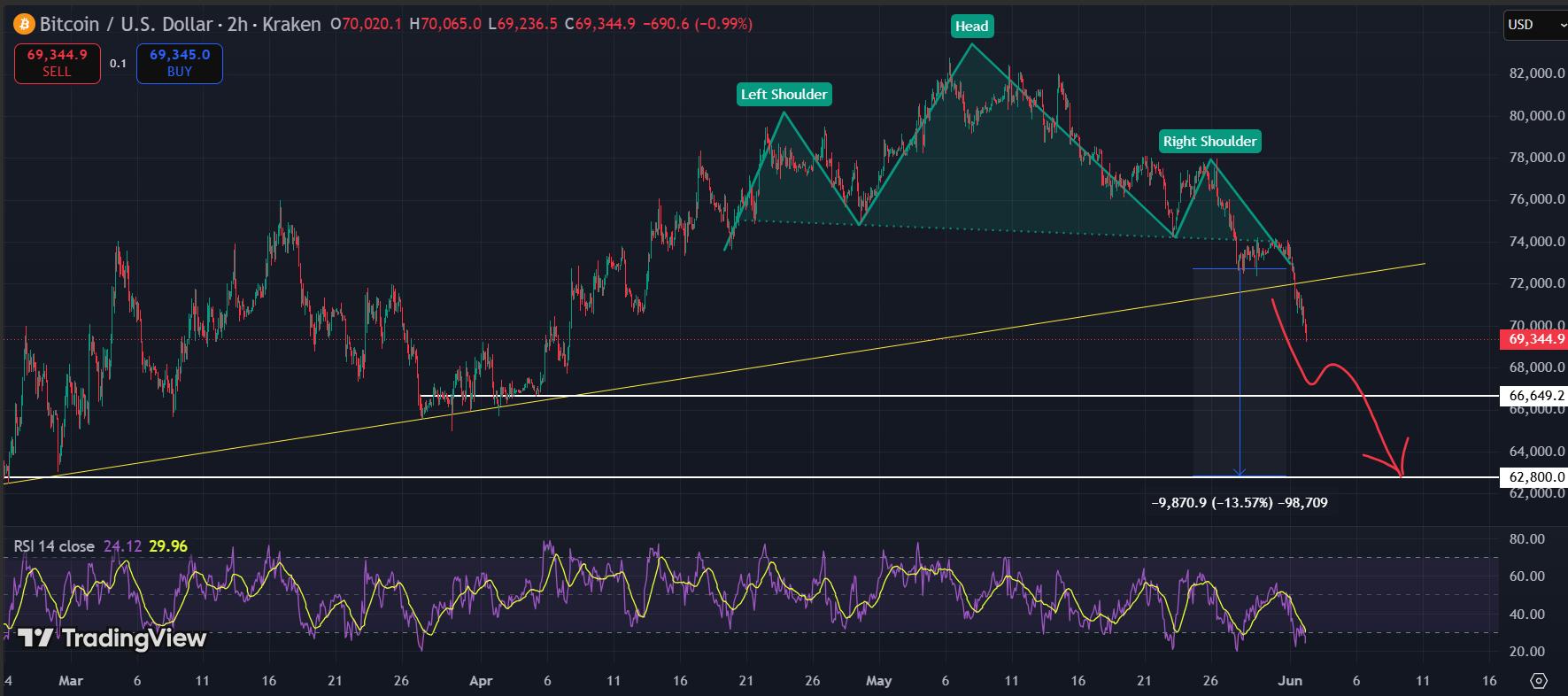
The trendline from February broke on June 2 as Bitcoin fell to $69,344. The head and shoulders measured move now points to $66,649 then $62,800. RSI at 29.96, approaching oversold. Source: TradingView
The head and shoulders pattern that broke on May 28 always had two targets. The trendline was the only thing delaying the measured move. With it gone, both targets are now active.
$66,649 is the first stop. The prior support level from March consolidation and the first measured move from the neckline breakdown. At $69,550, that is roughly 4% lower.
$62,800 is the full pattern target. The February cycle low. The origin of the trendline that just broke. A return there erases the entire four-month recovery, a 13.57% decline from the neckline.
The RSI at 27.56 on the 2H chart is now in oversold territory for the first time since the February bottom. Oversold does not mean the bottom is in. It means the selling has been extreme and a relief bounce toward $71,000 to $72,000 is possible. That zone is now resistance.
The Strait of Hormuz Is the Variable
The original article identified three geopolitical scenarios. Scenario 2 has not fired yet.
Oil is currently near $95 to $100 after falling from the April peak of $120 during the brief ceasefire period. If Iran follows through on the Strait of Hormuz closure threat, oil returns to $120 or higher. That scenario kills rate cut expectations entirely and adds the macro pressure that sends Bitcoin toward $62,800 rather than stabilizing at $66,649.
The ceasefire that held the trendline alive since April is now formally suspended. The two-week ceasefire announced in early April that sent Bitcoin to $72,700 and triggered $600 million in short liquidations is over. The same geopolitical driver that gave Bitcoin a four-month floor just removed it.
The Recovery Level Has Not Changed
To invalidate the head and shoulders entirely, Bitcoin still needs a 4H close above $74,783. Nothing between $69,550 and that level changes the pattern. A bounce is possible. A pattern invalidation requires reclaiming the neckline.
The buyers who established positions at the February low near $62,800 are still watching. If the full measured move plays out and price reaches $62,800, those are the hands most likely to step in. Whether the geopolitical situation gives them the chance depends entirely on what Iran does next.
The trendline is gone. The targets are active. The Strait of Hormuz is the remaining variable.