
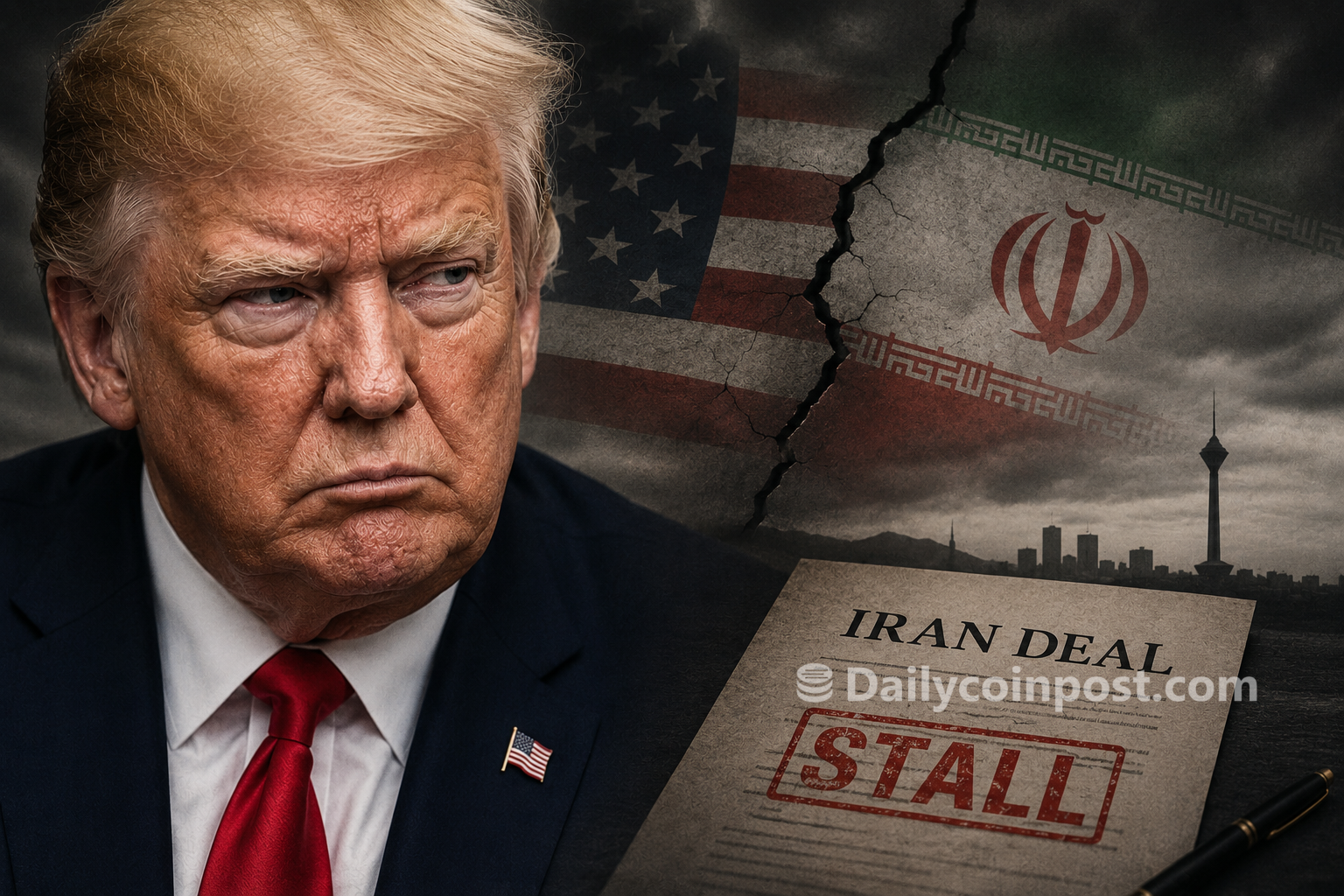
“Just sit back and relax, it will all work out well in the end. It always does.”
That is what Trump posted on Truth Social on Monday. He was not announcing a deal. He was not confirming a timeline. He was telling everyone to stop asking questions, Democrats, Republicans, and the market alike.
Bitcoin is at $72,600. It has been at $77,000, give or take $4,000, for two weeks. The market sat back. It is not relaxing.
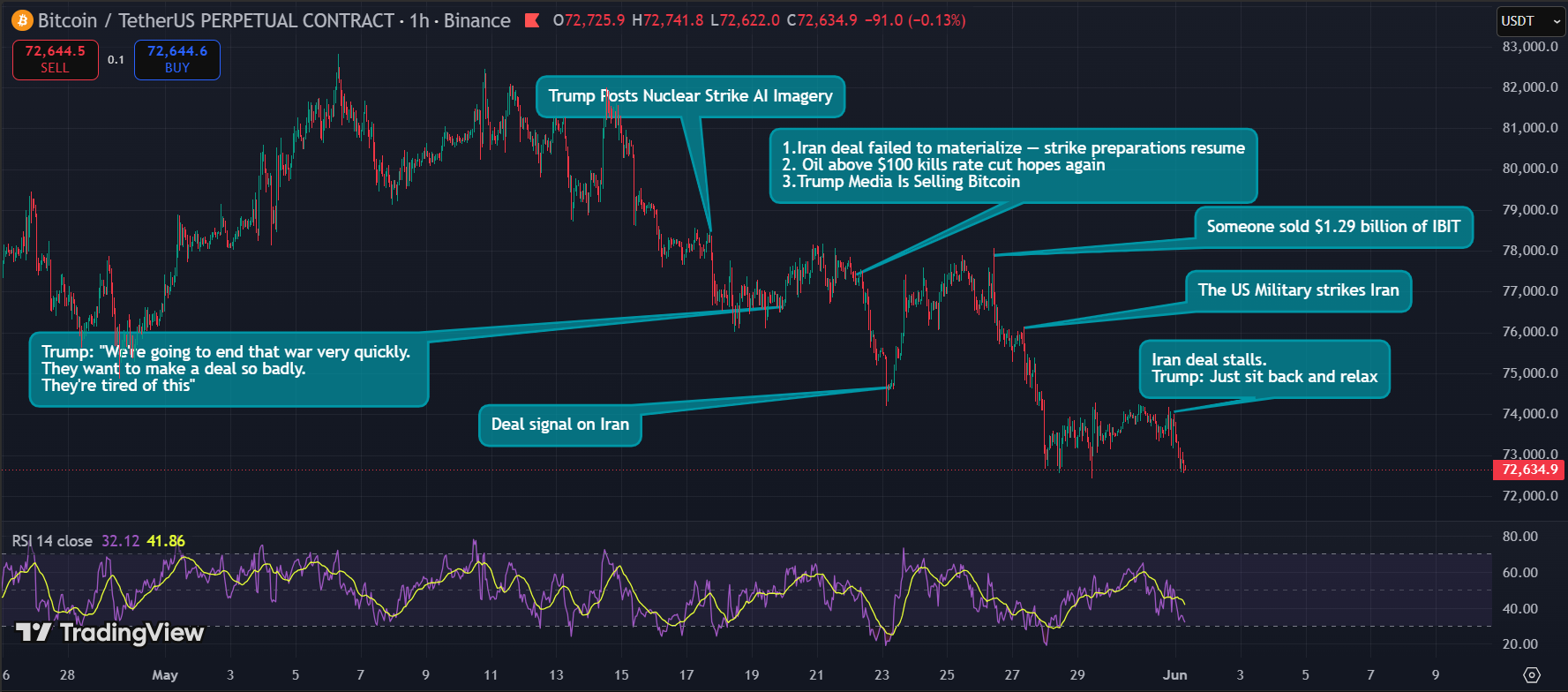
Bitcoin fell to $72,634 after the US military struck Iran on May 29 and the peace deal stalled. Trump’s response: “Just sit back and relax.” Source: TradingView / Binance
The Pattern the Chart Already Called
We identified the head and shoulders formation on Bitcoin’s chart. The pattern projected a move toward $72,000 to $73,000 on a confirmed breakdown. Bitcoin hit $74,000 on May 27. The pattern played out almost exactly.
What has kept Bitcoin from falling further is not fundamentals. It is hope. Every time Trump signals progress on Iran, Bitcoin bounces. Every time Iran rejects the US terms, Bitcoin sells off. The cycle has now repeated four times since February.
Bitcoin dropped below $80,000 after Iran rejected Trump’s proposal, which called on Tehran to reopen the Strait of Hormuz, because it did not include reparations for war damage. That was the first rejection. There have been more since.
Bitcoin recovered to around $77,500 after Polymarket odds for a permanent US-Iran deal rose to 37%, up from roughly 14% on Friday, with traders placing the odds of a deal by early June at 46% and by end of July at 72%.
The market is not trading fundamentals right now. It is trading Polymarket odds and Truth Social posts.
What Trump’s Post Actually Says
Read the Monday post carefully. He says Iran “really wants to make a deal.” He does not say a deal has been reached. He does not say when. He says the problem is political interference from his own side, Democrats and Republicans both telling him to move faster, slower, toward war, away from war.
That is not a man closing a deal. That is a man describing a negotiation under domestic political siege with no clear endpoint.
Trump has proposed a 60-day pause in fighting as part of the framework and emphasized that any agreement would include strict conditions on Iran’s enriched uranium production. For context, the last major Iran nuclear deal, the JCPOA signed in 2015, took over two years of intensive multilateral negotiations.
Two years. Trump is asking the market to believe he can close in weeks what took Obama two years. The market keeps believing it. Then it keeps being disappointed.
The Terms Are Still Far Apart
Trump said Iran must permanently abandon nuclear weapons, reopen the Strait of Hormuz with no tolls, and allow the United States to remove buried enriched uranium. He added that no money would change hands “until further notice.”
Iran’s position has not moved materially. Tehran wants sanctions relief, war reparations, frozen asset releases, and Iranian oversight of the Strait. The gap between those two positions is not a drafting dispute. It is a fundamental disagreement about who controls the most important chokepoint in global energy trade.
We covered Iran’s permanent toll system on the Strait and what it means for oil prices and inflation. We covered Iran’s Bitcoin insurance platform. Both of those moves represent Iran institutionalizing control of the Strait. You do not build a $10 billion Bitcoin insurance business around a chokepoint you are about to voluntarily reopen.
What Polymarket Is Actually Saying
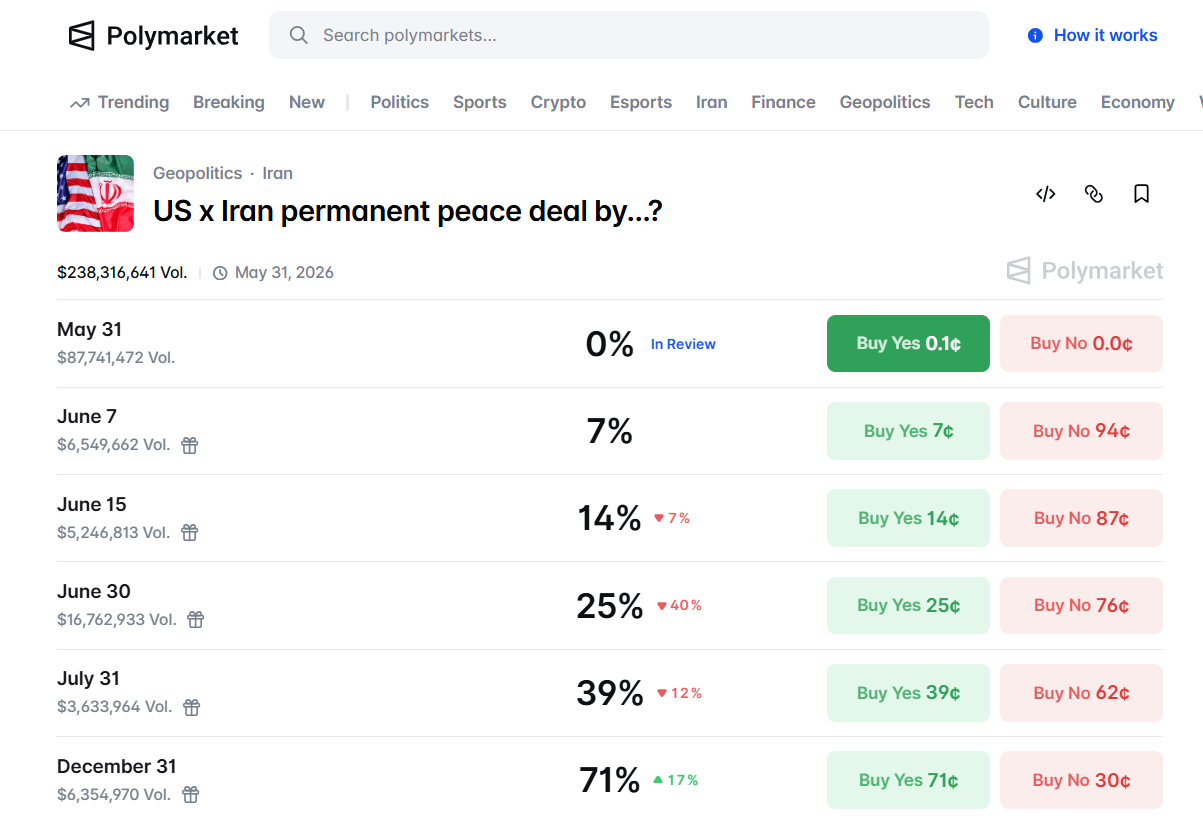
Polymarket gives a US-Iran permanent peace deal 0% odds by May 31 and 71% by December 31. The market is pricing a deal as a second-half 2026 event, not an imminent one. Source: Polymarket
The Polymarket contract “US x Iran permanent peace deal by…?” has recorded $238.31 million in total volume. The December 31, 2026 contract commands some confidence with 71% odds, reflecting a mild belief that a formal agreement, if it happens, arrives before year’s end rather than within weeks.
71% odds of a deal by December 31. That sounds a bit bullish until you realize December 31 is seven months away. The market is not pricing an imminent deal. It is pricing a deal sometime before the year ends. Bitcoin has been below its January peak for five months already. Seven more months of Iran uncertainty is not a bullish catalyst. It is a ceiling.
Where Bitcoin Goes From Here
The head and shoulders target at $72,000 to $73,000 has been tested. The question is whether it holds as support or breaks.
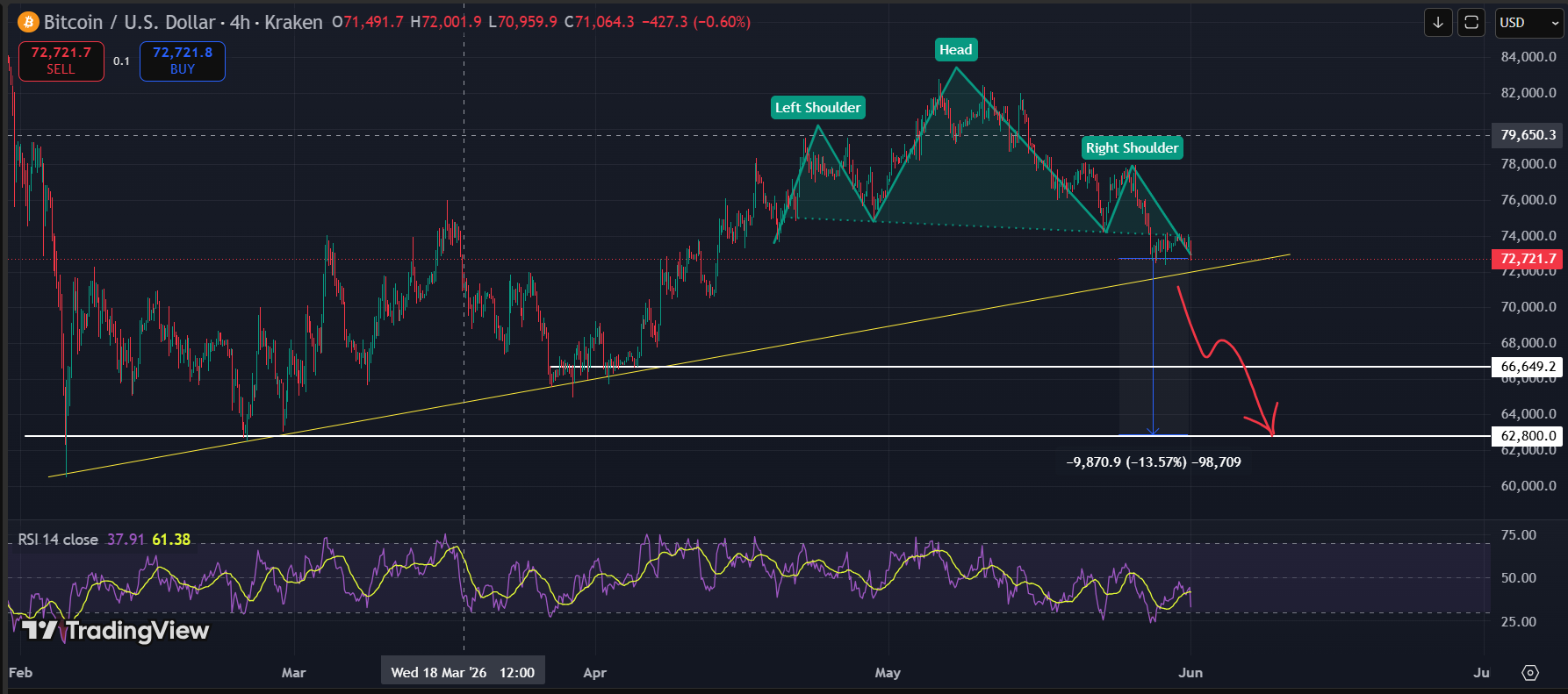
The head and shoulders breakdown on May 28 projects two targets: $66,649 and $62,800. The rising trendline from February is the only active support. Source: TradingView / Kraken
Bitcoin has stabilized slightly above $77,000 on Memorial Day, with analysts noting further progress toward a 60-day ceasefire extension. Spot Bitcoin ETFs marked one of their worst weeks from May 18 to May 22, recording more than $1.2 billion in outflows.
Three levels define the next move. $79,188 to $80,000 is the first meaningful resistance, analysts are watching a clean daily close above $79,188 to $80,000 as the first stronger bullish signal. Below current prices, $74,000 is the support that held during the worst of the war panic. Below that is $72,000 and the head and shoulders target.
Trump says relax. The chart says watch $72,000. One of them will be right first.