

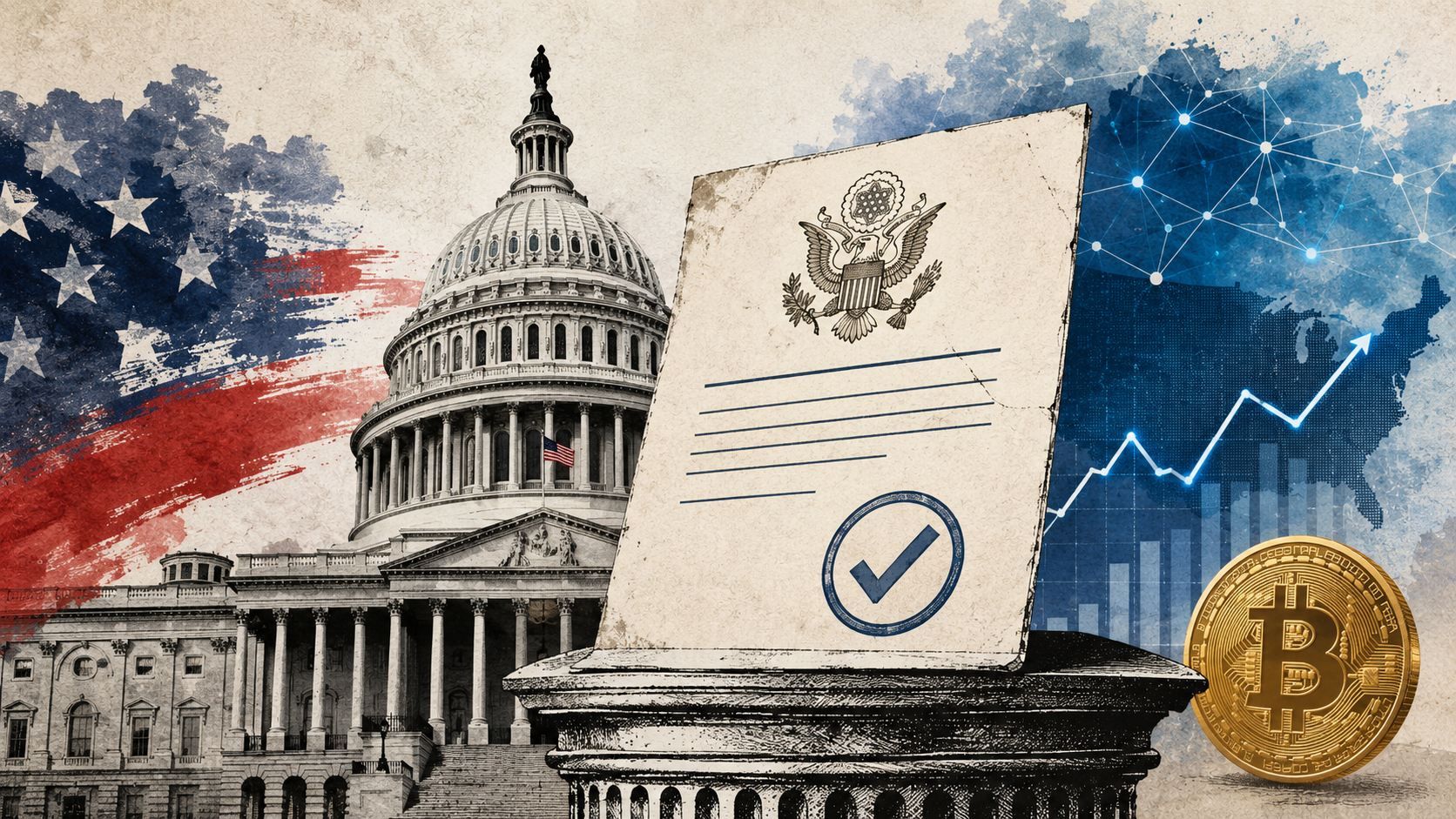
Donald Trump’s financial disclosure showed $1.4 billion in crypto-related income last year. Roughly $636 million came from the memecoin business. Another $594 million came from World Liberty Financial, the crypto firm that sold a 49% stake to a UAE royal four days before inauguration.
On Monday, Trump agreed to ethics language for the CLARITY Act that would ban senior officials from profiting from crypto while in office.
Bitcoin jumped from $63,500 to $66,255 on the news. The crypto market added $63 billion in 24 hours.
Here is the part that matters: the Democrats whose seven votes determine whether this bill passes have not seen the language yet.
What Actually Happened
The CLARITY Act has been stuck for months on one clause. Democrats demanded a conflict-of-interest provision that would prevent the president, vice president, and senior officials from holding or profiting from digital assets they are responsible for regulating. Republicans held 53 seats. They need 60 to overcome a filibuster. Seven Democrats have to cross over, and every one of them made the ethics provision a condition of their support.
The White House position throughout was that it would accept across-the-board rules while rejecting language that singled out a specific office or family. That impasse killed multiple draft versions and drove Polymarket’s odds of 2026 passage to 32% by Friday.
Then on July 17, Trump met in the Oval Office with Senators Cynthia Lummis and Bernie Moreno and acting Attorney General Todd Blanche. Four days later, on Monday evening, White House crypto adviser Eleanor Terrett reported that the ethics language had been agreed and circulated to Senate Republicans.
The specific text has not been made public. The White House has not issued an official statement. The revised bill has not been released. What was released was a report from industry sources that an agreement exists, sent to Republicans, not yet to Democrats.
The Catch
The bill needs Democratic votes. The ethics language was sent to Republican senators. Democrats found out the same way everyone else did, from Eleanor Terrett’s post on X.
Senators Ruben Gallego and Angela Alsobrooks have tied their support to illicit finance safeguards. Senators Chris Murphy, Jeff Merkley, and Chris Van Hollen publicly opposed the current version in early July, demanding a ban on officials’ crypto businesses. A Senate committee amendment from Van Hollen failed 13 to 11 along party lines in May.
The White House agreeing to something and Democrats agreeing to accept it are two different events. The market priced the first one on Monday. The second has not happened.
The Clock
Senate Republicans have until roughly August 7 before recess. That is 17 days. White House crypto adviser Patrick Witt reversed his scheduled departure for months-long Georgia Army National Guard training to stay in Washington for this push. That signals the administration believes the window is real but narrow.
If the bill text releases this week and Democrats see language they can accept, a floor vote before August 7 is possible. If the text gets delayed or Democrats reject the ethics provision as insufficient, the bill waits until November when midterm elections reshape the Senate landscape entirely.
Polymarket’s 2026 passage odds moved from 32% on Friday to 43% on Monday. The market is pricing possibility, not certainty.
What the Chart Actually Shows
Bitcoin at $66,255 sits 5.6% below $70,000. Glassnode’s UTXO data shows only 1.03% of Bitcoin supply sitting between current price and $70,685. Above that the road clears until the $83,000 to $85,600 supply wall.
The last comparable legislative catalyst was the GENIUS Act, the stablecoin law Trump signed in July 2025. Total crypto market cap crossed $4 trillion for the first time that week. Then regulators missed the law’s one-year rule-writing deadline last Saturday. Passage is a catalyst. It is not a finish line.
The CLARITY Act is a bigger bill than GENIUS. It hands most crypto oversight to the CFTC, leaves securities-like tokens with the SEC, protects customer funds in bankruptcy, and creates safe harbors for DeFi developers. If it passes it resolves the jurisdictional uncertainty that has kept institutional legal teams from signing off on larger crypto allocations for three years.
That is the real price catalyst. Not the headline. The legal clarity underneath it.
The Honest Read
Trump agreed to ethics language restricting crypto profits for officials while in office. The man with $1.4 billion in disclosed crypto income from last year agreed to restrict that income stream going forward.
Either the language has enough carve-outs to make the restriction manageable, or Trump made a genuine concession to get the bill through before August recess.
Nobody knows which one it is because nobody has seen the text.
Bitcoin jumped $3,000 on a report from industry sources about language that has not been released, sent to senators who have not yet agreed to support it, with a 17-day window before the whole thing goes on hold until November.
The optimism is real. The bill is closer than it has ever been. The gap between closer and done is where markets have been burned before on this specific piece of legislation.
Watch for the text. Then watch for the first Democrat to say yes.
This article is not financial advice. The CLARITY Act bill text had not been publicly released at time of publication.