
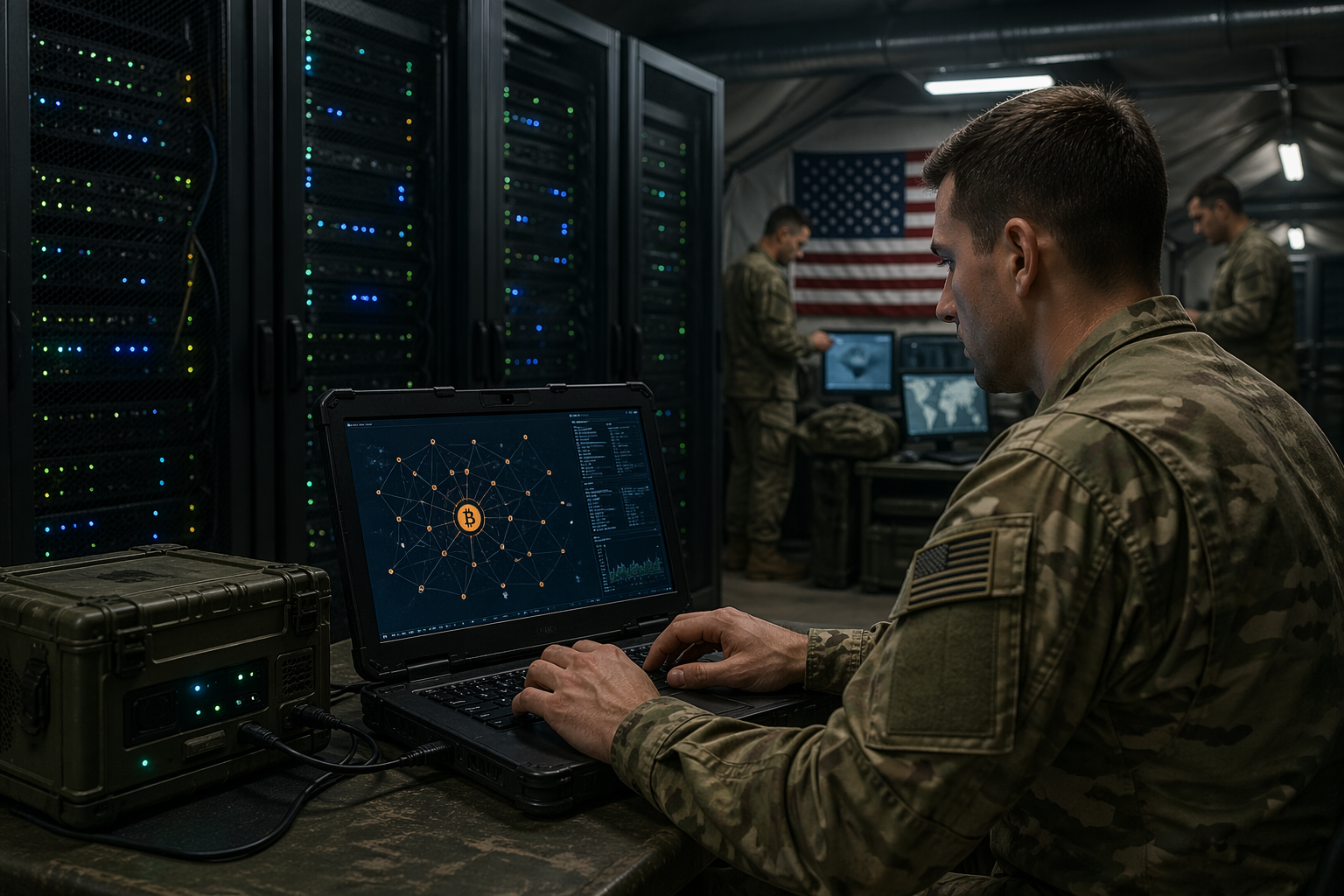
In April 21, Admiral Samuel Paparo, commander of US Indo-Pacific Command, sat before the Senate Armed Services Committee and said something that has never been said by a sitting US combatant commander in public before. “We have a node on the Bitcoin network right now. We’re doing a number of operational tests to secure and protect networks using the Bitcoin protocol.”
He called it power projection. He called Bitcoin “a peer-to-peer, zero-trust transfer of value.” He told the committee that proof-of-work’s ability to impose real computational costs on adversaries has serious cybersecurity applications. Some details of INDOPACOM’s Bitcoin research, he noted, remain classified.
The same week, Iran was collecting Bitcoin tolls from ships transiting the Strait of Hormuz, the chokepoint that moves roughly 20% of the world’s oil. The US and Iran are on opposite sides of the most dangerous naval corridor on earth. They are both using the same network. Neither of them controls it.
That is not a coincidence. It is the most important financial story of 2026 and almost nobody is framing it correctly.
What Paparo Actually Said
The admiral was careful with his words. He did not frame Bitcoin as a financial asset. He did not endorse the Strategic Bitcoin Reserve directly when Sen. Tommy Tuberville raised it. He confined his remarks to the technical architecture, cryptography, blockchain, proof-of-work, and what those properties mean for military applications.
“It’s a valuable computer science tool as a power projection,” Paparo said. “Outside of the economic formulation of it, it has got really important computer science applications for cybersecurity.”
Running a node means INDOPACOM maintains a full copy of the Bitcoin blockchain, enforces the network’s protocol rules independently, and participates in the peer-to-peer network directly. It is not mining. It earns nothing. What it does is give the military first-hand visibility into the network rather than relying on third-party data. There are an estimated 15,000 to 20,000 publicly reachable full nodes on Bitcoin as of early 2026, according to Unchained. The actual number is likely higher because many operate behind firewalls.
One node out of twenty thousand does not give the US military control over anything. Paparo knows this. The point is participation, not dominance. INDOPACOM is not trying to take over Bitcoin. It is trying to understand it well enough to use it.
The Other Side of the Same Network
While Paparo was testifying, Iran was doing something more direct.
As we reported in March, Iran began requiring ships transiting the Strait of Hormuz to pay tolls in Bitcoin. The system routes payments through intermediaries to obscure the transaction trail and avoid sanctions. It is not elegant. But it works. Bitcoin does not ask where you are from or whether you are under US sanctions. It processes the transaction the same way it processes every other transaction, without permission from anyone.
This is the property that makes Bitcoin useful to Iran and simultaneously useful to INDOPACOM. The network is neutral. It does not distinguish between a sanctioned regime collecting tolls and a US military command running security tests. Both are just nodes. Both are just transactions.
The US has spent decades building financial infrastructure designed to exclude adversaries. SWIFT. Dollar-denominated trade. Correspondent banking. Sanctions enforcement through the financial system. Bitcoin exists outside all of it. That is why Iran uses it. And that is exactly why the US military is studying it, because any tool an adversary uses effectively is a tool worth understanding.
China Is Watching
Paparo’s testimony did not happen in a vacuum. The Chinese Communist Party’s main monetary think tank recently published research on Bitcoin as a strategic asset, according to the Bitcoin Policy Institute, which noted the Chinese research was a direct response to BPI’s own work on Bitcoin as a national security asset. Taiwan’s policymakers are discussing Bitcoin as a reserve asset. The US holds approximately 328,000 BTC in its Strategic Bitcoin Reserve. China holds an estimated 194,000 BTC seized through law enforcement actions.
Every major power in the Indo-Pacific is now positioning around Bitcoin simultaneously. None of them designed the network. None of them control it. All of them are treating it as strategic infrastructure.
This is what Bitcoin looks like during a real war, not the theoretical war that crypto Twitter debates, but the actual geopolitical competition happening right now between the US, China, and Iran across the most critical shipping corridor on earth. The asset that was supposed to be too volatile and too marginal to matter is now being discussed in Senate Armed Services Committee hearings alongside carrier strike groups and missile defense systems.
What the Network Actually Is
Bitcoin has no military. It has no government. It has no flag. The protocol does not know that INDOPACOM is running a node any more than it knows that Iran is collecting tolls. It processes transactions and blocks according to rules that no single participant can change, including a four-star admiral and including the Islamic Revolutionary Guard Corps.
That is either the most important property in geopolitics right now or it is an inconvenient complication for everyone trying to use Bitcoin as a weapon. Probably both.
The US military calling Bitcoin power projection and Iran using it to collect money from the same ships the US Navy is protecting are not contradictions. They are the same story told from opposite sides of a network that was built to have no sides.
Satoshi did not build it for any of them. It runs anyway.