

Most people who own Bitcoin have never run a node. Most people who have never run a node do not fully own Bitcoin in the sense that Satoshi intended. That is not a moral judgment. It is a technical fact worth understanding before you decide it does not apply to you.
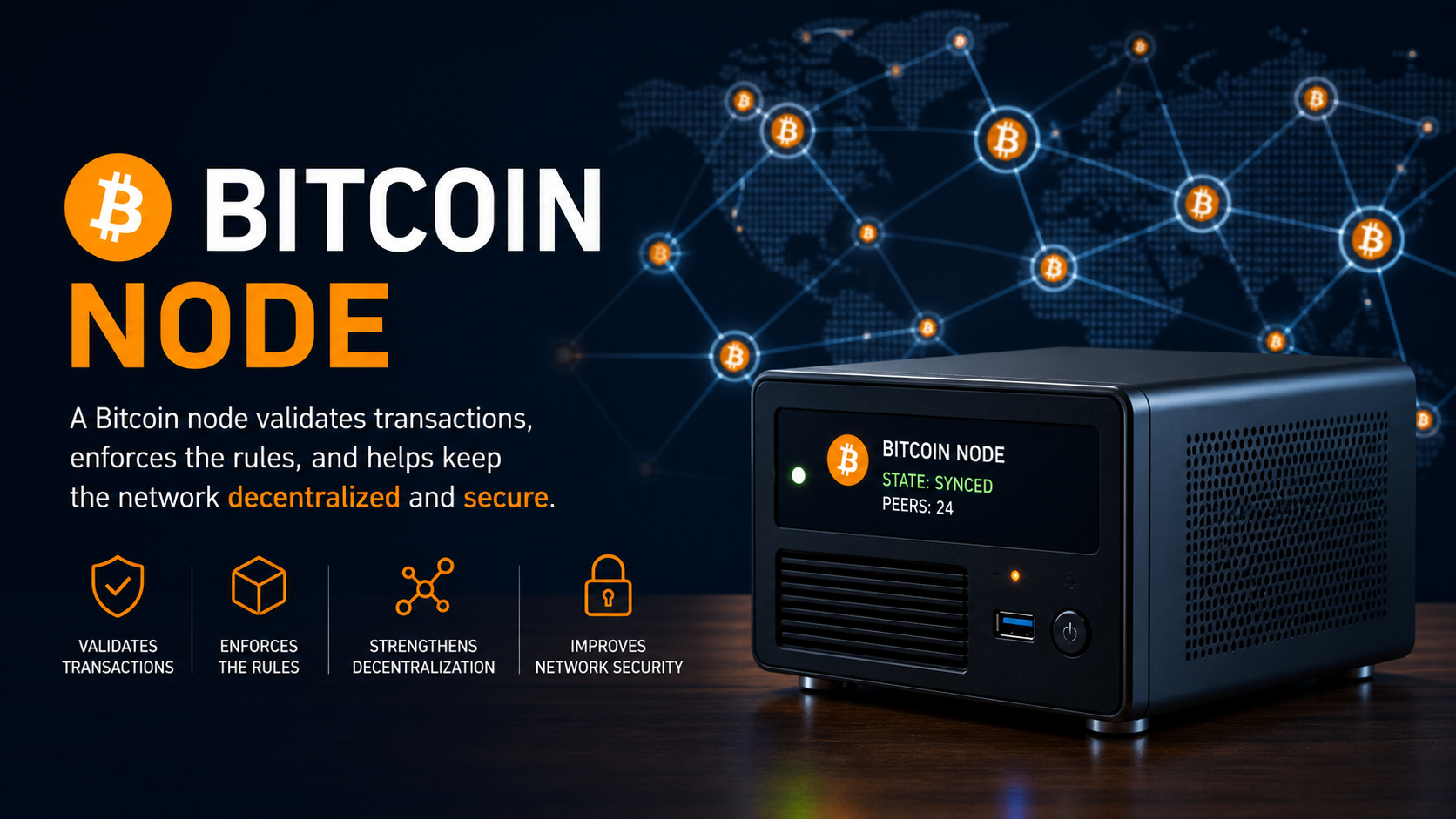
A Bitcoin node is a computer running the Bitcoin software that independently downloads, verifies, and stores the entire history of the Bitcoin blockchain. Every transaction ever made. Every block ever mined. Every rule ever enforced. A node does not trust anyone else’s version of that history. It checks everything itself.
That is the point. That is the whole point.
What a Node Actually Does
When a transaction is broadcast to the Bitcoin network, nodes are the entities that decide whether it is valid. They check that the coins being spent actually exist. They check that the person spending them has the private key to do so. They check that the transaction follows every rule in the Bitcoin protocol — the right format, the right fees, the right signatures.
When a miner finds a new block and broadcasts it to the network, nodes check that block too. They verify the proof of work. They verify every transaction inside it. They verify that the block reward is correct and has not been inflated. If a miner tried to give themselves more Bitcoin than the protocol allows, every honest node would reject that block immediately. The miner would have wasted their electricity on a block nobody accepts.
This is how Bitcoin enforces its rules without a central authority. Not because a regulator says so. Not because a company says so. Because tens of thousands of nodes independently running the same software all agree on what is and is not valid, and the network follows the consensus of that agreement.
The 21 million coin limit is not enforced by a promise. It is enforced by every node on the network simultaneously rejecting any block that violates it. No government can change that. No company can change that. No miner can change that. They would need to convince the majority of node operators to run different software, and node operators run Bitcoin nodes specifically because they want the rules to stay as they are.
The Difference Between a Node and a Miner
This confuses people and it is worth being precise about.
Miners do the computational work to find new blocks and earn block rewards. They are the ones spending electricity. They are the ones whose hardware costs millions of dollars. Mining is competitive, expensive, and increasingly industrial.
Running a node costs almost nothing by comparison. A decent laptop, a reasonably fast internet connection, and about 600 gigabytes of storage will run a full Bitcoin node. The software is free. You do not earn anything for running it. You are not mining. You are verifying.
The distinction matters because miners and nodes have different kinds of power. Miners decide which transactions get included in blocks and in what order. Nodes decide which blocks are valid. Those are separate functions and the separation is intentional. Bitcoin is designed so that miners cannot unilaterally change the rules because nodes would reject any block that violated them, making the miner’s work worthless.
A Bitcoin network with many miners and few independent nodes concentrates too much power in the miners. A Bitcoin network with many nodes distributes that power back to the people running them.
Why Most People Do Not Run One
The honest answer is that most people do not need to run a node to buy, sell, or hold Bitcoin. If you use Coinbase or a hardware wallet connected to a trusted third party, you are relying on someone else’s node to tell you your balance and verify your transactions. This works fine almost all the time.
The risk is subtle. When you rely on someone else’s node, you are trusting that their node is honest, current, and running the correct version of the software. If it is not, you might receive false information about your balance or the state of the network. You would not know.
The US military recently confirmed it runs a live Bitcoin node, calling it a tool for cybersecurity and power projection. The reason that statement was significant is not that the military now validates Bitcoin. It is that even institutions with enormous computing resources and intelligence capabilities choose to run their own node rather than trusting someone else’s. Independent verification is the point.
What Running a Node Tells the Network
When you run a node you are not just verifying for yourself. You are contributing to the network’s resilience. Every additional independent node makes the network harder to attack, harder to censor, and harder to corrupt. An attacker trying to feed false information to the network has to overcome every honest node simultaneously. The more nodes there are, the harder that becomes.
BlackRock now holds over 800,000 Bitcoin. Strategy holds over 600,000. The US government holds hundreds of thousands more. That institutional concentration is real and it is worth paying attention to. But none of those entities control the protocol. They cannot change the rules. They cannot print more coins. The nodes running Bitcoin’s software prevent that regardless of how much Bitcoin any single entity holds.
Running a node is the most direct way an individual participates in that enforcement. You are not a passive holder waiting for someone else to maintain the system. You are one of the entities the system depends on.
How to Run One
The standard implementation is Bitcoin Core, available at bitcoincore.org. It is free, open source, and maintained by the developer community that has been working on Bitcoin’s codebase since the beginning. The download includes everything you need.
Requirements as of 2026: roughly 600 gigabytes of storage for the full blockchain, a broadband internet connection, and a computer that can stay online consistently. A dedicated machine works better than sharing one you use for other tasks, but it is not required to get started.
The initial sync, where your node downloads and verifies the entire blockchain history, takes anywhere from a few hours to a few days depending on your hardware and connection speed. After that it runs in the background and stays current automatically.
Raspberry Pi devices have become a popular choice for running a node cheaply and quietly. Dedicated node packages like Umbrel, Start9, and MyNode offer pre-configured setups that reduce the technical complexity significantly if you want to skip the manual configuration.
You do not need to open ports or configure your router to run a node. You will receive fewer incoming connections that way, which slightly limits your contribution to the network, but your node will still fully verify everything and protect you from invalid information.
Who Should Run One
Anyone who holds a meaningful amount of Bitcoin and wants to verify their own balance independently. Anyone building applications on Bitcoin. Anyone who wants to understand how the network actually works rather than taking someone else’s word for it.
And honestly, anyone who believes in what Bitcoin is supposed to be. The network’s decentralization is not maintained by ideology. It is maintained by the practical choices of individual people deciding to run software on their own hardware.
The institutions buying Bitcoin in bulk are not running nodes out of ideology. They are running them because independent verification is more reliable than trust. That logic applies equally to people holding a fraction of a Bitcoin on a hardware wallet.
Satoshi designed a system where you do not have to trust anyone. Running a node is how you actually use that design.