


Two things happened in 48 hours that individually would have moved HYPE. Together they are repricing what Hyperliquid actually is.
On Thursday Coinbase announced it will become the official USDC treasury deployer on Hyperliquid under a new framework called AQAv2. On Friday Bitwise launched BHYP, the second US spot HYPE ETF, on NYSE. HYPE hit $47, a yearly high, up roughly 23% from where it was trading before either announcement.
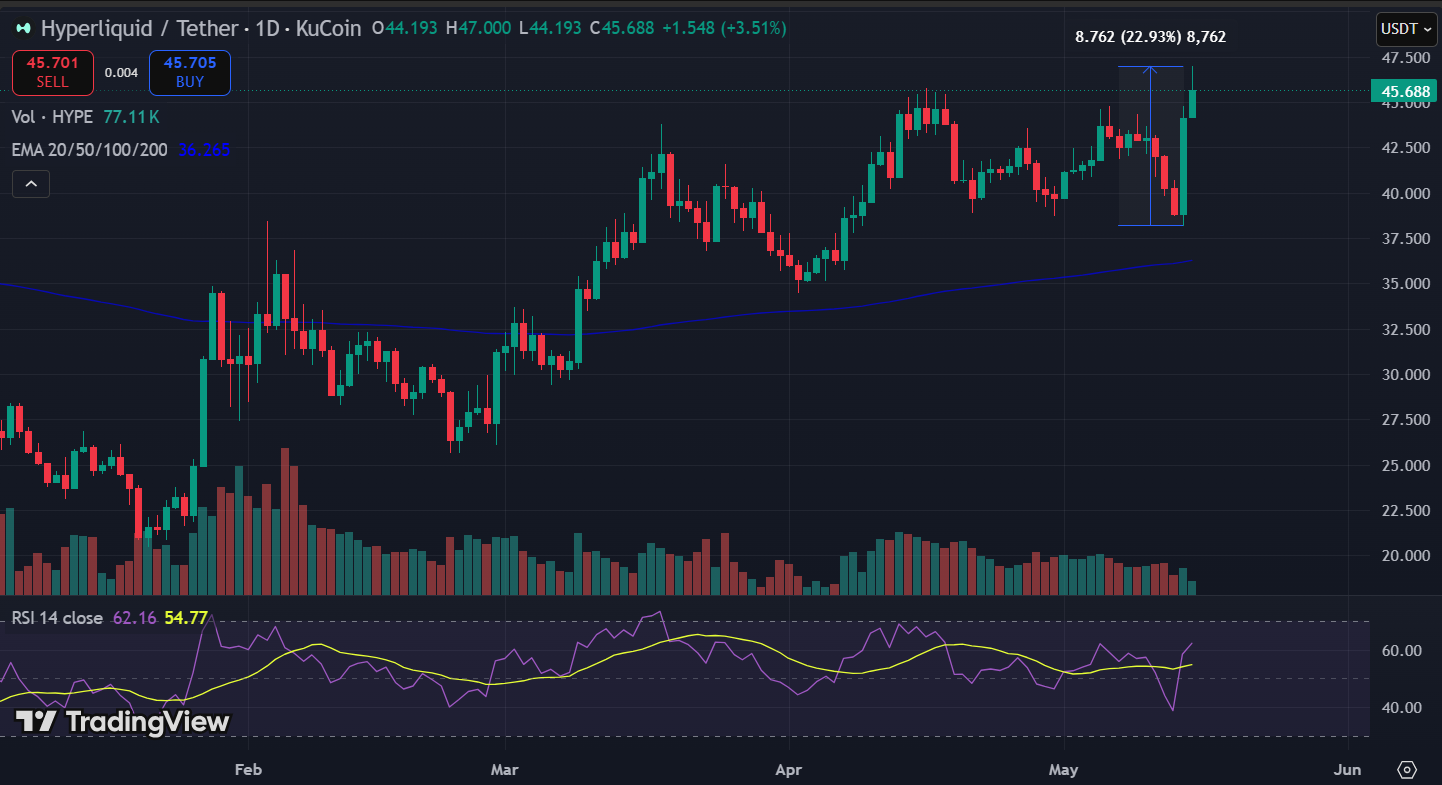
Hyperliquid – $HYPE chart – Source: Tradingview
The price move is the least interesting part of this story.
What the Coinbase Deal Actually Means
USDC supply on Hyperliquid has grown to roughly $5 billion, double what it was a year ago. That $5 billion was generating approximately $200 million in annual interest income. Until Thursday, that income was flowing to Coinbase and Circle with nothing returning to the Hyperliquid protocol or HYPE holders.
That is what the Coinbase deal changed. Under AQAv2, Coinbase will return roughly 90% of that interest income back to the protocol to fund HYPE buybacks and value accrual programs. One analyst calculated that works out to approximately $440,000 per day in additional HYPE buy pressure on top of the $1.7 million in daily revenue the protocol already generates from trading fees.
The framing that Coinbase won by becoming the official deployer misses what actually happened. Hyperliquid extracted a significant yield-sharing concession from one of the largest US crypto exchanges in exchange for giving them the dominant stablecoin position on the platform. That is not a DEX getting absorbed by institutional infrastructure. That is a DEX negotiating with institutional infrastructure from a position of strength.
Hyperliquid’s own statement made the terms clear: “With Coinbase sharing the vast majority of reserve yield revenue with the protocol, USDC will become the most aligned stablecoin on Hyperliquid.” The native stablecoin USDH is being phased out. USDC becomes the canonical quote asset across all markets. And Coinbase is staking HYPE to activate the framework, meaning they now have skin in the network’s success.
The Bitwise ETF and What It Does Differently
21Shares launched the first US spot HYPE ETF on Tuesday. By Thursday it had processed $8.1 million in daily trading volume and $4.9 million in net inflows, its best day since launch.
Bitwise’s BHYP launched today on NYSE with one structural difference that matters for long-term holders. It is the first HYPE ETF to use in-house staking infrastructure through its own division, Bitwise Onchain Solutions, rather than outsourcing to a third party. Third-party staking operators take a cut of rewards. On a network where base HYPE staking yield hovers around 2.2%, that haircut compounds across the lifetime of a position. BHYP eliminates that leakage.
The fee is 0.34%, slightly above 21Shares’ 0.30%, but the in-house staking argument may justify the difference for institutional buyers focused on total return rather than headline fee.
Bitwise CIO Matt Hougan framed the investment thesis around the moment in February when geopolitical tensions spiked on a Sunday morning and traditional markets were closed. Institutions turned to Hyperliquid for price discovery. Bloomberg cited its crude oil contract as the most relevant price in the market. That is not a fringe DeFi claim. That is a mainstream asset manager making the case that a DEX has become critical financial infrastructure.
The Question Nobody Is Asking
Hyperliquid processed $2.9 trillion in trading volume in 2025. It commands approximately 60% of all onchain derivative open interest globally. It processes 200,000 orders per second. It has a pre-IPO market for Cerebras that did $280 million in volume in a single day this week. It now has $5 billion in USDC, two regulated ETFs, Coinbase as its stablecoin infrastructure partner, and Circle staking HYPE tokens to become a validator.
At what point does calling it a DEX undersell what it actually is?
The category was always a placeholder. Decentralized exchange described the mechanism, not the function. What Hyperliquid has built functions more like a parallel financial system that operates when traditional markets cannot. When Iran launched strikes in February and the Strait of Hormuz disrupted global commodities, Hyperliquid’s oil perpetuals became the relevant price. That is not a DEX moment. That is an infrastructure moment.
The market is beginning to price that distinction. Two ETFs in one week. Coinbase as treasury deployer. Circle as validator. $440,000 per day in new buy pressure flowing back to the protocol.
The institutions are not arriving. They have arrived. The question now is whether the price has caught up to the infrastructure or is still catching up.