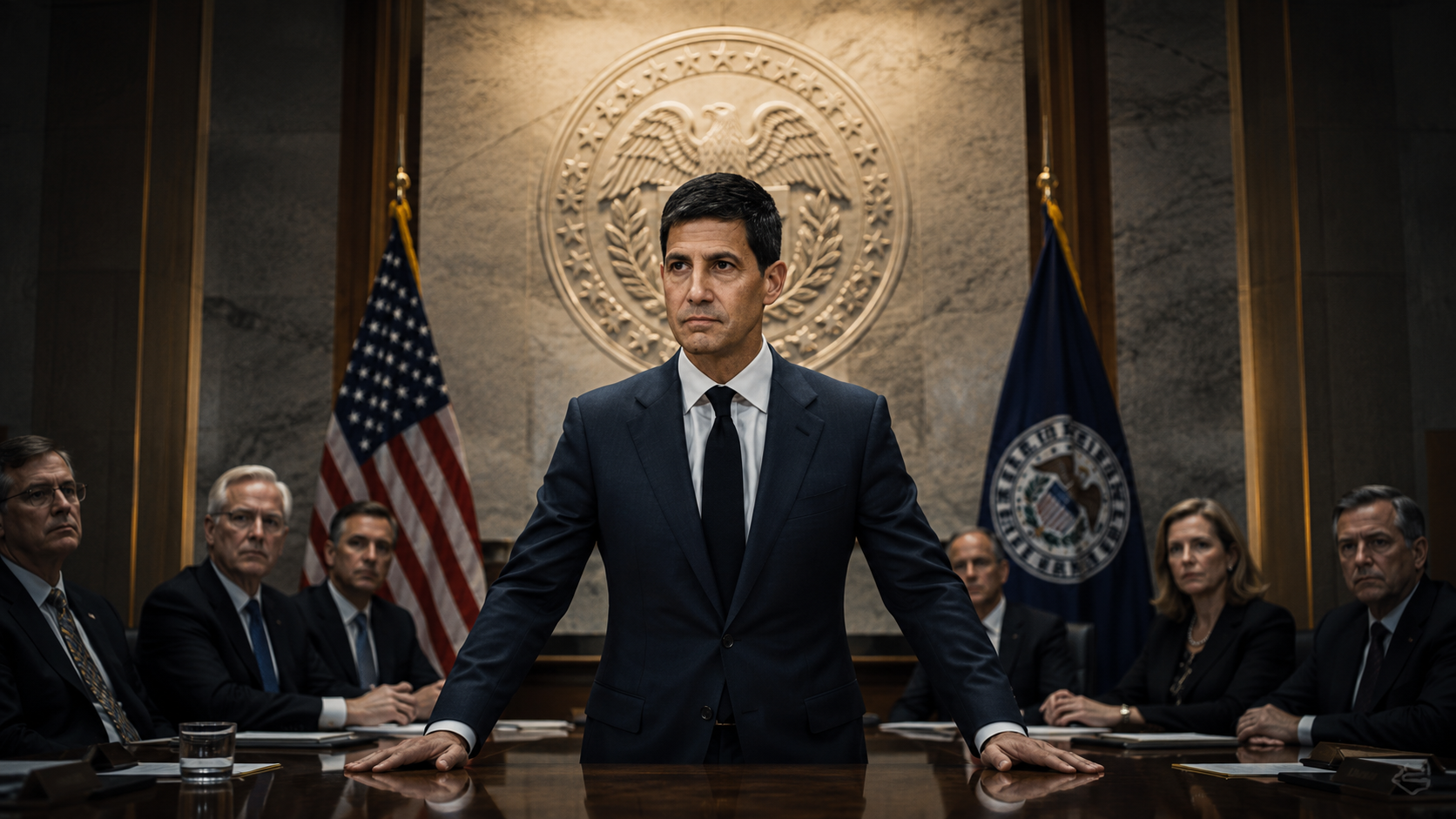
Kevin Warsh takes over the Federal Reserve today. The Senate confirmed him 54-45 on Wednesday, the most divisive confirmation vote in the central bank’s modern history. Jerome Powell retains his seat as a board governor through 2028 but his four-year term as chair expires today.
Every outlet is calling Warsh Bitcoin-friendly. That label is doing a lot of work it cannot support.
Bitcoin-friendly means he understands the asset, has invested in the ecosystem, and does not view crypto as a threat to the dollar. All of that is true. We covered his crypto portfolio in April when the financial disclosure landed. Flashnet, Bitwise, Polymarket, dYdX, Blast, Optimism. Deliberate bets on specific infrastructure. Not a passive index fund. The man knows what he owns.
Bitcoin-bullish means his policy decisions will create the conditions for Bitcoin to go up. That is a different question entirely. And the answer is not obvious.
The QT for Cuts Problem
Warsh outlined his policy approach in a November 2025 Wall Street Journal op-ed. He wants to cut the federal funds rate while simultaneously shrinking the Fed’s $6.5 trillion balance sheet through active mortgage-backed securities sales. He calls it QT for Cuts. No Fed chair has ever done this simultaneously.
The theory is internally consistent. The practical effect on Bitcoin is not what the Bitcoin-friendly narrative implies. QT removes liquidity from the financial system regardless of what the short-term rate says. Bitcoin has historically correlated with global liquidity conditions more than with the federal funds rate itself. A weaker dollar and lower rates are what get Bitcoin out of the $80,000 range, but the dollar does not weaken automatically when QT is simultaneously tightening financial conditions. These two levers can cancel each other out.
What He Inherits Today
Warsh’s first FOMC meeting as chair is June 16 to 17. Before he gets there he inherits this:
April CPI at 3.8%, the highest since May 2023. April PPI at 6%, the highest since December 2022. Rate hike odds sitting near 30% by year end. Bitcoin at $80,832, still below the 200-day moving average that has rejected every rally since January.
Warsh publicly advocated for lower rates before this data existed. The man who said “Bitcoin doesn’t trouble me” at the Hoover Institution last year now chairs a central bank where the data is actively arguing against the policy he was selected to deliver.
Trump wants rate cuts. The inflation data says no. Warsh sits between those two forces at his first press conference.
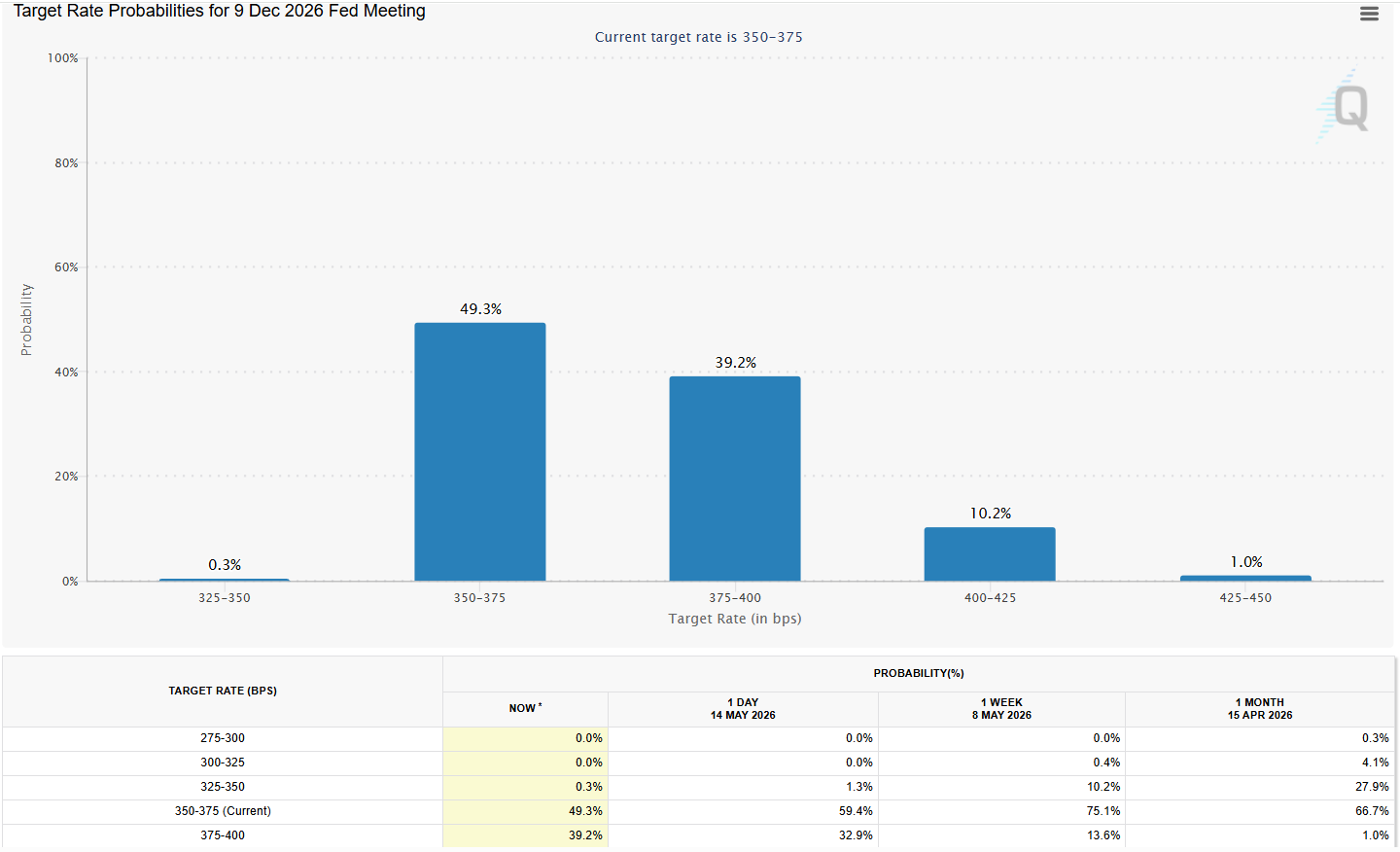
Markets pricing near-even odds between a rate hold and a rate hike by December 2026. Source: CME FedWatch
What he says between now and June 16 is what markets will trade. Not what he believes about Bitcoin. Not his portfolio. His words about the rate path in a 3.8% CPI environment with PPI running at 6%.
The Conflict That Did Not Go Away
Warsh divested his crypto positions as required by federal ethics rules. The one-year cooling-off period means he may be required to recuse himself from stablecoin legislation, bank custody guidance, and tokenized deposit frameworks for the first year. The legal separation is complete on paper.
The worldview is not divested. You cannot sell your mental model of how money works along with your Polymarket position. Warsh spent years building exposure to the specific corner of the financial system he now regulates because he formed a view about where that system was going. That view shapes how he reads data, how he frames trade-offs, how he talks to other governors.
That is not a scandal. It is the most relevant fact about what the next decade of Fed crypto policy looks like. A chair who backed DeFi derivatives and Bitcoin Lightning infrastructure approaches the stablecoin question differently than a chair who has never held a crypto wallet. The question is whether different means better for the industry.
What Bitcoin Actually Needs From Warsh
Strip away the portfolio and the quotes and the generational narrative. What Bitcoin needs from Warsh is concrete: dollar weakness, liquidity expansion, rate cuts that are not offset by balance sheet tightening, political cover for banks to custody digital assets, and a Fed that stops treating stablecoins as existential threats and starts treating them as payment infrastructure.
According to Blockhead, the crypto industry’s near-term interest in Warsh may be less about his personal holdings and more about the tone he sets on stablecoin regulation and bank crypto custody standards, questions that will move through his tenure regardless of what Bitcoin does day to day. On those questions, Warsh’s positions are genuinely constructive. He opposes a retail CBDC and backs private-sector stablecoins. That puts him closer to the industry’s preferred regulatory outcome than any previous Fed chair.
But none of that matters if inflation stays above 3% through summer. Warsh cannot cut without losing the inflation fight Powell spent three years winning. He cannot hike without triggering the recession Trump sent him there to prevent. And he cannot shrink the balance sheet and cut rates simultaneously without the market noticing the contradiction.
The 54-45 confirmation vote is the most divisive in modern Fed history. That number tells you how many people in Washington think this ends cleanly.
What the Trade Actually Is
Bitcoin is at $80,832 this morning. The 200-day moving average is the ceiling it has tested and failed three times. Warsh takes the chair today with his first FOMC meeting 32 days away.
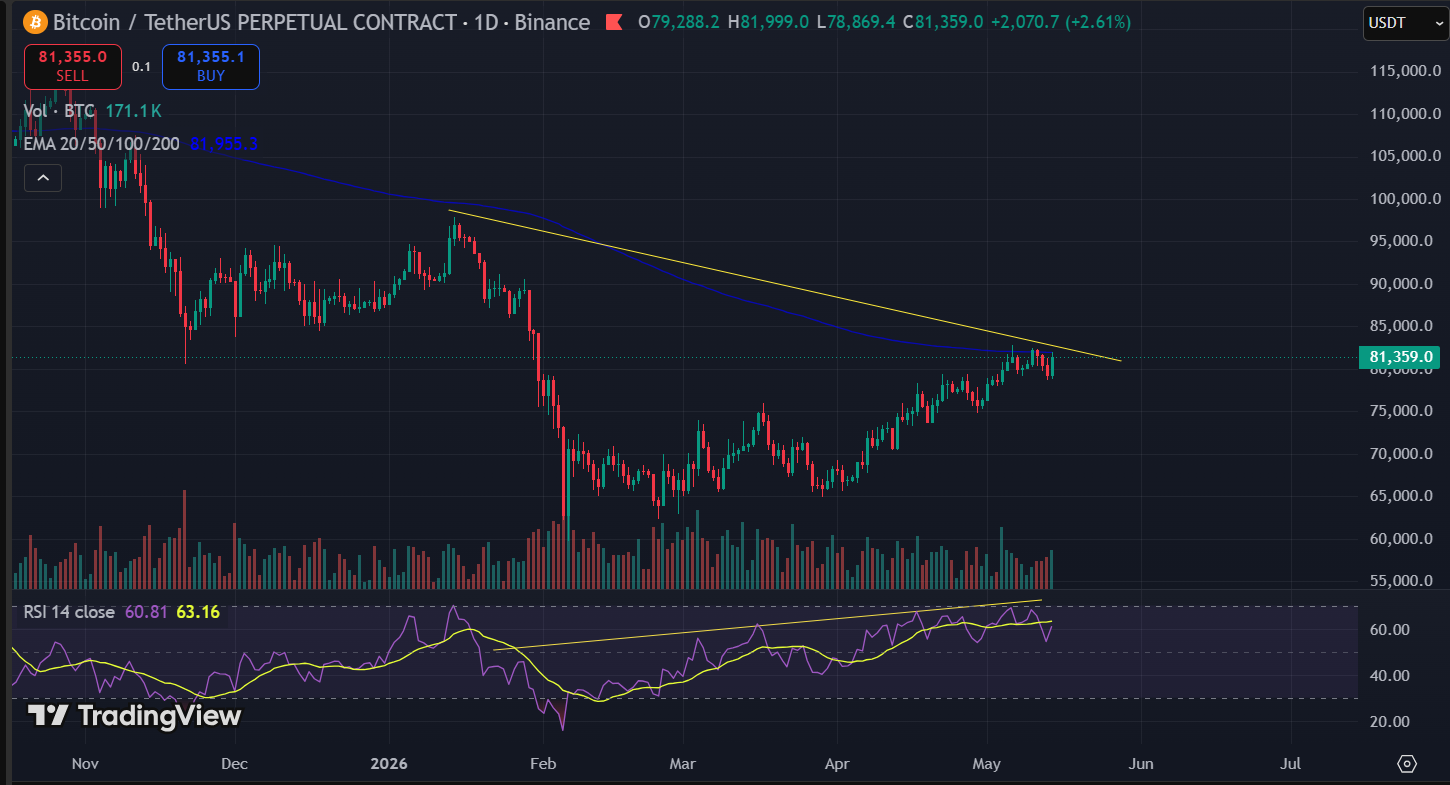
Hidden divergence,declining volume Source:Tradingview
If CPI rolls over in May and June, if the Iran ceasefire holds, oil retreats, and the PPI pipeline does not feed through as fast as the historical pattern suggests, Warsh gets room to cut without credibility damage. That is the scenario where Bitcoin-friendly becomes Bitcoin-bullish.
If inflation stays above 3% through summer, he is boxed in. Bitcoin stays boxed in with him.
What he says before June 16 is the trade. What he does in June is the answer.