


Let’s start with the number that should end the conversation about whether this is coincidence.
A single trader won 93% of their five-figure wagers on US and Israeli military actions against Iran. Not 60%. Not 70%. Ninety-three percent. On unannounced military operations. Operations the Pentagon designed specifically to be unreadable from the outside, using decoy bombers and long-range stealth aircraft to prevent exactly this kind of advance knowledge from leaking.
The trader netted nearly $967,000. Their overall win rate across all bets was 83%. Most high-frequency traders, the best in the world, with sophisticated models and real-time data, run win rates slightly above 50%. Todd Phillips, a finance professor at Georgia State who previously served on a CFTC advisory board, looked at this data and said: “It sure seems like this person either has incredible luck, or was insider trading.”
That is a polite way of saying the math does not work any other way.
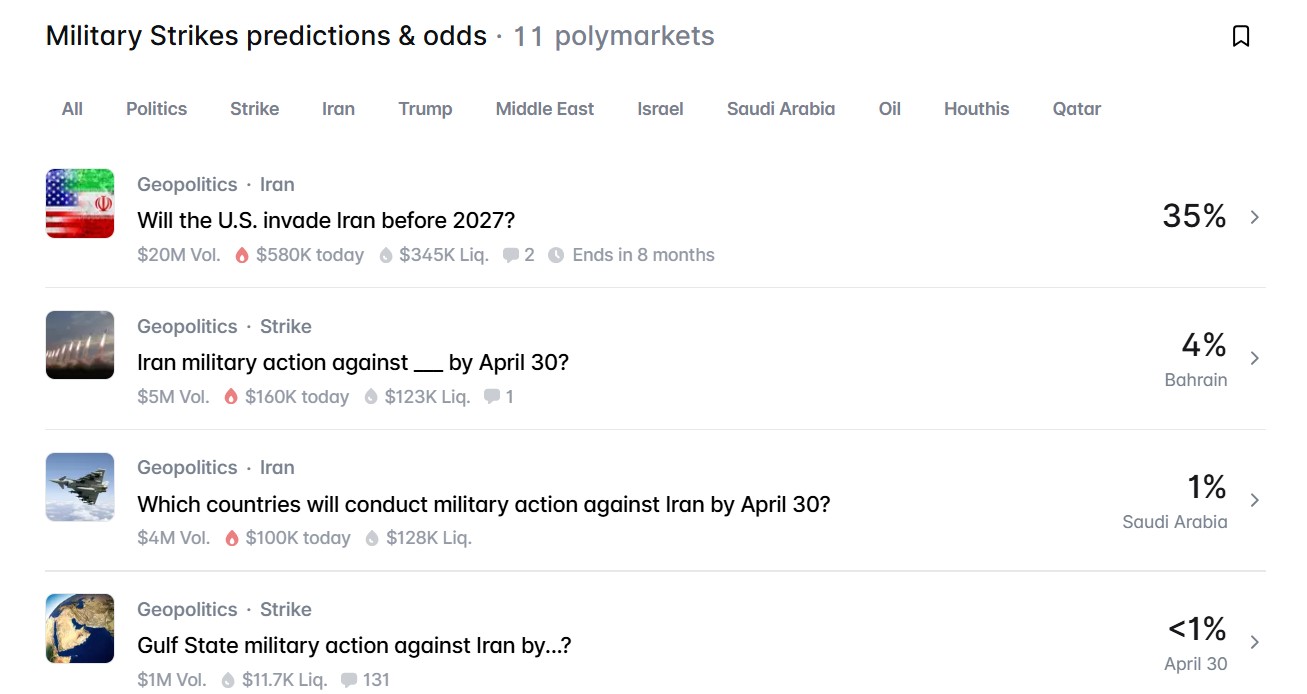
The Green Beret Was Just the Beginning
The 93% trader is not even the most documented case. That distinction belongs to Master Sergeant Gannon Ken Van Dyke, a US Army Special Forces soldier assigned to Fort Bragg, who was part of the January 2026 operation to capture Venezuelan President Nicolás Maduro.
Van Dyke placed 13 bets totaling $33,034 on Polymarket in the week before the operation. He made nearly $400,000. The Justice Department indicted him. He is now the public face of prediction market insider trading, the case that supposedly proves the system works because it caught him.
But Van Dyke is not the interesting part. Van Dyke got caught because he was a soldier using classified information about a specific operation he personally participated in. That is the easy case. The interesting part is everything that happened around him that nobody caught.
The Anti-Corruption Data Collective analyzed every settled Polymarket contract from January 2021 through mid-March 2026, more than 435,000 markets and $54.4 billion in cumulative volume. What they found is not an isolated breach. It is a pattern.
Longshot bets win 51.8% of the time in Polymarket’s military and defense markets. The baseline across political markets is 14%. In the hours before military events resolve, winning longshot bets consistently outnumber losing ones, contrary to what market prices imply. The June 2025 US strikes on Iran are the clearest case study. In the hours before the strike, 19 longshot bets totaling $164,292 were placed across the contracts that ultimately resolved YES. Eight wallets shared about $1.8 million in profits, with one taking nearly $500,000.
The Pentagon had designed the operation to be unreadable. Someone read it anyway.
The Architecture of the Problem
Here is where the story gets structurally uncomfortable.
Polymarket’s CEO Shayne Coplan told Axios that it was “super cool” that his platform “creates this financial incentive for people to go and divulge the information to the market,” including potential insiders. He has since moderated that position under legal pressure. But the original statement reveals how the platform was designed to think about this. Insider information flowing into prediction markets was, in the original vision, a feature. It made markets more accurate. The fact that the people providing that information were profiting from classified military operations was, apparently, a secondary concern.
Donald Trump Jr. joined Polymarket’s advisory board last year. His venture capital fund has invested an undisclosed amount in the company. He also advises Kalshi, the other major prediction market that received CFTC approval under the Trump administration. Trump Jr. says via a spokesperson that he does not trade on prediction markets and has not interacted with the federal government on behalf of either company.
The CFTC, which now operates under the Trump administration, approved Polymarket for US customers last year. It also closed a Biden-era criminal probe into whether Polymarket was improperly allowing US users onto its offshore platforms. The platforms where the 93% win-rate trader was operating. The platforms where eight wallets made $1.8 million on classified military strike timing.
When Trump was asked about Van Dyke’s indictment, he compared it to Pete Rose betting on his own baseball team and called it “not so bad.” When asked about the suspiciously timed Iran war bets, he said he was “not happy with any of that stuff.” Neither response suggested urgency. Neither response suggested the administration viewed this as a national security crisis.
Israel has been more direct. It charged a reservist and a civilian for using secret data to bet on military outcomes. At least one country treating this as what it is.
What the Data Actually Says
The ACDC report is careful about what it claims. Longshot bets outperforming can have innocent explanations, including mispricing, shifts in public expectations, or concentrated expertise in specific domains. The researchers do not assert that everyone winning at unusual rates is a criminal.
What they assert is that the pattern in military markets is inconsistent with what skill or luck alone would produce. And that the markets where outcomes are controlled by the smallest group of decision-makers are the markets where the information asymmetry is widest and the insider advantage is largest.
$63 million has been wagered on a US-Iran peace deal on Polymarket. $23 million on whether China will invade Taiwan in 2026. These are not niche markets. They are major geopolitical questions where the outcome depends on decisions made by a handful of people in classified settings. And the data says someone keeps getting those outcomes right at rates that are statistically impossible to explain without an information advantage.
The working paper from London Business School and Yale found that roughly 3% of traders account for most price discovery on Polymarket. Solidus Labs found that fewer than 1% of wallets capture about half of all gains. The market is not a wisdom-of-crowds mechanism at this scale. It is a mechanism where a tiny group of highly informed participants extract value from a large pool of uninformed ones.
The Crypto Angle Everyone Is Missing
Polymarket runs on crypto. Every bet is a blockchain transaction. Every wallet operates pseudonymously, and every payout is in USDC, settled on-chain, with no traditional financial institution in the middle.
That architecture is why the 93% trader has not been identified. The blockchain is transparent in the sense that anyone can see the transactions. It is opaque in the sense that nobody can be compelled to reveal who controls the wallet without a legal process that requires jurisdiction the CFTC is still figuring out.
This is the same architecture that made Iran’s Hormuz toll system possible. The same architecture that made the RAVE token manipulation possible. Pseudonymous wallets, on-chain settlement, no intermediary to freeze or reverse. In the Hormuz context, that architecture protected a sanctioned state. In the Polymarket context, it is protecting whoever is leaking classified military operations into a prediction market run by a company whose advisory board includes the president’s son.
The Honest Question
Nobody has been able to answer the question that actually matters here, not the ACDC, the DOJ, or Congress.
Who is the 93% trader?
The data exists on-chain. The wallets are visible. The timing of the bets is documented. The outcomes are public record. What is missing is the legal compulsion to connect those wallets to a real identity, and the political will to demand it from a platform whose regulatory approval came from an administration with direct financial ties to that platform.
Van Dyke got caught because he was a soldier in a chain of command that cooperated with investigators. The 93% trader has no such vulnerability.
Polymarket says it flagged the Van Dyke case and cooperated with the DOJ. It calls this proof that the system works. The ACDC report, covering five years and $54.4 billion in volume, suggests the system has been working for a very small number of people in a very specific way that has nothing to do with wisdom of crowds.
The prediction market was supposed to aggregate public information into accurate odds. What the data shows is that in military markets, it has been aggregating something else entirely.
Someone keeps winning at 93% on unannounced military strikes. The platform is run by a company the president’s son advises. The regulator that approved it is run by the president’s administration. The blockchain shows every transaction. Nobody is asking for the name.