


32 Bitcoin. That is 0.004% of Strategy’s 843,706 BTC holdings. At the average sale price of $77,135 it generated $2.5 million. Strategy also raised $128.3 million selling common stock the same week. The Bitcoin sale was not a financial necessity.
It was a symbolic one. And the market priced it that way.
In May we wrote that Saylor saying he would probably sell was the first crack in the never-sell thesis. The 8-K filed June 1 confirmed the crack became a transaction. Bitcoin dropped to $65,372 on June 3. Total crypto liquidations reached $1.86 billion. Bitcoin alone accounted for $896 million, almost entirely long positions.
32 coins. $1.86 billion in collateral damage.
What the Filing Actually Says
Strategy disclosed the sale in a Form 8-K filed with the SEC on June 1, 2026. Between May 26 and May 31, the company sold 32 Bitcoin at an average net price of $77,135 per coin for aggregate proceeds of $2.5 million. The filing is explicit about the purpose: proceeds are expected to fund distributions on preferred stock.
The detail worth noting is what Strategy did not do. As of May 31, Strategy’s US dollar reserve, a management-designated liquidity pool created in December 2025 specifically to cover preferred dividends and debt interest, held $900 million. The company had $900 million in cash set aside for exactly this purpose and chose to sell Bitcoin instead.
That decision is not irrational. Saylor telegraphed it on the Q1 earnings call when he described the model: buy Bitcoin with credit, let it appreciate, sell Bitcoin to pay the dividend. The 32 BTC were sold above the company’s average purchase price of $75,699. It was a profitable trade.
But the $900 million reserve sitting untouched while Bitcoin gets sold is the detail that deserves attention. Strategy is not selling Bitcoin because it has to. It is selling Bitcoin because it chose to. That is a different signal than financial distress. It is a demonstration that Bitcoin is now explicitly working capital in Strategy’s capital structure, not a permanent hold.
The Polymarket Dispute Nobody Is Connecting
The sale triggered a $15 million dispute on Polymarket over contract settlement timing. Traders who had bet on whether Strategy would sell Bitcoin in 2026 found themselves arguing about the exact definition of a sale and the settlement rules for the contract.
We have covered Polymarket before as the most honest pricing mechanism in crypto. The dispute is itself a signal. $15 million in contested bets on a 32 Bitcoin transaction tells you how much money was positioned around the never-sell thesis. The market had been treating Saylor’s conviction as a tradeable certainty. Now it is a settlement dispute.
Why 32 Bitcoin Moved the Market
The May 6 article ended with this line: “This is not a crisis. Bitcoin traded through the announcement without breaking anything.”
That was accurate on May 6. It is not accurate on June 3.
The difference is context. In May, Bitcoin was above $80,000 and the sale was hypothetical. In June, Bitcoin had already broken the four-month trendline, the head and shoulders measured move was active with targets at $66,649 and $62,800, Iran had suspended ceasefire talks, and $3.5 billion in cumulative ETF outflows had removed the institutional cushion that absorbed selling pressure earlier in the year.
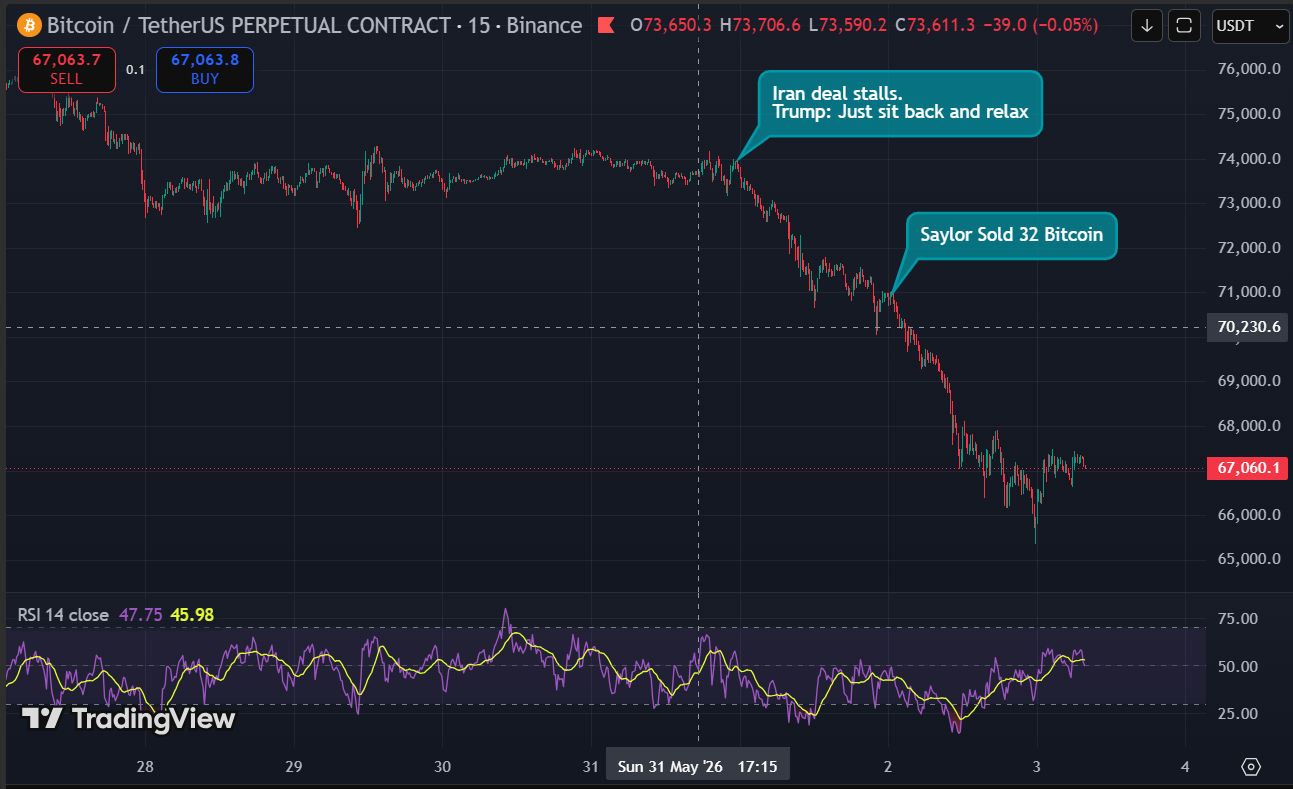
Two catalysts, one chart. Iran deal stalls on May 31, Saylor sells 32 Bitcoin on June 2. Bitcoin drops from $74,000 to $65,000. RSI recovers to 45.98 from oversold lows. Source: TradingView / Binance
The 32 Bitcoin sale did not cause the crash. It confirmed the direction. A market looking for a reason to sell found one in the most symbolic possible place: the man who built his identity around never selling had sold.
The liquidation cascade that followed was mechanical. Long positions opened on the assumption that $67,000 would hold got stopped out. Those stops triggered more selling. Bitcoin touched $65,372 before recovering above $67,000 within an hour. The bounce does not change the structure. The trendline is broken. The targets are active.
The Uncomfortable Math
Strategy holds 843,706 Bitcoin acquired for $63.87 billion at an average of $75,699 per coin. Bitcoin is currently at $67,088. The position is underwater by roughly $7,000 per coin on average.
The preferred stock obligations have not changed. Five series of preferred stock carry active dividends payable June 30, 2026. STRK yields 8%. STRF yields 10%. STRC carries an 11.5% rate. A competitor, Strive’s SATA preferred stock, now offers 13%, creating direct yield competition that did not exist six months ago.
The $900 million reserve covers near-term obligations. The question is what happens when that reserve needs replenishing and Bitcoin is still below Strategy’s average cost basis. The credit-buy-appreciate-sell model Saylor described on the earnings call requires the appreciate step to work. At $67,000 against a $75,699 average cost, that step is currently running in reverse.
This is not a crisis today. But the capital structure that looked elegant at $100,000 Bitcoin looks different at $67,000 Bitcoin with $1.5 billion in annual preferred stock obligations.
Saylor built this structure on the assumption that Bitcoin’s fixed supply and institutional accumulation would drive price higher indefinitely. The 32 Bitcoin sale is the first data point that tests that assumption from the inside.
Strategy sold 32 Bitcoin between May 26 and May 31, marking its first disclosed Bitcoin reduction since 2022, at an average net price of $77,135 per coin.