

April 20, 2024. The block reward dropped from 6.25 BTC to 3.125 BTC. Miners earned half as much per block. The supply of new Bitcoin entering the market got cut in half. The script was supposed to write itself from there.
It did not.
Two years later Bitcoin is trading around $74,000. That is not a bad number in isolation. Against the 2020 halving cycle, which produced a 541% gain within twelve months, or the 2016 cycle at 291%, it is a genuinely disappointing one (CoinDesk). The 2024 halving has so far produced the weakest post-halving performance on record. The people who bought expecting the usual playbook have been waiting longer than any previous cycle asked them to wait.
The question worth asking is why. Not the Twitter version of why, which involves picking a villain and assigning blame. The actual version, which is messier and less satisfying.
The Macro Ate the Cycle
Bitcoin continues to cluster underneath the base of the Macro Triangle price broke down from months ago
More, Bitcoin is building a multi-month cluster of price action beneath the Triangle, very similar to the 2014 cluster
However history suggests price won't be able to… https://t.co/fLe9rajX4K pic.twitter.com/bPRgrtEuhq
— Rekt Capital (@rektcapital) April 17, 2026
Every previous halving happened in a world where the Economic Policy Uncertainty Index was running at somewhere between 107 and 186. In the six months after the 2024 halving, that index averaged 317 (FRED). Trade wars, tariff threats, a shooting war in the Middle East, oil supply under threat, the Strait of Hormuz in play. Bitcoin got its supply shock on schedule. It absorbed that shock inside one of the most uncertain macro environments in a generation.
That context does not excuse the underperformance. It explains it. When institutional money gets scared, it sells the most liquid thing it can find. Bitcoin is now liquid enough to be that thing. The ETFs made it easy to exit. And money exited.
The irony is that the same institutional infrastructure that was supposed to accelerate this cycle also made the drawdowns faster and sharper. BlackRock and Fidelity opened the door. When sentiment shifted, that door swung both ways.
The Network Does Not Care About the Price
Here is the part that does not get enough attention. Bitcoin’s hash rate just hit an all-time high (CoinWarz). Miners are deploying more computing power to secure the network right now than at any point in Bitcoin’s sixteen-year history. They are doing this for half the block reward they were earning two years ago.
That means one of two things. Either miners believe the price is going significantly higher and are positioning ahead of it, or the industry has become efficient enough that it can sustain operations at current prices even with reduced rewards. Probably some of both. Either way, the network security story has never been stronger. The price story and the network security story have completely decoupled.
This matters because the people who argue Bitcoin has no underlying value usually point to price. The people who argue it does point to things like hash rate, node count, settlement finality. By every measure that describes what the network actually does, 2024 and 2025 were good years. By the measure most people use to judge it, they were not.
Everything the Bulls Wanted Happened
Think about what has occurred in the two years since that halving. The SEC approved spot Bitcoin ETFs. BlackRock, Fidelity, and a dozen other institutions built products and distributed them to millions of retail and institutional accounts. The US government created a Strategic Bitcoin Reserve. Strategy holds over 600,000 BTC. Morgan Stanley just launched its own spot ETF (CoinDesk). Citi is building custody infrastructure. The UAE’s largest banks are publicly calling Bitcoin digital gold.
All of that happened. Bitcoin is still 40% below its all-time high.
If you had told a Bitcoin believer in 2020 that by 2026 the US government would hold Bitcoin as a reserve asset, BlackRock would custody hundreds of thousands of coins, and spot ETFs would have absorbed over $56 billion in inflows (CoinDesk), they would have told you Bitcoin would be at $200,000. The institutional adoption thesis played out almost exactly as the bulls described. The price did not follow.
That is not an argument against Bitcoin. It is an argument against the idea that any single factor, including the halving, determines the price. Bitcoin in 2024 became large enough and liquid enough that the same macro forces that move every other asset started moving it too. The supply shock still happened. It just got absorbed by a market that had bigger things to worry about.
What the Miner Numbers Actually Show
Transaction fees tell a quieter story. In the first year after the 2020 halving, miners collected 37,000 BTC in fees on top of their block rewards. In the first year after the 2024 halving, that number was just over 8,000 BTC. The Runes protocol launched around the halving and briefly drove fees to record highs, then faded. On-chain activity has not filled the gap left by the reduced block reward.
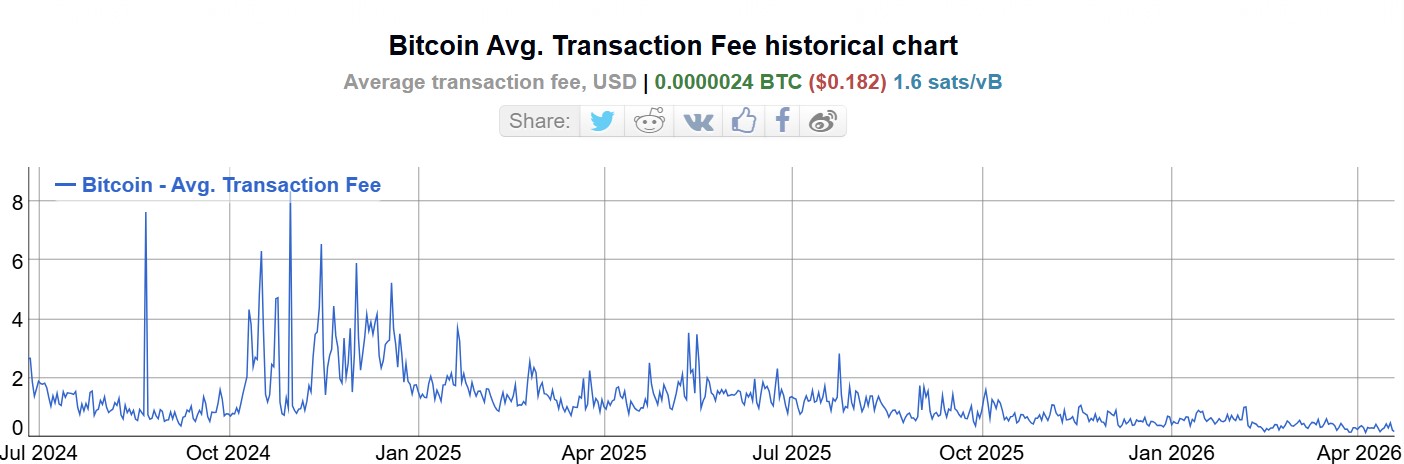
Bitcoin Avg. Transaction Fee historical chart- Source: Bitinfocharts
This is the slow-moving problem that does not make headlines. As block rewards keep halving every four years, the network’s long-term security depends increasingly on transaction fees. If those fees stay low, the economic incentive for miners erodes over time regardless of price. Nobody is sounding an alarm about this yet because the hash rate is still climbing. But the fee numbers are worth watching and almost nobody is watching them.
The Cycle Is Not Over
Bitcoin peaked at $126,000 in October 2025 before pulling back. That peak happened roughly eighteen months post-halving, which is actually consistent with the historical pattern when you account for the macro headwinds that delayed the rally. The question now is whether the current $74,000 level is the bottom of a consolidation before another leg up, or whether this cycle already played out and we are in the boring middle of a long flat period.
The shorts are as crowded as they have been at any point since 2022. Funding rates on perpetuals have been negative for 46 consecutive days. Institutional inflows are picking back up. The peace negotiations between the US and Iran are removing the geopolitical premium that was suppressing risk assets. The macro setup, for the first time in two years, is arguably turning supportive rather than hostile.
None of that is a price prediction. It is just the backdrop. Bitcoin will do what it does, which is move violently and without much warning in either direction.
Two years after the halving that was supposed to be the catalyst for a historic run, Bitcoin is still waiting for its moment. The supply shock happened on schedule. The institutions showed up. The network is more secure than it has ever been.
The market has not caught up yet. It usually does. It also usually takes longer than anyone expects.