

For 46 consecutive days, the majority of leveraged Bitcoin traders have been betting on lower prices. For 46 consecutive days, they have been wrong. And for 46 consecutive days, they have been paying the longs to hold their positions.
This is not a normal market condition. The 30-day average funding rate for Bitcoin perpetual futures has been negative since approximately March 1, confirmed across Binance, Bybit, and OKX simultaneously. That rules out an exchange-specific anomaly. The entire Bitcoin derivatives market has been short-biased for six weeks straight. At minus 0.005% on a seven-day moving average according to Glassnode data, funding rates have hit their most negative levels since 2023.
The last time this happened, the worst of the bear market was already over.
What Funding Rates Actually Measure
Perpetual futures contracts never expire. That creates a structural problem because if too many traders pile onto one side, the contract price drifts away from Bitcoin’s actual spot price. The funding rate is the mechanism that corrects this. When longs dominate, they pay shorts. When shorts dominate, they pay longs.
A persistently negative funding rate means one thing. Bearish traders are so dominant in the derivatives market that they are writing checks every eight hours to maintain their positions. At minus 0.005% per period, that cost compounds quickly for anyone holding a large short.
But here is the detail that makes this setup unusual. Open interest across Bitcoin perpetuals has climbed roughly 12% over the past month even as funding stayed negative. Traders are not just holding existing short positions. They are actively opening new ones at $74,000. Fresh capital is flowing into the short side of this trade right now, according to analysis from K33 Research’s Vetle Lunde.
That combination, rising open interest plus persistently negative funding, is what derivatives traders call a crowded short regime. And crowded short regimes have a specific historical track record in Bitcoin.
The Historical Record Is Short and Specific
Extended negative funding streaks of 40 or more consecutive days have only appeared twice before in Bitcoin’s perpetual futures history.
The first was during the mid-2021 bear market triggered by China’s mining ban. Bitcoin dropped from $64,000 to $30,000. Funding rates turned sharply negative. Crowded shorts built up at the lows. The unwind that followed carried Bitcoin to its first all-time high above $68,000 by November 2021.
The second was the FTX collapse in November 2022. Bitcoin fell below $16,000. Negative funding persisted for weeks as bearish positioning dominated. The recovery from that low eventually carried Bitcoin to $126,000 in October 2025, a 700% move from the bottom.
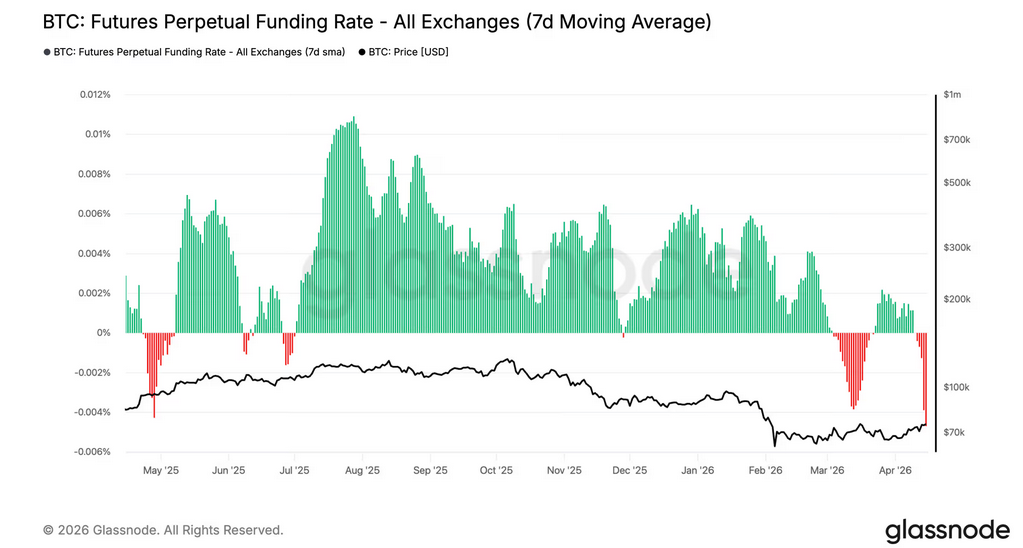
Glassnode and CoinDesk data confirm additional shorter episodes where negative funding aligned with local lows. March 2020 during the COVID crash when Bitcoin hit $3,000. The Silicon Valley Bank crisis in 2023 when Bitcoin briefly dipped below $20,000. The yen carry trade unwind in August 2024. The April 2025 Liberation Day selloff. In each case negative funding rates coincided with prices that proved to be entry points rather than continuation patterns.
The current 46-day streak is the longest since the FTX aftermath. Bitcoin is at $75,000.
The Mechanics of Why This Matters
Every short position currently open in this market is a future forced buyer.
When price rises, short sellers face two choices. Close the position and buy Bitcoin to cover, which pushes price higher. Or add margin to hold the position, which is increasingly expensive at negative funding rates. The longer price grinds higher against crowded short positioning, the more painful both options become.
This creates the conditions for a short squeeze. A squeeze happens when rising price forces short sellers to buy back positions to limit losses. Those forced buybacks push price higher. Higher price forces more short liquidations. The feedback loop amplifies moves in ways that have nothing to do with fundamental news or ETF flows.
K33 Research’s Lunde described the current setup directly. “Comparable risk-off regimes have historically been attractive entry points for BTC,” he said, noting that crowded short trades were historically forced to unwind. That unwind is what turns a grind from $60,000 to $75,000 into a move toward $80,000 or beyond.
What the Honest Counterargument Says
Two data points do not make a guaranteed pattern. Extended negative funding streaks are historically rare enough that the sample size for drawing firm conclusions is small. The mechanical logic is sound. The timing remains uncertain.
Negative funding alone does not guarantee a rally. The signal sharpens when paired with rising open interest, which is present here. It sharpens further when price is already grinding higher against the short positioning, which is also present. But Bitcoin has spent the better part of six weeks struggling to break and hold above $76,000, a level that has capped every rally attempt since February.
CryptoQuant noted this week that large holders are positioning to sell near a key breakeven zone around current prices. That supply pressure is real and it is working against the short squeeze narrative in the near term.
The setup is not a certainty. It is a probability distribution skewed in one direction. Every major Bitcoin rally in derivatives history has eventually cleared its crowded short overhang. The question is whether it clears at $75,000 or after a retest of lower levels first.
The Number That Keeps Getting Bigger
The 46-day streak keeps extending. Every day that passes without a resolution adds to the coiled spring. Every new short position opened at current levels adds another future forced buyer to the queue.
When the FTX streak ended, Bitcoin was below $20,000 eight months later it was above $30,000. When the mid-2021 streak ended, Bitcoin was at $30,000. Five months later it was above $68,000.
The shorts have been wrong about direction for 46 days straight. They are paying for it daily. And the market is approaching the level that has rejected every rally attempt since the Iran war began.
Something has to give. The historical pattern says it is the shorts that give first.