

The move was clean. Bitcoin ran from $76,960 at the weekly open to $82,500 intraday on Wednesday, breaking above the descending trendline that had capped every rally since February. For about twelve hours it looked like the breakout traders had been waiting for since January was finally happening.
Then the 200-day moving average at $82,228 did exactly what 200-day moving averages do at the end of downtrends. It rejected the price.
Bitcoin sits at $79,340 heading into the weekly close. The rally was real. The rejection was also real. And the close tonight matters more than almost any single price point in the past three months.
Why the Weekly Close Is the Number That Counts
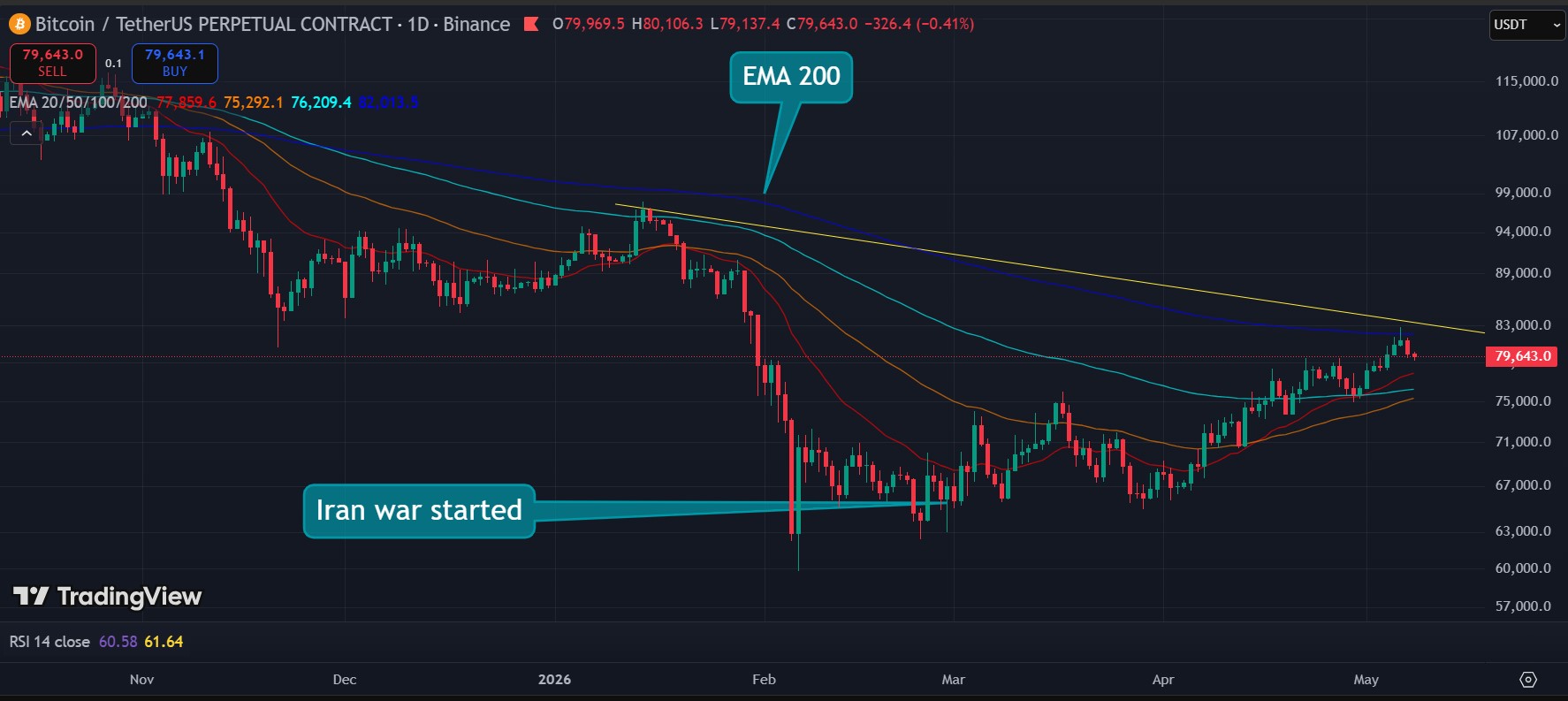
Bitcoin daily chart. The Iran war started at the exact bottom. The EMA 200 is now the ceiling. Source: TradingView / Binance
Yesterday we wrote about why the crypto market was down and identified the descending trendline through $81,000 to $82,000 as the key resistance. That trendline and the 200-day moving average converged in the same zone. Bitcoin hit both simultaneously and pulled back.
A weekly close above $80,000 keeps the bullish structure intact. The week would end with Bitcoin having tested and held above a major support level after rejecting resistance. That is consolidation. It is healthy.
A weekly close below $80,000 turns the weekly candle into a rejection signal. The chart would show Bitcoin approaching a major technical level, getting turned away, and closing below the prior support. That is the pattern that invites more selling in the first days of the following week.
Support levels to watch on weakness are $79,000, $78,000, and $76,960 at the weekly open. Resistance remains $80,000, $81,500, and $82,228 at the 200-day moving average.
The weekly close is in a few hours. Watch $80,000.
What Actually Caused the Rejection
Two Bitcoin whales sold a combined 2,521 BTC near the $82,000 level, booking significant profits. One wallet had bought 1,470 BTC three weeks ago at $74,448 and sold for a $10.23 million profit. Another had picked up 1,051 BTC just five days ago at $78,325 and walked away with a $3.24 million gain.
This kind of coordinated profit-taking at a known technical level is not unusual. Large holders accumulate during the fear phase, ride the move up, and distribute at resistance. The 200-day moving average is the most watched level in technical analysis. Everyone knows it is there. The whales knew it was there. They sold into the buyers who were chasing the breakout.
The short squeeze fuel that powered the rally from $65,000 to $82,000 over the past six weeks is not exhausted. Funding rates have normalised but open interest remains elevated. The bears who capitulated have been replaced by a new set of shorts who faded the move into resistance. If Bitcoin reclaims $82,228 on a daily close those new shorts face the same problem the old ones did.
The Macro Wildcard Nobody Is Talking About Enough
All three Fed Chair transitions over the past 12 years have coincided with significant Bitcoin drawdowns. Kevin Warsh replaces Jerome Powell on May 15. That is seven days away.
Markets have been relatively calm about the transition. Warsh’s confirmation hearing delivered no surprises. His stated policy preferences, balance sheet reduction before rate cuts, are already priced in to some degree. The institutional crypto community is cautiously optimistic because Warsh has called Bitcoin the new gold for people under 40 and invested in Bitwise.
But uncertainty around new leadership has historically weighed on risk assets in the days leading up to the change regardless of who the incoming chair is or what they believe. The market does not know exactly how Warsh will communicate, how he will handle press conferences, or how he will respond to the first piece of data that contradicts his priors. That uncertainty has a price.
The White House wants the CLARITY Act passed by July 4. Senate Banking Committee markup is planned for May, with Senate floor time in June and a House vote before Independence Day. If the markup goes smoothly next week it gives Bitcoin a legislative catalyst that could offset the Warsh uncertainty. If it stalls the market loses one of its two remaining near-term catalysts.
The Bigger Picture Has Not Changed
The most hated rally thesis is intact. Bitcoin is up significantly from the lows. The bears who were positioned for collapse have mostly capitulated. The structural buyers, ETFs, corporate treasuries, sovereign accumulators, have not shown any sign of stopping.
ETF inflows remained strong through April at $1.97 billion for the month. Strategy continues buying. The on-chain setup is fine.
The chart just rejected from exactly where it was supposed to reject. That is not a bearish signal by itself. It is the market behaving rationally at a known resistance level. The question is whether this is a pause before the breakout or the beginning of a deeper pullback before another attempt.
The weekly close answers that question. Above $80,000 the bulls stay in control. Below it the bears get one more chance to make their case.
Check back Sunday.