


Saturday night, Trump posted AI-generated imagery of himself sitting at a military command console with nuclear strike screens behind him. Sunday afternoon, he posted: “For Iran, the Clock is Ticking, and they better get moving, FAST, or there won’t be anything left of them. TIME IS OF THE ESSENCE.”
Monday morning, Asian markets open into that.
New media post from Donald J. Trump
( TruthSocial: May 17 2026, 4:48 PM ET ) pic.twitter.com/cl0gq4yy7M
— Commentary Donald J Trump Truth Social Posts On X (@TrumpTruthOnX) May 17, 2026
Trump is expected to convene a Situation Room meeting Tuesday with VP JD Vance, Secretary of State Marco Rubio, CIA Director John Ratcliffe, and Defense Secretary Pete Hegseth to formally review military strike options against Iran. Verified flight trackers show US Air Force airlift activity moving weapons and gear to regional bases. This is not rhetoric warming up. This is logistics moving.
TRUMP EXPECTED TO HOLD SITUATION ROOM MEETING WITH TOP NATIONAL SECURITY TEAM ON TUESDAY TO DISCUSS OPTIONS FOR MILITARY ACTION
— First Squawk (@FirstSquawk) May 17, 2026
Bitcoin sits under $77,000. Down roughly 4% on the week. The 200-day moving average at $82,100 that has capped every rally since January is now a distant memory. The question going into Monday is not whether crypto opens red. The question is how red.
What the Historical Record Says
This has happened before and the pattern is consistent. When the US struck Iranian nuclear facilities in mid-2025, BTC crashed below $105,000, wiping out roughly $40 billion in market cap within hours. The mechanism is the same every time. Military escalation triggers risk-off. Institutional traders liquidate volatile assets to cover margin calls. The liquidation cascade amplifies the move.
Bitcoin plummeted to a 2026 low of $65,834 on April 3, 2026, following escalating executive rhetoric regarding military strikes. Spot Bitcoin ETFs recorded a massive $174 million net outflow on April 2, 2026, signaling a retreat in institutional risk-on sentiment.
The market has been here before. It has not learned to price it in advance. It prices it on impact.
The Oil Problem Nobody Is Solving
We covered Iran’s permanent Strait of Hormuz toll system last week. The PGSA is operational. The US is enforcing a blockade over Iran’s use of Hormuz “as a weapon to threaten freedom of navigation,” according to a CENTCOM spokesperson.
Any US military strike escalates that standoff from a toll dispute into a full naval confrontation. Analysts previously modeled oil at $105 to $165 per barrel depending on closure duration. We are already above $100. A strike pushes that ceiling higher and the April PPI we covered earlier this week, already running at 6%, gets a fresh injection of energy inflation that the Fed cannot ignore.
G7 finance ministers are meeting in Paris Monday and Tuesday. German Finance Minister Lars Klingbeil said the Iran conflict together with the Hormuz blockade poses “a serious threat to the global economy.” The world’s largest economies are meeting to discuss a war while Trump is scheduling a Situation Room meeting to discuss strikes. Those two events happening simultaneously on Monday and Tuesday tells you how close to the edge this is.
The Bitcoin Thesis Under Pressure
Bitcoin is supposed to be the non-sovereign store of value. The war hedge. The asset that goes up when the dollar’s credibility is questioned.
That thesis has not worked cleanly in 2026. Gold and silver currently outperform Bitcoin, weakening the digital gold narrative. Institutional Bitcoin accumulation remains strong but could pause during extreme geopolitical risk.
The reason is simple. Bitcoin trades like a risk asset in the first phase of a crisis. Liquidity stress hits. Margin calls come. The most liquid volatile asset gets sold first. Bitcoin is that asset for institutional portfolios. The non-sovereign store of value thesis plays out in the second phase, after the initial shock, after weak hands have been flushed, after the dust settles enough for buyers to re-enter.
We are in the first phase. The Situation Room meeting is Tuesday. The dust has not settled.
The One Scenario That Changes Everything
Bitcoin initially climbed after Trump previously said he would delay strikes on Iranian energy facilities and postpone action for five days. Risk assets rallied broadly, with the S&P 500 gaining 1.5%, while Treasury yields and the dollar declined.
The mirror image of the Monday risk-off open is a Tuesday de-escalation rally. If the Situation Room meeting produces a diplomatic off-ramp rather than a strike authorization, Bitcoin recovers fast. The short-term Sharpe ratio is already at levels that historically precede violent recoveries. Weak hands have been flushing since April. The setup for a sharp bounce exists, it just needs a catalyst in the right direction.
Trump said Sunday he still believes Iran wants a deal and is waiting for an updated Iranian proposal. That sentence kept the door open. The nuclear imagery on Truth Social tried to close it again. Markets do not know which Trump shows up Tuesday.
𝗗𝗼𝗻𝗮𝗹𝗱 𝗝. 𝗧𝗿𝘂𝗺𝗽 𝗧𝗿𝘂𝘁𝗵 𝗦𝗼𝗰𝗶𝗮𝗹 𝟱.𝟭𝟳.𝟮𝟲 𝟭𝟮:𝟰𝟮 𝗣𝗠 𝗘𝗦𝗧
For Iran, the Clock is Ticking, and they better get moving, FAST, or there won’t be anything left of them. TIME IS OF THE ESSENCE! President DJT
— Commentary Donald J. Trump Posts From Truth Social (@TrumpDailyPosts) May 17, 2026
What to Watch
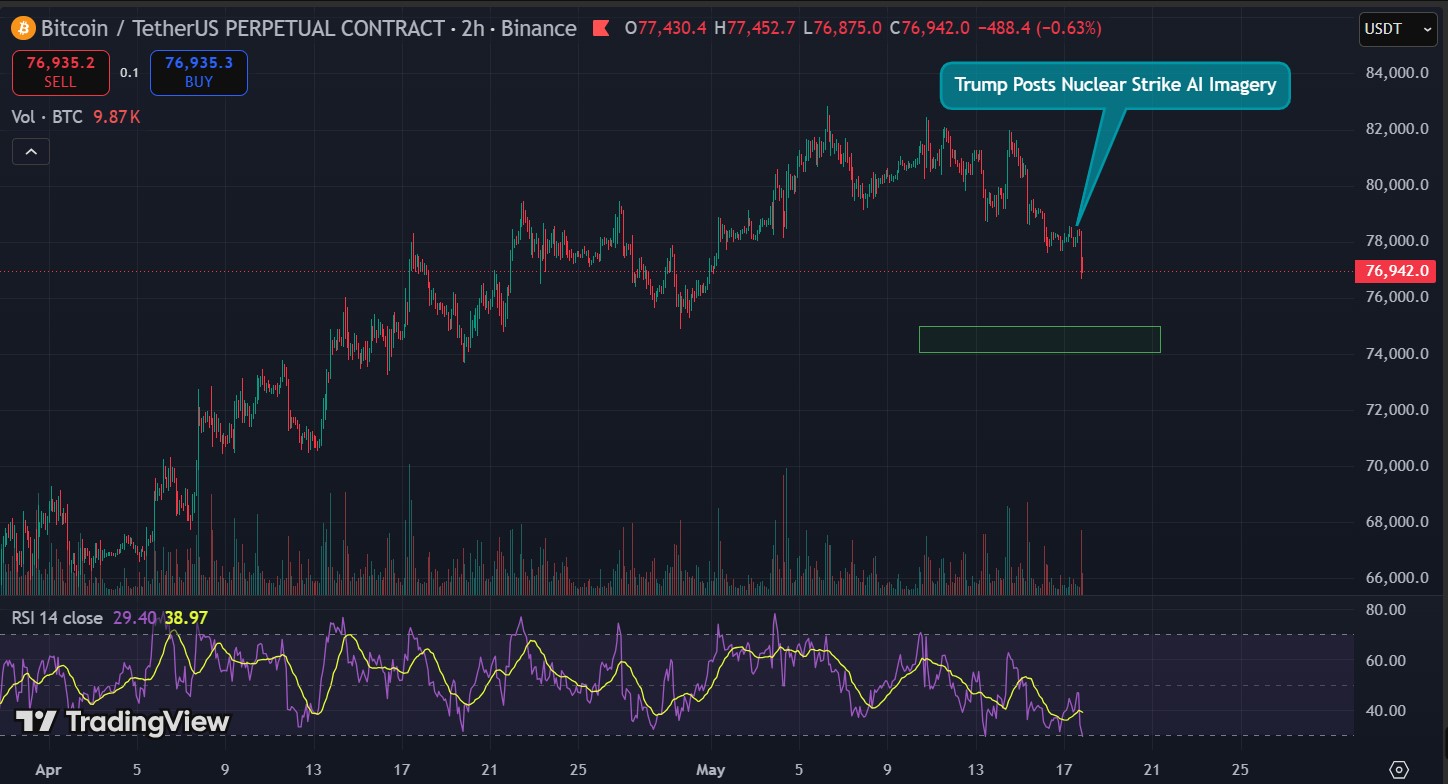
Bitcoin drops under $77,000 – Source: Tradingview
The Situation Room meeting Tuesday is the binary event. Strike authorization sends Bitcoin toward $74,000 to $75,000 on the first move. A diplomatic off-ramp or pause sends it back toward $82,000 within days.
Between now and Tuesday, watch oil. Watch the dollar. Watch Treasury yields. If all three move in the same direction, oil up, dollar up, yields up, Bitcoin has no support at current levels and $75,000 becomes the next test.
The clock Trump is talking about is ticking for Iran. The clock the crypto market is watching ticks until Tuesday morning.