


A $39 million token just claimed it can beat OpenAI at its own game at 20 times lower cost and 3 times the speed. The market heard that and sent SERV up 70% in 24 hours.
The project is called OpenServ. It builds infrastructure for autonomous AI agents — the tools that let AI systems act independently, not just respond to prompts.
Here is what is actually behind the claim, why it matters, and why the RSI at 80 means you should read this before buying.
$SERV pumps 69% today following a technical breakout, likely fueled by interest in its autonomous AI agent narrative. pic.twitter.com/jbJAH8ZZqm
— CoinGecko (@coingecko) May 17, 2026
What OpenServ Actually Is
OpenServ is not a meme coin riding an AI narrative. It is an infrastructure layer for autonomous AI agents, a platform that lets you build, deploy, and monetize AI agent teams without writing the underlying orchestration code yourself. AI agents with autonomous capabilities introduce their own security risks as one attack earlier this month demonstrated.
The BRAID framework, which stands for Bounded Reasoning for Autonomous Inference and Decisions, is the technical core. It is currently running in production across 10 enterprise and government deployments including UAE government work with partner Neol. SERV is the platform’s utility token covering fees, staking, and launch participation.
That is a real product with real deployments. That matters for what comes next.
The Benchmark Claim That Moved Markets
OpenServ founder Tim Hafner posted the claim that lit the fuse:
“Our reasoning framework is currently beating every OpenAI model on industry standard benchmarks. There are six models in development. SERV-nano just matched GPT-5.4 at 20x lower cost and 3x the speed. The research paper backing it is in peer review at a top-1% AI journal. The UAE government is running it in production, so are 10+ enterprises.”
That is an extraordinary claim. CryptoRank’s analysis noted the key caveat immediately: “claims are driving token narrative and potential adoption but lack full public verification, named deployments, reproducible benchmarks and clear token value accrual are needed.”
There is also a timing problem. OpenServ is benchmarking against GPT-5.4. OpenAI replaced GPT-5.4 with GPT-5.5 on April 23, and GPT-5.5 is a substantially more capable model that now leads frontier benchmarks like Terminal-Bench 2.0 at 82.7%. The benchmark SERV-nano is claiming to match is no longer OpenAI’s current offering.
That does not make the claim false. It makes it less impressive than the headline reads.
The Autonomous AI Agent Sector Is Real
Strip away the benchmark debate and the broader narrative is legitimate. The autonomous AI agent sector now carries a combined market cap above $15 billion. Agent launchpad Virtuals Protocol alone trades at roughly $477 million. Capital has been rotating into agent infrastructure plays after months of consolidation.
OpenServ sits at a market cap of $39 million with a fully diluted valuation of $52 million. If the BRAID framework delivers on even a fraction of what government and enterprise deployments suggest, the gap between its current valuation and comparable AI infrastructure projects is significant.
That is the bull case. It is real. It is also exactly the kind of narrative that drives 70% moves on thin volume before the reality check arrives.
What the Chart Is Saying
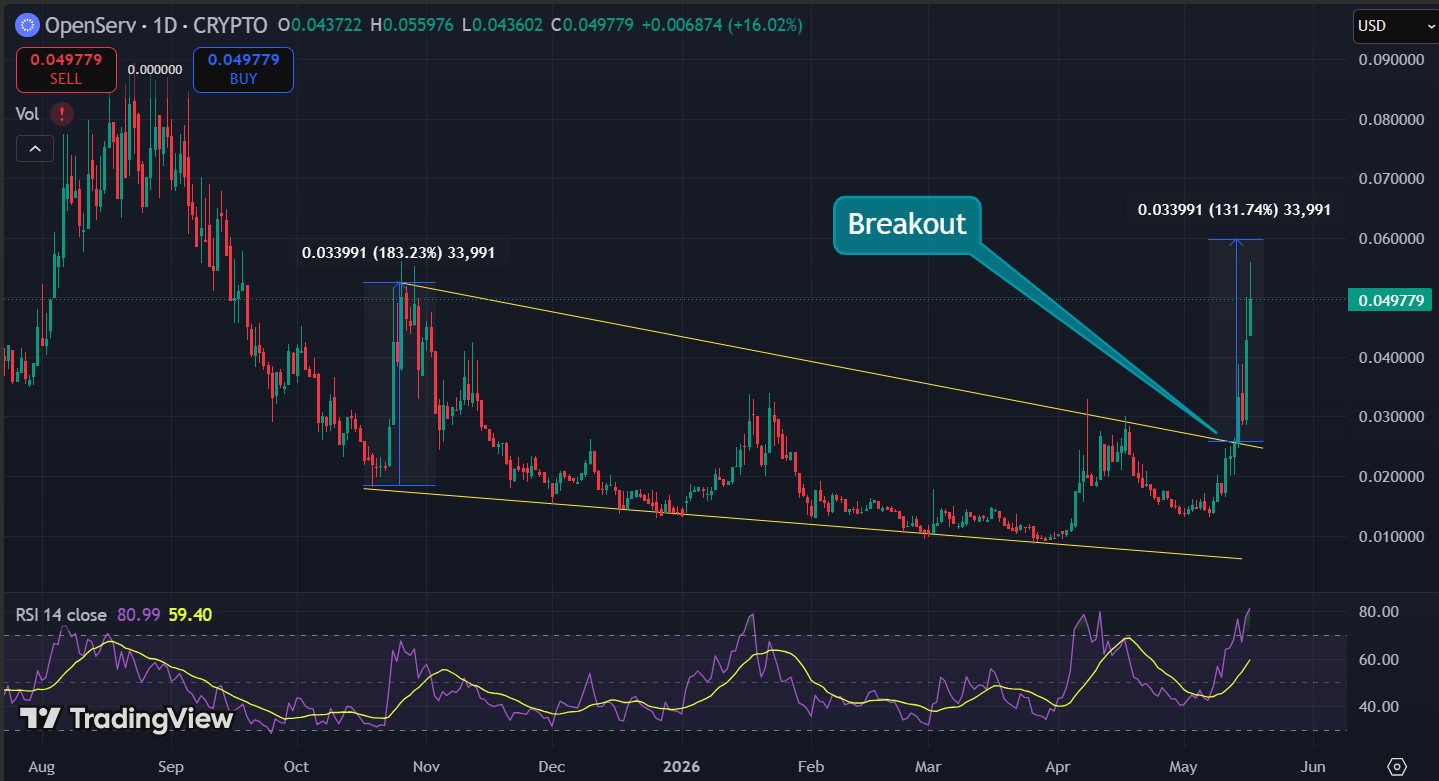
SERV breaks out of a 7-month falling wedge on the daily chart. The measured move target sits near $0.067. RSI at 80.99 signals overbought conditions. Source: TradingView
The technical picture is clean but late. SERV broke out of a falling wedge that compressed price for seven months. The breakout above $0.0287 confirmed the pattern and the measured move target sits near $0.067, roughly 31% above today’s price.
The problem is that RSI has pushed above 80, deep in overbought territory. Price has already covered roughly three-quarters of the measured move range. Momentum tokens at RSI 80 on thin volume either push through quickly or stall and retrace hard.
Daily volume sits around $3.8 million. That is not the kind of sustained institutional buying that holds a 70% move together. It is retail momentum chasing a story.
A hold above the $0.0287 breakout level keeps the bull case alive. A failed retest of that trendline invalidates the entire pattern and sends SERV back toward the base of the wedge.
The CoinGecko Warning Worth Reading
Before anyone hits buy, there is a GoPlus security flag on the SERV contract that CoinGecko displays prominently: “The contract creator can make changes to the token contract such as disabling sells, changing fees, minting, transferring tokens. Exercise caution.”
That is a standard flag on many early-stage tokens but it is worth knowing before sizing up.
The Bottom Line
OpenServ has a real product, real enterprise deployments, and a genuine position in one of crypto’s strongest 2026 narratives. The benchmark claim that drove this move deserves scrutiny but the underlying business case is not vapor.
The question is whether a $39 million market cap with RSI at 80 after a 70% move is the entry point. History suggests the answer is usually no. Retail traders who chased similar moves in 2026 already know how that ends. The AI agent narrative is not going away. The next entry on a confirmed retest of $0.0287 is a better risk-reward than chasing a vertical move at the top of the range.
The story is real. The timing is late.