

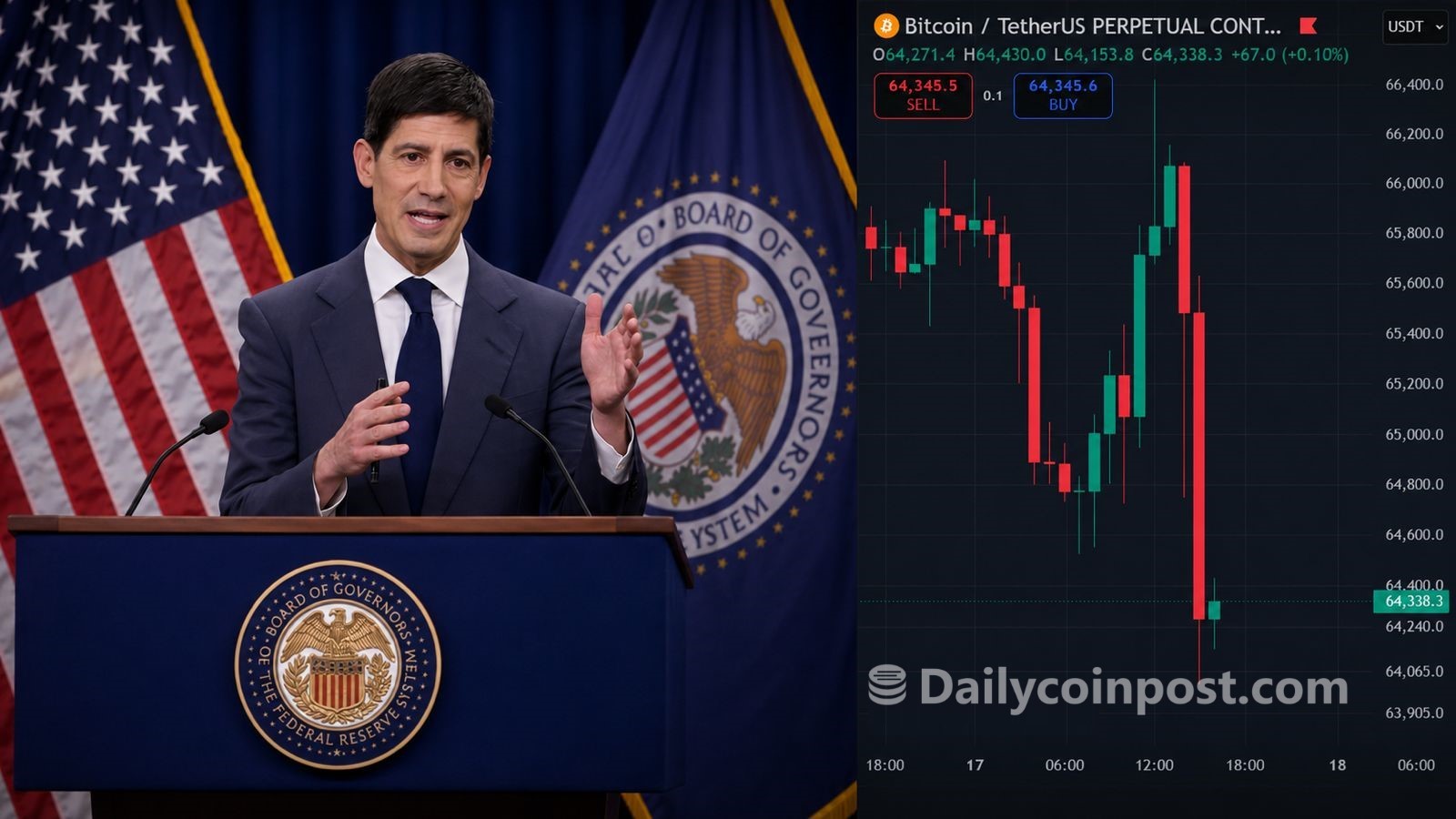
Kevin Warsh held rates at 3.50% to 3.75% in his first FOMC meeting. That part was priced at 97% probability before he sat down. Nobody was watching the decision.
What nobody had fully priced was nine of 18 FOMC participants projecting at least one rate hike before December. Not three. Nine. Half the committee.
Bitcoin was at $65,700 when Warsh started speaking. It hit $64,077 before he finished. The S&P 500 fell 1.07%. Gold dropped 0.98% to $4,288. Everything sold off at the same time on the same signal.
We wrote two weeks ago that the press conference was the story, not the decision. This is what that looked like in practice. The broader irony is worth noting. Trump nominated Warsh expecting looser monetary policy. Warsh’s first meeting delivered the most hawkish dot plot in years. He read the data and the data did not cooperate with the rate-cut thesis. That is not betrayal. That is a Fed Chair doing his job in a 4.2% inflation environment.
BREAKING: The Dow is now down -800 points since the Fed decision was released.
The S&P 500 has erased -$1.2 trillion in market cap in under 2 hours. pic.twitter.com/a26ogFKgL4
— The Kobeissi Letter (@KobeissiLetter) June 17, 2026
What the Dot Plot Actually Said
The June dot plot removed the last projected rate cut for 2026. Every meeting prior still had at least one cut penciled in somewhere. That cut is gone.
In its place, nine participants now see a hike coming. ZeroHedge noted one dot is missing from the plot entirely, most likely Warsh’s, which means the hawkish count may actually understate where the committee sits. A chair who withholds his own projection while nine colleagues project hikes is not sending a dovish signal.
The FOMC statement stripped out “additional rate adjustments” language entirely and replaced it with purely data-dependent framing. The easing bias is gone. The neutral stance is in. And CME FedWatch is now pricing a 58.6% probability of at least one hike by December, up from near zero a month ago.
Why Gold Sold Off Too
BREAKING: Spot gold prices fall sharply after the Fed signals potential rate hikes ahead. https://t.co/lyve7qUeri pic.twitter.com/1ZS3Xthk1W
— The Kobeissi Letter (@KobeissiLetter) June 17, 2026
The simultaneous selloff across Bitcoin, stocks, and gold is worth paying attention to. When all three fall together it is not a flight to safety. It is a liquidity event. Higher rates for longer means tighter financial conditions across every asset class simultaneously. There is nowhere to hide in that scenario except cash and short-duration bonds, which is exactly where Treasury yields moved. The 2-year yield jumped 11 basis points to 4.153%.
Gold dropping on a hawkish Fed is textbook. Higher real rates make non-yielding assets less attractive. Bitcoin dropping is the same logic applied to a higher-beta asset. The move was mechanical and fast.
What This Means for the Recovery Thesis
The Iran deal we covered on June 15 gave Bitcoin a macro tailwind. Oil fell from $106 to $83. The three-link chain that trapped Bitcoin since February started to break.
Warsh just introduced a countervailing force from the other direction. The Iran deal eases the inflation input. The Fed meeting signals that even with oil falling, inflation at 4.2% with PPI at 6.5% is not falling fast enough to stop a hike. Both things are true simultaneously. Bitcoin is caught in the middle.
The 60-day Hormuz toll clock adds a third variable. Oil is at $83 today. If Iranian service fees restart at day 61, oil moves back toward $90 and the inflation math gets worse again just as the Fed is already considering a hike. That timeline runs into September, which is exactly when Citadel Securities flagged hike risk earlier today.
The Honest Read
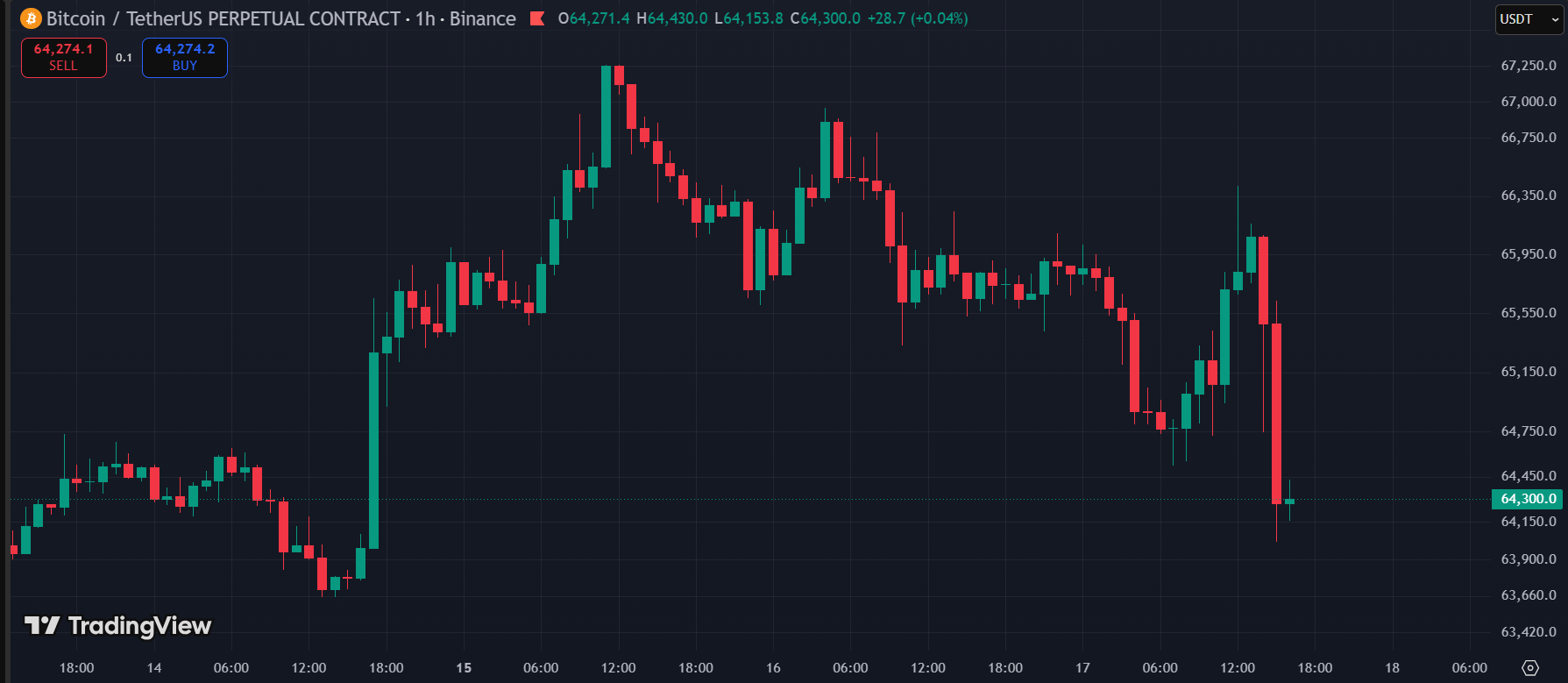
Bitcoin rallied to $67,250 on the Iran deal and gave back most of the gains the moment Warsh spoke. The candle on June 17 tells the whole story. Source: TradingView
Bitcoin at $64,077 is not a disaster. It is down $1,600 from this morning, which is a 2.4% move on a Fed day with a hawkish surprise. That is a rational repricing, not a panic.
The recovery thesis from $59,000 is still intact. The Iran deal is real. The strait is reopening. ETF inflows turned positive last week for the first time in 13 sessions. Long-term holders have not sold through any of this.
What changed today is the ceiling. The path to $70,700 at the 50-day EMA and $78,500 at the 200-day now has to navigate a Fed that half its members want to hike, a 60-day oil toll clock, and 4.2% inflation that is not moving fast enough for anyone’s comfort.
The bottom is probably in. The recovery is going to be slower than the Iran deal bounce made it look last week.