

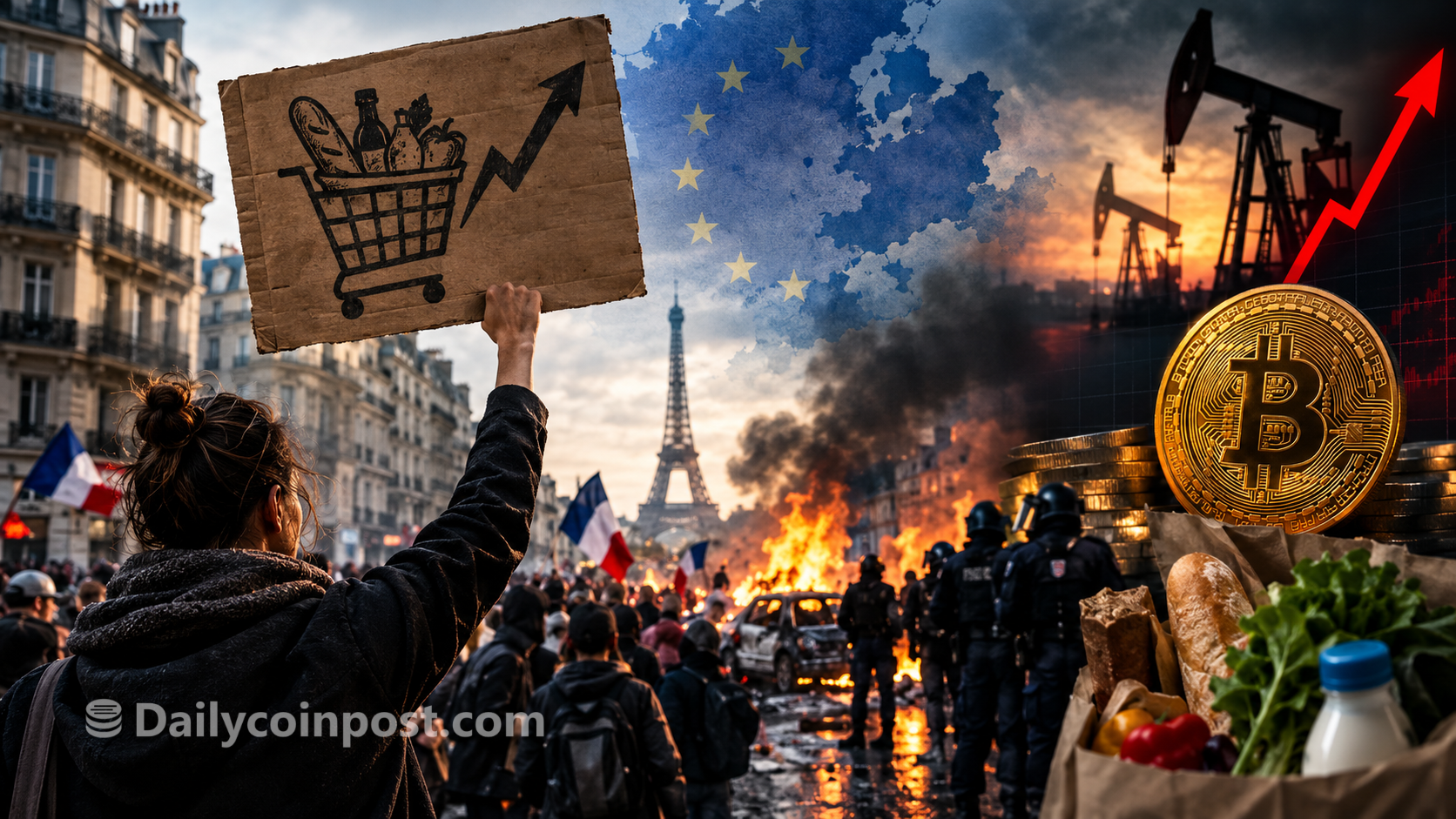
On October 17, more than 500,000 people took to the streets across France, Italy, Portugal, and Belgium in the same weekend. They did not coordinate. They did not share a single political platform. They shared a grocery bill.
In Paris, rioters set cars on fire at the Canal Saint Martin. In Milan, demonstrators clashed with police at Piazza Duomo. In Lisbon, tens of thousands marched against housing costs that rose 16.5% in a single year, the largest annual increase of any EU member state. In Brussels, police deployed water cannons.
France saw its worst riots in decades. The protests began at high schools in Paris’ working-class northern suburbs, where anger over teacher shortages and crumbling facilities spread outward until it had a different name. Not an education protest. A cost of living protest. Those are the words on every sign in every city.
EU food and non-alcoholic beverage prices rose 34% between August 2021 and August 2026, according to Eurostat data analysed by Euronews Business. That is five years. That is not a spike. That is a new floor.
What Stagflation Actually Does to People
Economics textbooks describe stagflation as the combination of high inflation, slow growth, and elevated unemployment. The textbooks do not describe what happens in the fifth year of it.
In the fifth year, people who adjusted their budgets in year one, who switched to cheaper brands in year two, who stopped going out in year three, who moved to smaller apartments in year four, have run out of adjustments. The margin is gone. The buffer is gone. What remains is anger that has nowhere productive to go and a government that cannot fix it because the tools that would fix it, rate cuts, stimulus spending, energy subsidies, would make the inflation worse.
That is the trap. And that is what the streets of Paris looked like last weekend.
Oil is at $117 a barrel. The US 10-year Treasury yield is at 5%. The ECB cannot cut rates without accelerating inflation. Governments cannot spend without widening deficits that bond markets are already pricing skeptically. The IMF estimates that oil sustained above $130 through Q1 2027 reduces global growth by 0.5 percentage points. Brent is already at $117. The distance between now and that scenario is not large.
The Connection to Bitcoin That Nobody Is Making
BeinCrypto ran a global economic outlook piece this week that correctly identified the risks: AI spending bubbles, China’s property crisis, Middle East conflict, stubborn inflation. It placed Bitcoin in a table and called it liquidity-sensitive.
That framing misses the more important question.
The people marching in Lisbon over 16.5% annual housing price increases are not experiencing a liquidity problem. They are experiencing a purchasing power problem. Their wages did not rise 16.5%. Their savings did not rise 16.5%. The money they earned and saved is worth measurably less than it was last year, and the year before, and the year before that.
Bitcoin’s thesis is not that it protects you during a financial panic. It is that it protects you against exactly this. Against five years of 34% food price increases. Against a monetary system that cannot stop inflation without triggering recession and cannot avoid recession without feeding inflation. Against the trap.
The BeinCrypto piece correctly notes that Bitcoin can fall sharply during a financial crisis when investors need liquidity. That is true and important. What it does not note is that the people rioting in Paris over housing costs are not experiencing a financial crisis. They are experiencing the long-run consequence of a fiat monetary system under stress.
Those are different problems. Bitcoin performs differently in each of them.
What the Riots Are Actually Telling You
There is no single trigger for what happened on October 17. Capital Economics’ Chief Europe Economist said so explicitly. That is the point. When there is no single trigger, when the anger is distributed across housing, food, fuel, education, wages, and public services simultaneously, you are not looking at a policy failure. You are looking at a system failure.
EU food prices up 34% in five years. Portugal housing up 16.5% in one year. Brent crude at $117. ECB rates still restrictive. Real wages falling across the continent. Five things, all pointing the same direction, none of them fixable by the tools available to the governments being protested.
The IMF 2027 outlook describes this as a situation where “individually, these problems are manageable. Together, they increase the possibility of a more serious downturn.”
The streets of Paris last weekend are what it looks like when those problems stop being individually manageable for ordinary people while remaining individually manageable for policymakers. The gap between those two experiences is what 500,000 people were marching about.
What Comes Next
Bitcoin is at $80,000. US spot ETFs saw $636 million in net outflows on October 22 after three days of inflows. The short-term price action reflects US macro, not European riots.
But the European riots reflect something the US macro data does not yet fully capture. When EU food prices have risen 34% over five years and the response is water cannons, the political pressure on European central banks to ease policy increases regardless of what inflation data says. And when European central banks ease into elevated inflation, the dollar strengthens, commodity prices stay elevated in euro terms, and the whole cycle repeats.
The people in the streets of Lisbon and Paris are not Bitcoin investors. Most of them have never thought about monetary policy. But the problem they are protesting, the slow, persistent, grinding devaluation of the money they earn against the prices of everything they need, is the problem Bitcoin was designed to solve.
Not in a crisis. Over decades. One block at a time.