
Somewhere in Washington last week, someone picked up a phone and called Tether.
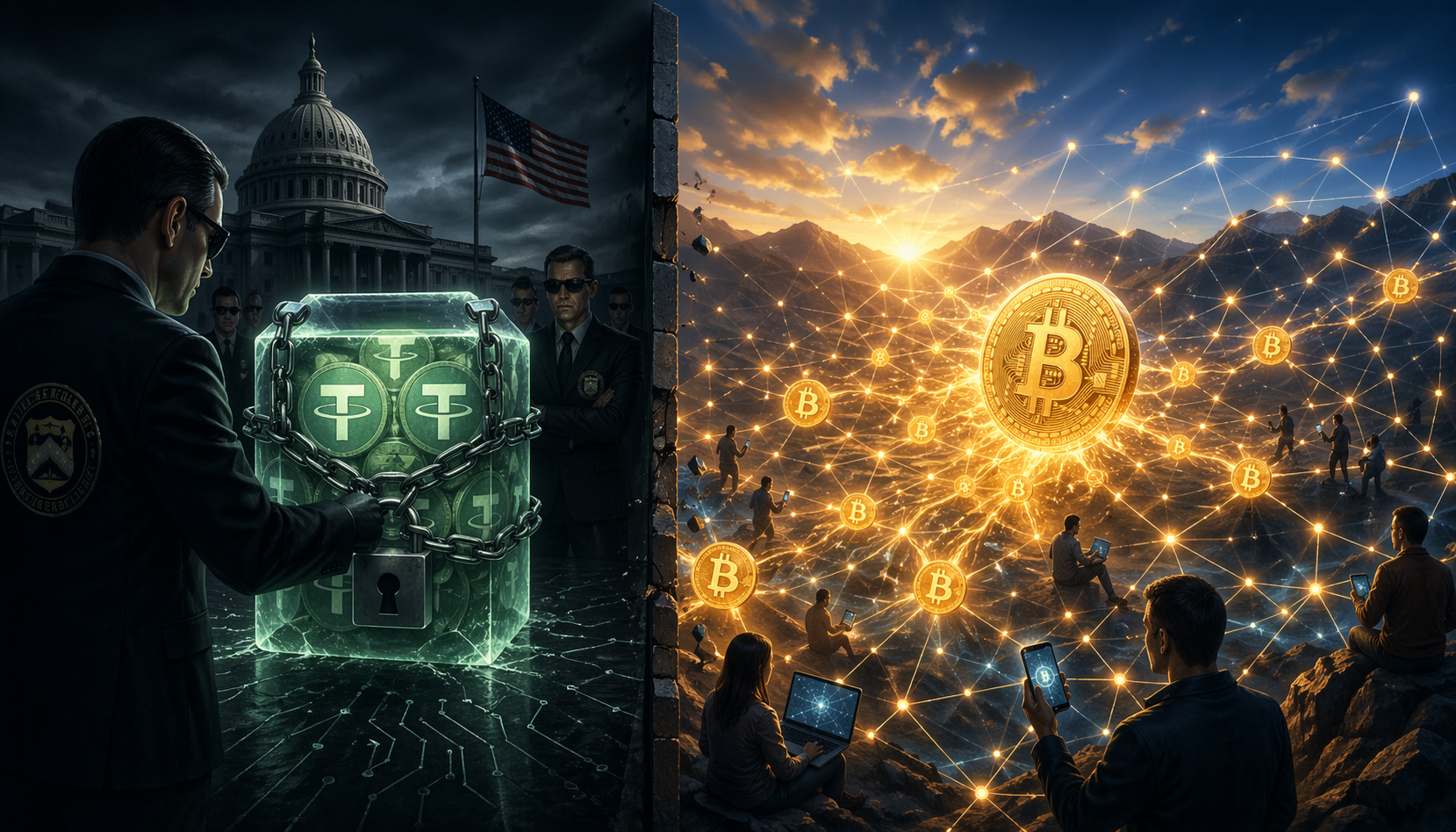
By the time that call was done, $344 million in USDT sitting across two wallets on the Tron blockchain was gone. Frozen. Inaccessible to whoever held it. Treasury Secretary Scott Bessent went on X and named it Operation Economic Fury, a campaign to cut off every financial lifeline Tehran has left. “We will follow the money that Tehran is desperately attempting to move outside of the country,” he said.
Under Economic Fury, @USTreasury will continue to systematically degrade Tehran’s ability to generate, move, and repatriate funds.
Treasury’s Office of Foreign Assets Control is sanctioning multiple wallets tied to Iran — resulting in the freeze of $344 million in…
— Treasury Secretary Scott Bessent (@SecScottBessent) April 24, 2026
One phone call. $344 million frozen. That is how fast it happened.
Now ask yourself: who do you call to freeze Bitcoin?
Nobody. Because there is nobody to call.
The Call That Could Not Be Made
Iran has been collecting Bitcoin tolls from ships transiting the Strait of Hormuz since the war started. Over $1 million per vessel, payable in Bitcoin, routed through layers of intermediaries to keep the trail cold. The US Navy controls the waters. It cannot control the transactions. Because Bitcoin does not have a Tether. There is no company registered somewhere that owns the protocol. There is no compliance team waiting for an OFAC letter. There is no freeze function written into the code.
The money moves. It has always moved. It will keep moving.
This week made that contrast impossible to ignore. The Treasury froze $344 million in stablecoins and simultaneously had to watch Bitcoin transactions it could not touch continue processing in real time. The US military confirmed it runs a live Bitcoin node and calls it power projection against China. The same government. The same week. Two completely different relationships with two different parts of the crypto ecosystem.
They control one of them. They are studying the other because they cannot.
What Tether Actually Is
Tether has frozen over $4.4 billion across more than 2,300 addresses in its history, according to CryptoTimes. It does this quietly and routinely. Most USDT holders have no idea the function exists until it gets pointed at someone they know.
The Tron blockchain kept running normally while those two wallets were frozen. Every other transaction processed without interruption. The chain itself was not touched. Just the stablecoin sitting on top of it. Justin Sun had called Tron “the most decentralized blockchain in the world” just days before. He was not wrong about the blockchain. He was talking about the wrong layer.
USDT is not a blockchain. It is a dollar IOU issued by a company in the British Virgin Islands. That company can freeze your balance on a government request. The blockchain underneath it is completely beside the point. You are not holding crypto. You are holding a digital promise from a company with a compliance department.
Iran Figured This Out Before Most Crypto Twitter Did
Chainalysis put Iranian crypto holdings at $7.8 billion in 2025, with the IRGC controlling roughly half of that in the final quarter of the year. Iran has been rerouting its financial system through crypto since its traditional channels were sealed off. The interesting part is not that Iran uses crypto. It is which crypto Iran uses for which purpose.
The Hormuz tolls are collected in Bitcoin. The wallets Treasury froze this week were USDT.
That could be coincidence. It could also be that the people managing Iran’s financial survival in the middle of a war have a clearer picture of the difference between a censorship-resistant asset and a dollar IOU than the average person buying stablecoins on Coinbase does.
The Part Nobody Wants to Say Out Loud
Every stablecoin has an issuer. USDT has Tether. USDC has Circle. EURC has Circle. PYUSD has PayPal. Every single one of them has a freeze function and a legal team that picks up the phone when OFAC calls. That is not a bug. It is how they were designed. It is why governments tolerate them.
Bitcoin has none of that. No issuer. No freeze function. No phone number. That is also not a bug. It is the entire point.
When the US Treasury freezes $344 million in stablecoins and cannot replicate that action on Bitcoin in the same news cycle, it is the argument in practice.
The people who built USDT made it freezable on purpose. The person who built Bitcoin made it unfreezable on purpose. Both designs worked exactly as intended this week.
You just need to know which one you are actually holding.