


September is Bitcoin’s worst month by historical average. The data is real. Since 2013, Bitcoin has averaged a 5.9% decline in September. It has closed red in September seven out of the last twelve years. The pattern has a name. Rektember. Every analyst with a chart subscription is running it today.
Here is the problem with Rektember 2026.
The sellers already sold.
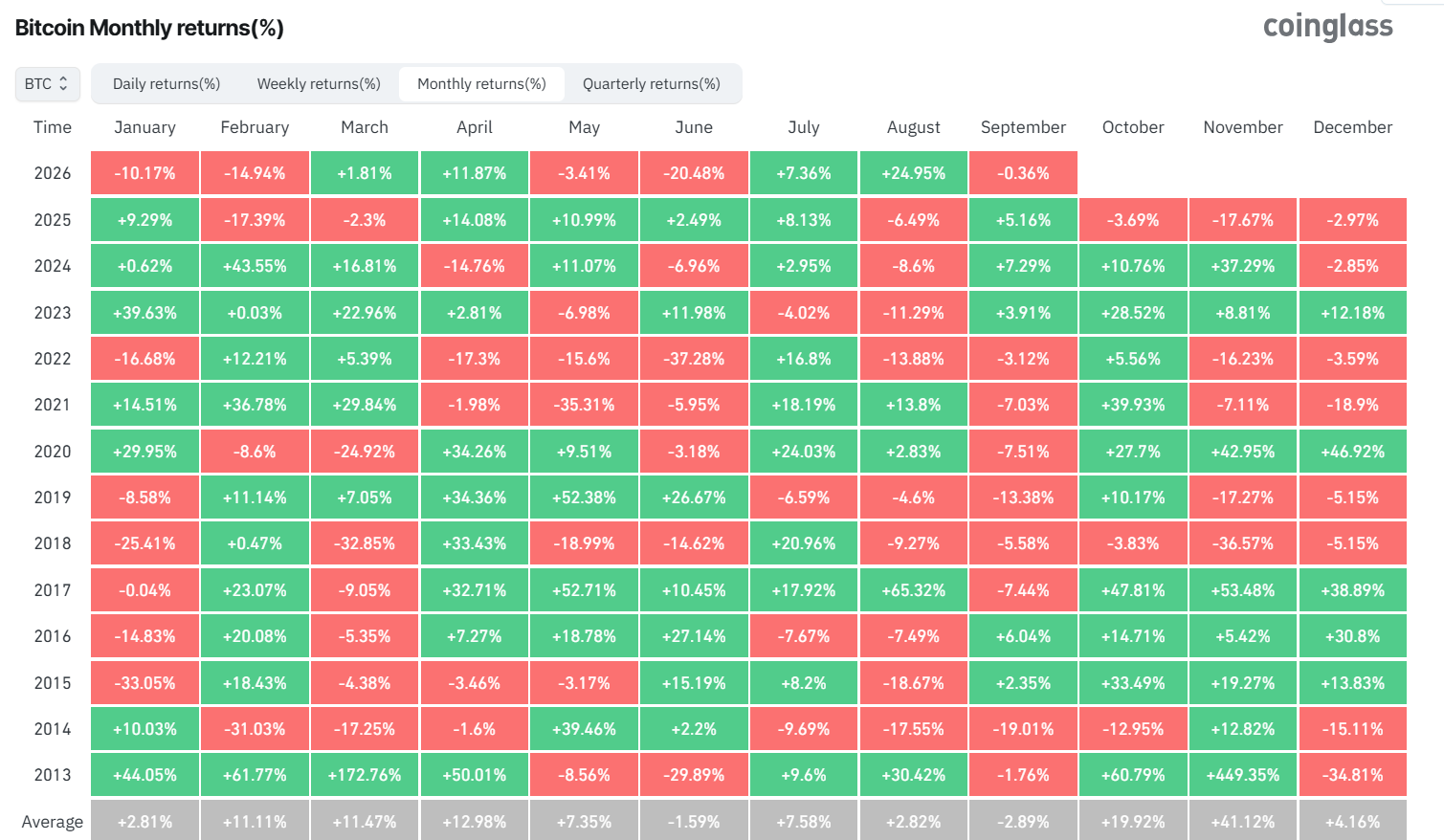
Bitcoin Monthly returns(%) – Source: Coinglass
What the Seasonal Pattern Actually Requires
Rektember is not magic. It is the aggregate result of specific human behaviors that repeat in September. Summer liquidity dries up. Traders return from holiday and reassess positions. Institutions rebalance portfolios at quarter end. Tax-loss harvesting begins in earnest. The combination historically produces more sellers than buyers in September and price falls.
Every one of those behaviors requires people who are still holding Bitcoin at $80,000 and deciding whether to sell.
More than $4 billion in bearish crypto positions were liquidated during the recent rally.</cite> Those were the bears who planned to profit from a September decline. They got liquidated in August instead. The traders who were short Bitcoin at $65,000 to $67,000 expecting a breakdown to $55,000 covered their positions involuntarily when the Treasury buyback sent Bitcoin vertical on August 19.
The people who were going to create September selling pressure already created their selling pressure. In June. In July. At $62,000 to $67,000. They are not going to sell again in September because they have nothing left to sell.
The Rate Hike Risk Is Real. It Is Also Already Priced.
The actual bearish case for September is not the calendar. It is the FOMC.
Bitcoin crossed $80,000 for the first time since May as optimism returns to the beaten-down crypto market.</cite> That optimism is pricing in a specific outcome from the September 15 to 16 FOMC meeting. The market expects Warsh to signal easing. If he signals tightening instead, or says nothing at all about rate cuts, the rally loses its forward-looking justification.
That risk is legitimate. Warsh inherited 3.8% CPI and 6% PPI when he took the chair in May. The Treasury buyback compressed long-end yields temporarily. The 30-year yield was at 5.34% on August 18 and is already recovering toward that level. If Warsh acknowledges that inflation has not been solved and rate hikes remain on the table, September becomes difficult for Bitcoin regardless of what happened to the shorts in August.
But that risk is not Rektember. It is a specific policy risk on a specific date. Rektember is a seasonal pattern. Those are different arguments and they should not be conflated.
What the Data Actually Shows This Year
US spot Bitcoin ETFs attracted about $1.918 billion over five trading sessions through August 21, marking their strongest weekly inflow of 2026.</cite>
Demand from institutions returned, with spot Bitcoin ETFs posting $1.92 billion in inflows last week, their largest weekly inflow since October when Bitcoin reached its cycle peak.</cite>
That institutional inflow structure did not exist in any previous Rektember. In 2022 when Bitcoin fell 3.1% in September, there were no spot Bitcoin ETFs. In 2023 when Bitcoin fell 11.3%, ETF approval was still two months away. In 2024 when Bitcoin fell 7.8%, ETF AUM was a fraction of what it is today.
The structural buyer base is different now. ETF inflows do not stop because the calendar says September. Institutional allocation schedules run quarterly and annually, not around retail seasonal patterns. The same Rektember data set that everyone is citing was built before institutional participation at this scale existed.
The Contrarian Position
Bitcoin climbed above $80,000 for the first time since mid-May, extending its seven-day advance to roughly 25%.</cite> A market that just liquidated $4.3 billion in shorts and posted its strongest ETF inflow week of 2026 is not the same market that historically produced Rektember.
The contrarian position is not that September will be green. It is that the Rektember thesis this year is built on the wrong inputs. Historical September averages include years without ETFs, without institutional participation at this scale, and with a very different short positioning structure entering the month.
The two real variables for September are September 15 and whatever Warsh says at the FOMC. The CLARITY Act cloture vote and the Fed meeting land on the same day. Those outcomes will move Bitcoin in either direction. The calendar will not.
Rektember is a pattern from a different version of this market. The people citing it are using 2018 and 2022 data to predict a 2026 market that has $1.92 billion in weekly ETF inflows and just flushed four billion dollars in short positions.
The sellers who were supposed to sell in September already sold in June.