


The daily RSI hit 15.11 today. The last time it was this low was March 2020 when COVID crashed Bitcoin from $9,000 to $3,800 in 48 hours. Traders who remember what happened next are getting excited. Here is why that excitement is dangerous.
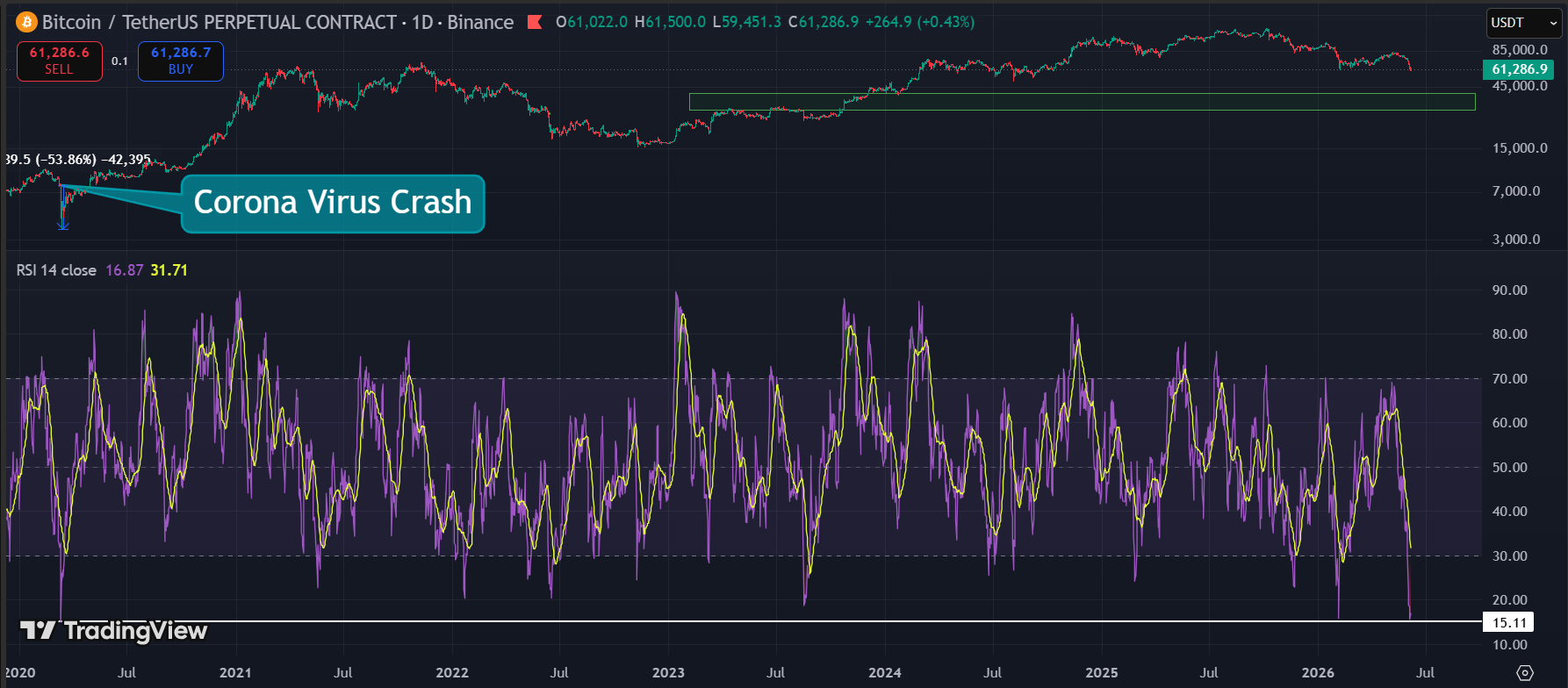
Bitcoin’s daily RSI at 15.11, matching the COVID crash low from March 2020. The green zone marks the $30,000-$40,000 accumulation range that followed the COVID bottom. The current RSI reading is the lowest since that crash. Source: TradingView / Binance
What the COVID Crash Actually Was
The COVID crash was a single acute shock. One catalyst. One moment of maximum fear. The virus appeared, markets panicked, Bitcoin dropped 53% in days, and then the Federal Reserve did something unprecedented.
Jerome Powell cut rates to zero. Congress passed the CARES Act. The Treasury and Fed injected over $4 trillion into the economy in months. Every risk asset on earth pumped because the Fed handed the market a firehose of liquidity and told it to drink.
Bitcoin went from $3,800 to $69,000 not because the RSI was oversold. It went there because the most aggressive monetary stimulus in modern history followed the crash. The RSI told you the bottom was in. The Fed told you where the top was going.
That mechanism does not exist in 2026.
The same RSI. A completely different world underneath it.
What Is Actually Happening Now
Bitcoin is not dealing with one acute shock. It is dealing with six simultaneous pressures that do not resolve on a single headline.
Inflation is not beaten Inflation is still running at 3.5% to 4%. The Fed cannot cut. Every rate cut hope has been priced in and then priced back out since January. The Fed funds rate stays where it is until inflation moves, and inflation is not moving while oil is above $100.
Iran has no clean resolution. The Strait of Hormuz conflict is still active, with every escalation adding to energy costs, every energy cost increase feeding into inflation, and every inflation reading keeping the Fed frozen. The loop does not break until the war breaks.
Strategy broke the narrative Strategy sold Bitcoin for the first time since 2022. It was 32 BTC, 0.004% of their holdings, technically irrelevant. What it broke was the narrative that institutional Bitcoin holders never sell. That narrative was worth more than 32 BTC.
ETF holders are not done ETF outflows hit $3.4 billion in a single week, the largest exit since Bitcoin ETFs launched in January 2024. The institutional floor that was supposed to catch every dip has a hole in it.
AI is absorbing speculative capital The marginal dollar that would have gone into Bitcoin is going into Nvidia, Anthropic pre-IPO tokens, and AI infrastructure plays. SpaceX prices June 11. Bitcoin is competing for that capital right now and losing.
Bitcoin has lost all three narratives It is not acting as digital gold. Gold is up. Bitcoin is down 45% from its ATH. It is not acting as an inflation hedge. Inflation is rising and Bitcoin is falling. It is not acting as a high beta tech play. The S&P 500 is hitting fresh records while Bitcoin hits 2026 lows.
The Mechanism That Saved Bitcoin in 2020 Does Not Exist
This is the critical difference the RSI comparison obscures.
In 2020, Jerome Powell could cut rates to zero in an emergency meeting and announce unlimited QE. That was the actual bottom signal. Not the RSI. The RSI told you the market was oversold. The Fed told you it was about to flood the system with liquidity.
In 2026, Kevin Warsh cannot cut rates into 4% inflation without risking a 1970s-style stagflation spiral. There is no emergency meeting coming. There is no QE on the horizon. The mechanism that turned the COVID bottom into an 18-month bull run does not exist in the current monetary environment.
A technical bounce from RSI 15.11 is likely. Markets do not stay this oversold for long. But a bounce from oversold conditions and the beginning of a new bull run are not the same thing.
The COVID bottom bounced because the Fed removed every obstacle between Bitcoin and higher prices. The 2026 bottom will bounce because markets are technically oversold. Whether it goes anywhere after the bounce depends on whether any of the six pressures above resolves.
The Honest Read
RSI at 15.11 means the selling has been extreme and a relief rally is probable in the near term. Traders who bought the COVID RSI reading made generational returns. That data point is real.
But the COVID trade worked because of what came after the crash, not because of the crash itself. The stimulus was the trade. The RSI was just the entry signal for a bet that the Fed would intervene massively.
The Fed is not intervening massively in 2026. The war is not over. Inflation is not beaten. Strategy is not done with its preferred stock obligations. ETF holders are not done reassessing their allocations.
Anyone buying this RSI level is making a different bet than the people who bought the COVID RSI level. They are betting that six chronic problems resolve faster than the market expects. That bet might pay off. Iran deals have happened before. Inflation can break. Sentiment can flip overnight.
But it is not the same trade. The chart looks the same. The macro does not.
Know what you are actually betting on before you size the position.
This article is not financial advice.