


🔄 New Update: June 15, 2026
The golden cross is in play again amid a deal with Iran and the reopening of the Strait of Hormuz.
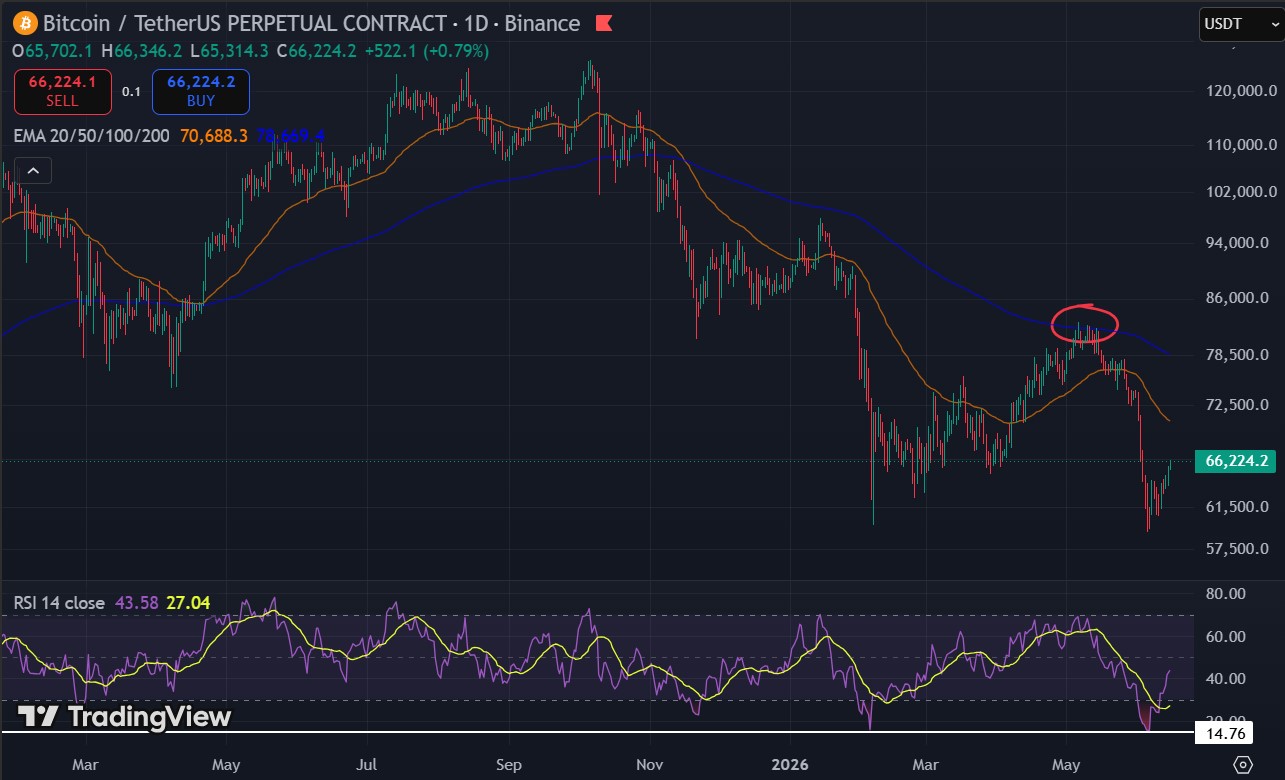
Bitcoin recovering to $66,234 after the RSI hit 14.76, the lowest reading since the COVID crash. The 50-day EMA at $70,700 is the first hurdle. The circled rejection at $82,000 is where the 200-day EMA at $82,000 turned price back in May. Source: TradingView
The Early June Collapse: By June 6, 2026, Bitcoin was trading at $61,268, below every major moving average on the daily chart. The 50-day EMA was at $74,000 and the 200-day at $74,032, with price trading well beneath both. The golden cross requires the 50-day to cross above the 200-day. By June 6, the 50-day was below the 200-day and price was below both. That is the opposite structure.
The Late May Setup: On May 27, when Bitcoin was trading at $75,886, global equities were sitting at record highs. For most of 2025, those two facts had moved in the same direction; when equities ran, Bitcoin had run harder. When they dropped in January 2026, Bitcoin dropped further. The correlation was tight enough at the time that traders had priced them as the exact same trade.
That changed in April. Equities recovered and kept climbing. Bitcoin recovered, stalled at $82,000, and is now sliding back to $75,886. The Nasdaq is up 19% year to date. Bitcoin is down 16%.
Right now it is not simple.
The Divergence
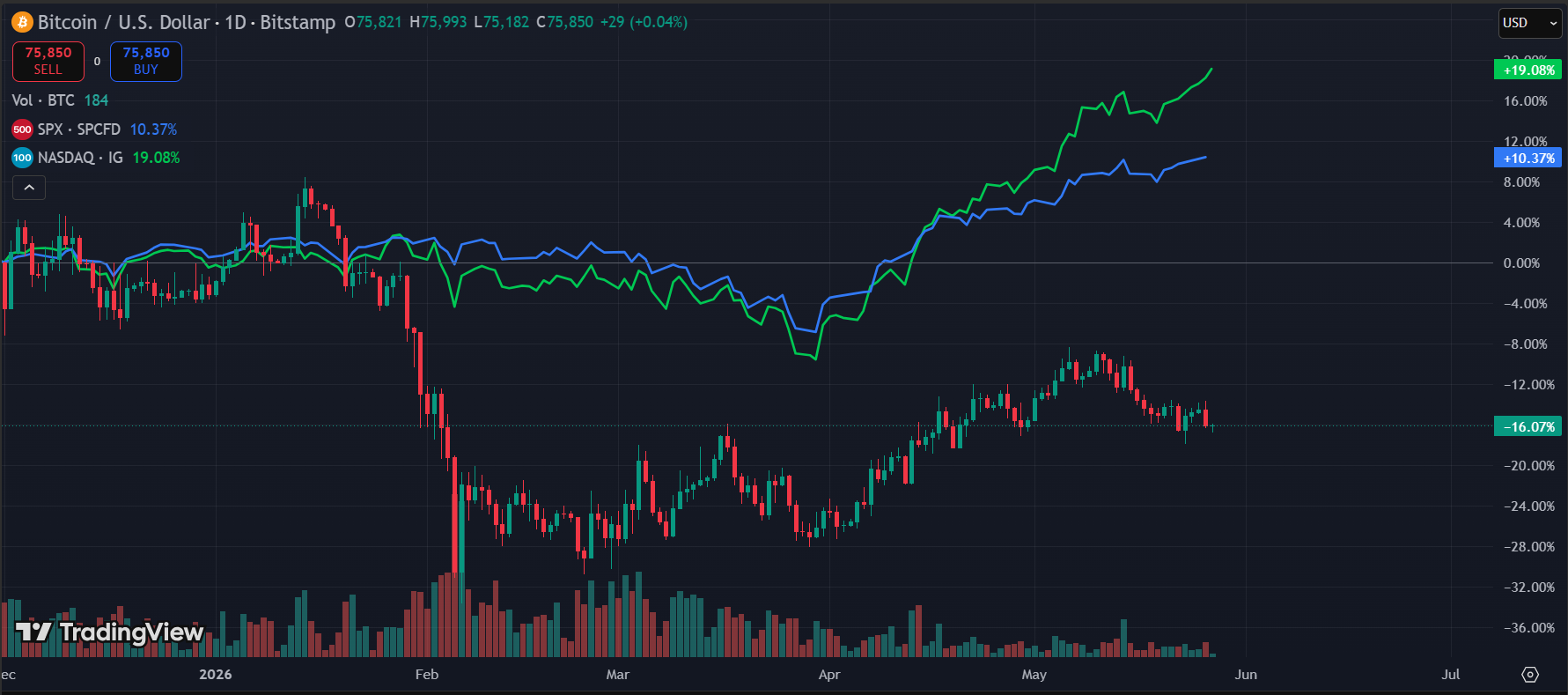
Bitcoin down 16% year to date while the Nasdaq is up 19.08% and the S&P 500 up 10.37% over the same period. Source: TradingView, May 27, 2026.
The Nasdaq and S&P 500 are hitting all-time highs in May 2026. The same macro environment that is pushing traditional risk assets to record levels is not lifting Bitcoin. BTC peaked at $126,000 in October 2025, dropped 52% to a low of roughly $60,000 in February, recovered to $82,000 in May, and is now pulling back to $75,886 while equity markets climb.
That is not a minor gap. That is a structural break in a relationship that investors have been pricing for years.
The correlation between Bitcoin and Nasdaq that defined the 2023 and 2024 bull runs has broken down. Capital that would historically rotate into crypto during a risk-on equity environment is not showing up. ETF inflows, which drove Bitcoin’s institutional adoption story, flipped to sustained outflows through much of May. A six-day outflow streak nearly erased all 2026 net inflows, leaving cumulative ETF flows at a fragile $536 million for the year.
Equities are partying. Bitcoin was not invited.
What the Chart Is Saying
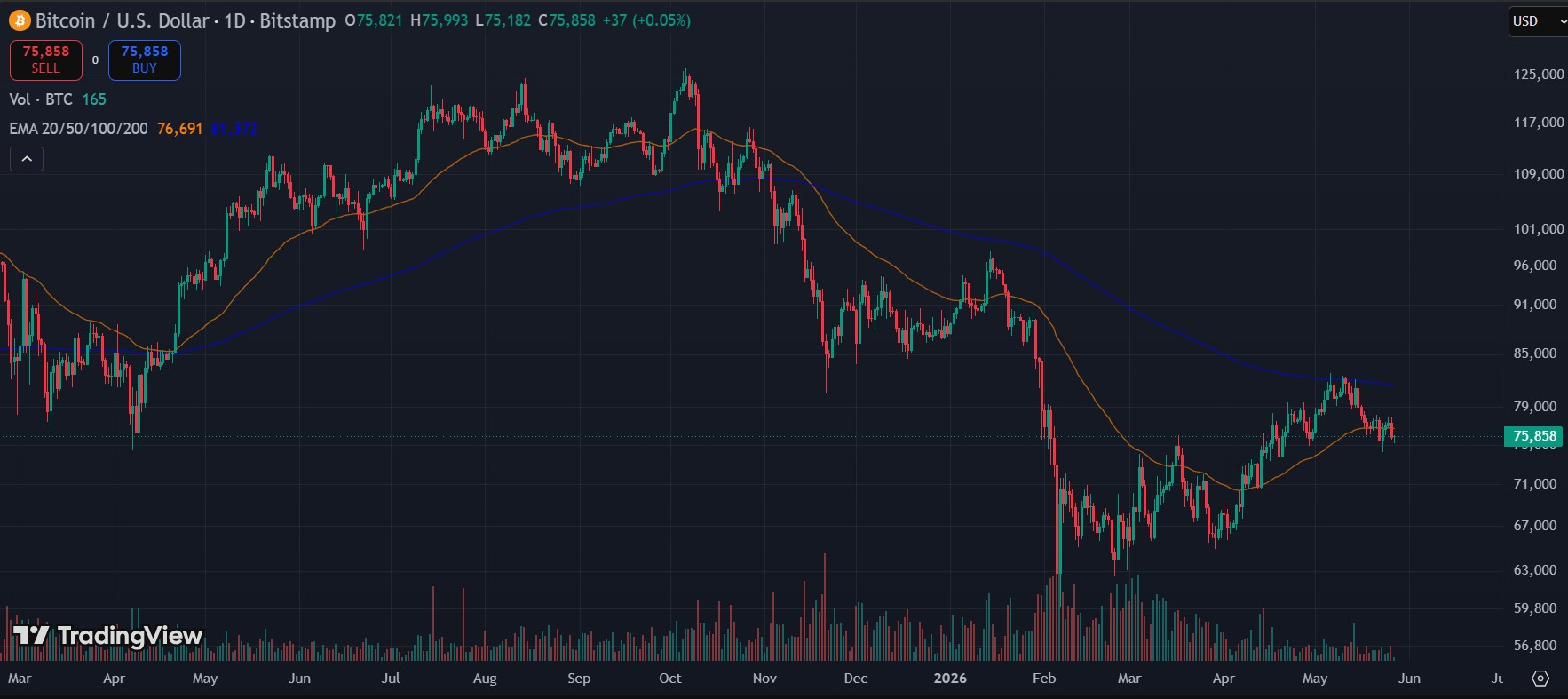
Bitcoin daily chart showing the 50 EMA (orange) at $76,691 converging toward the 200 EMA (blue) at $81,372 as BTC trades at $75,858. Source: TradingView
The daily chart tells a specific story. Bitcoin’s 50 EMA sits at $76,692 and the 200 EMA at $81,279. BTC at $75,886 is trading just below the 50 EMA, with both moving averages sloping down from above.
The one technically interesting development is that the 50 EMA and 200 EMA are converging. The 50 has been climbing since the April lows while the 200 has been slowly declining from the November 2025 peak. If that convergence continues, a golden cross, where the 50 crosses above the 200, becomes possible in the coming weeks. Traders are watching it. CoinDesk flagged it this morning.
But the golden cross does not change what the chart is showing right now. BTC is below both key EMAs in a bearish structure, trading at $75,886 while the assets it has historically tracked are making new all-time highs. A potential bullish signal weeks away does not explain today’s divergence.
Three Reasons the Old Correlation Broke
The first is ETF mechanics. Spot Bitcoin ETFs now hold roughly 6% of all Bitcoin in existence. When institutional investors redeem shares, authorized participants must sell actual Bitcoin into the market. That selling is mechanical and indiscriminate. It does not care whether equities are up or down. When the six-day outflow streak hit in May, that was real Bitcoin hitting the market regardless of what the Nasdaq was doing.
The second is the macro story specific to Bitcoin in 2026. The crash from $126,000 was not driven by crypto-specific failure. It was triggered by a tech stock selloff, unwinding of leveraged positions, and ETF outflows in January. Bitcoin followed equities down. But when equities recovered to record highs, Bitcoin did not follow them back up at the same pace. Something changed in the relationship on the recovery leg.
The third is gold. Since the start of 2026, gold has risen to $5,280 while Bitcoin has fallen roughly 40% from its peak. Capital that once rotated between gold and Bitcoin as competing macro hedges has been sitting in gold. The Iran conflict, the tariff environment, and global uncertainty measured by the World Uncertainty Index have all pushed capital toward bullion rather than digital assets. Bitcoin has not yet made the case that it belongs in the same conversation as gold during genuine geopolitical stress.
Why This Matters More Than the Golden Cross
The golden cross, if it forms, will generate headlines. Technically it signals that near-term momentum is overtaking longer-term momentum, which is broadly bullish. Traders will cite it. Influencers will post charts.
But the divergence from equities is the more important signal because it tells you something about what kind of asset Bitcoin is right now in the market’s eyes.
During the 2023 and 2024 bull runs, Bitcoin was treated as a high-beta risk asset. When institutional money wanted risk exposure, Bitcoin was one of the first things they bought. ETF inflows made that official. The narrative was that Bitcoin had graduated into the institutional portfolio as a liquid, accessible risk-on trade.
If that narrative were fully intact, Bitcoin would be at $90,000 right now following equities to record highs. It is not.
What the divergence suggests is that the institutional risk-on narrative is partially suspended. Investors who want risk exposure right now are finding it in equities, not Bitcoin. The ETF outflows confirm it. The correlation breakdown confirms it.
That does not mean the narrative is dead. Bitcoin has broken from equities before and reconnected. The $63,000 April low and the subsequent recovery to $82,000 showed genuine buying interest at lower levels. Long-term holder accumulation has continued through the entire drawdown. Institutional ETF inflows hit $2.44 billion in April, the strongest month of 2026, before the May reversal.
The structure is not broken. The timing is dislocated.
The Number That Matters Today
$74,000. That is the next meaningful floor below current price based on the April support structure. BTC holding above $75,886 keeps the recovery thesis intact. A break below $74,000 reopens the April lows at $63,000 and raises the question of whether the May recovery was a dead cat bounce rather than the start of a new leg.
The golden cross narrative and the equity divergence are pointing in opposite directions simultaneously. One says momentum is building. The other says the macro relationship that drove Bitcoin’s institutional adoption story is under stress.
Both can be true at the same time. That is what makes this specific moment in the cycle worth paying attention to.