

For years, buying Bitcoin meant wallets, seed phrases, hardware devices, and the constant anxiety that one wrong move could wipe out everything you owned. Then in January 2024, BlackRock walked into the ETF market and made it as simple as buying Apple stock.
A Bitcoin ETF is an investment fund that tracks the price of Bitcoin and trades on traditional stock exchanges like the NYSE or Nasdaq. No wallet, private keys, or crypto exchange account needed. Just a ticker symbol in your existing brokerage.
By 2026, spot Bitcoin ETFs had collectively crossed $100 billion in assets and survived their first real stress test, a 40% price crash during an active geopolitical conflict, with remarkably little panic. Understanding what Bitcoin ETFs are and how they work has never been more relevant.
- What is a Bitcoin ETF?
- Spot Bitcoin ETFs vs Bitcoin futures ETFs
- The major Bitcoin ETFs in 2026
- How a Bitcoin ETF actually works mechanically
- What happened in 2026: the first real stress test
- The advantages of Bitcoin ETFs
- The disadvantages of Bitcoin ETFs
- How to buy a Bitcoin ETF
- Bitcoin ETFs vs buying Bitcoin directly
- The bottom line
What is a Bitcoin ETF?
A Bitcoin ETF is a fund that holds Bitcoin as its underlying asset and issues shares that trade on regulated stock exchanges. When you buy shares of a Bitcoin ETF, you are buying a stake in a fund that owns Bitcoin on your behalf. You do not hold the Bitcoin directly. You do not need a crypto wallet, a private key, or an account on a cryptocurrency exchange.
The price of the ETF shares moves with the price of Bitcoin. If Bitcoin rises 5%, the ETF shares rise roughly 5%. If Bitcoin falls, the ETF falls with it.
Bitcoin ETFs trade during standard stock market hours, appear in brokerage accounts alongside stocks and bonds, and are subject to the same SEC regulatory oversight as any other listed investment product. For investors who already use a brokerage account, adding Bitcoin exposure requires nothing more than buying shares of an ETF, the same way they would buy shares of Apple or an S&P 500 index fund.
Spot Bitcoin ETFs vs Bitcoin futures ETFs
There are two types of Bitcoin ETFs and the difference matters significantly.
Spot Bitcoin ETFs hold actual Bitcoin. The fund manager, BlackRock, Fidelity, or one of the other approved issuers, purchases real Bitcoin and stores it in secure custody, typically offline in cold storage. Each share of the ETF represents a proportional ownership of that Bitcoin. The price tracks Bitcoin’s spot market price directly.
Bitcoin futures ETFs do not hold Bitcoin. Instead, they hold futures contracts, which are agreements to buy or sell Bitcoin at a specific price on a future date. The ProShares Bitcoin Strategy ETF (BITO), launched in October 2021, was the first Bitcoin ETF approved in the US and it used futures contracts. The problem with futures ETFs is a phenomenon called contango, where futures prices are higher than spot prices, which creates a gradual drag on returns as contracts are rolled over each month. Futures ETFs consistently underperform the actual Bitcoin price over time.
The January 2024 SEC approval of spot Bitcoin ETFs was significant precisely because it eliminated this drag. Spot ETFs track Bitcoin’s actual price rather than an approximation of it.
For most investors, spot Bitcoin ETFs are the superior product.
The major Bitcoin ETFs in 2026
Following the January 2024 SEC approval, eleven spot Bitcoin ETFs launched in the United States. The largest by assets as of 2026:
BlackRock iShares Bitcoin Trust (IBIT) is the dominant product, having crossed $100 billion in assets faster than any ETF in history. BlackRock’s institutional relationships and distribution network made IBIT the default choice for financial advisers and institutional allocators.
Fidelity Wise Origin Bitcoin Fund (FBTC) is the second largest, notable for being one of the few ETFs that custodies its own Bitcoin directly rather than using a third party custodian.
ARK 21Shares Bitcoin ETF (ARKB) combines Cathie Wood’s ARK Invest with Swiss crypto specialist 21Shares.
Bitwise Bitcoin ETF (BITB) from Bitwise, one of the original crypto index fund managers, runs a transparent proof of reserves model where the Bitcoin holdings can be verified on-chain.
Grayscale Bitcoin Trust (GBTC) converted from a closed-end trust to a spot ETF in January 2024, though its higher fee structure of 1.5% annually compared to 0.12% to 0.25% for competitors led to significant outflows following conversion.
How a Bitcoin ETF actually works mechanically
Understanding the creation and redemption mechanism explains why ETF prices stay close to the underlying Bitcoin price rather than diverging significantly.
When institutional investors called authorized participants want to create new ETF shares, they deliver cash to the fund manager who uses it to buy Bitcoin. New shares are issued representing that Bitcoin. When authorized participants want to redeem shares, they return shares to the fund and receive cash back, with the fund selling Bitcoin to fund the redemption.
This creation and redemption process keeps the ETF price aligned with the net asset value of the underlying Bitcoin. If the ETF trades at a premium to its Bitcoin holdings, authorized participants buy Bitcoin and create shares to profit from the difference, pushing the price back down. If it trades at a discount, they buy ETF shares and redeem them for Bitcoin, pushing the price back up.
The result is that spot Bitcoin ETFs track Bitcoin’s price with minimal deviation, unlike the old Grayscale Bitcoin Trust which traded at premiums and discounts of 40% or more because it lacked this mechanism before its ETF conversion.
What happened in 2026: the first real stress test
The 2026 US-Iran conflict and its associated oil shock provided the first serious test of how Bitcoin ETF investors behave under pressure. The results were revealing.
Bitcoin fell approximately 40% from its October 2025 high of $126,000 to a low around $63,000 in the early weeks of the Iran war. Every previous major drawdown had seen significant ETF outflows as retail and institutional investors sold under pressure.
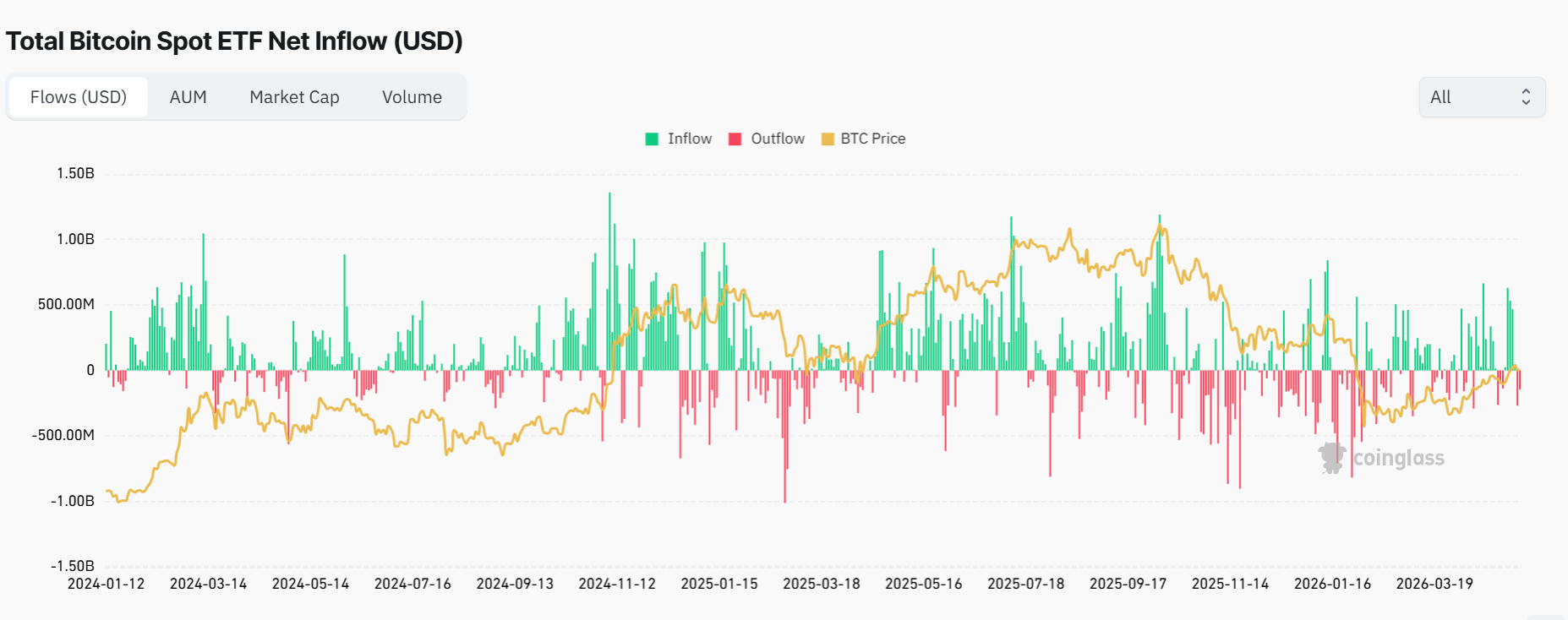
Total Bitcoin Spot ETF Net Inflow (USD) – Source: Coinglass
This time was different. Bloomberg ETF analyst Eric Balchunas noted that only 6.6% of Bitcoin ETF assets exited during the drawdown, compared to roughly one third of gold ETF assets that fled during a comparable gold drawdown a decade earlier. March 2026 saw $2.5 billion in net Bitcoin ETF inflows despite the price being down 40% from its peak and despite an active geopolitical conflict driving oil above $100.
Morgan Stanley filed for its own spot Bitcoin ETF during this period. Strategy, formerly MicroStrategy, authorized another $42 billion in Bitcoin purchases. The institutional infrastructure around Bitcoin expanded rather than contracted during the worst price environment in over a year.
According to André Dragosch, Head of Research at Bitwise Europe, as of October 2025 global Bitcoin ETPs and public companies had acquired 944,330 Bitcoin — equivalent to 7.4 times the entire new supply of Bitcoin mined that year.
🔥OFFICIAL: Funds & Public Companies have now bought more bitcoins in 2025 than in 2024!
As of 08/10/2025, global bitcoin ETPs & public companies have acquired 944,330 bitcoins which is equivalent to
*checks notes*
7.4 x times the new supply of bitcoins in 2025.
HUGE! pic.twitter.com/zwvwwp8Brb
— André Dragosch, PhD⚡ (@Andre_Dragosch) October 8, 2025
.
The 2026 stress test answered a question that had been theoretical since the ETF launch: when Bitcoin falls 40%, do ETF investors sell or hold? The answer was overwhelmingly hold, and in many cases buy more.
The advantages of Bitcoin ETFs
No self-custody required. Holding Bitcoin yourself means managing private keys and wallets. Losing access to your keys means losing your Bitcoin permanently. ETF investors bear none of this risk. The fund custodian manages security.
Brokerage account compatibility. Bitcoin ETFs appear in standard brokerage accounts, IRAs, and 401k plans where Bitcoin cannot be held directly. This makes Bitcoin accessible to retirement savers and investors whose accounts are limited to listed securities.
Regulatory oversight. Bitcoin ETFs are SEC-regulated products. Investors have recourse through standard financial regulatory channels that do not exist when holding Bitcoin on a cryptocurrency exchange.
Tax simplicity. ETF transactions generate standard brokerage tax forms. Direct Bitcoin trading requires tracking cost basis across potentially hundreds of transactions.
Institutional credibility. For fiduciaries, pension funds, and advisers with regulatory obligations, a BlackRock or Fidelity product provides a level of institutional credibility that holding Bitcoin directly on a crypto exchange does not.
The disadvantages of Bitcoin ETFs
Management fees. Bitcoin ETFs charge annual fees ranging from 0.12% for some competitive products to 1.5% for Grayscale’s GBTC. Holding Bitcoin directly on a hardware wallet costs nothing annually beyond the one-time hardware purchase.
No self-custody or sovereignty. The fund holds your Bitcoin. If the fund manager, custodian, or exchange faces problems, your assets are exposed to counterparty risk. Bitcoin’s core value proposition, that you and only you control your money, does not apply to ETF investors.
Trading hour restrictions. Bitcoin trades 24 hours a day, 7 days a week. Bitcoin ETFs trade only during standard stock exchange hours. Significant Bitcoin price moves over weekends or outside trading hours cannot be acted on until markets open.
No yield or utility. You cannot use ETF shares to interact with DeFi protocols, send value internationally, or participate in the Bitcoin network. ETF shares are purely a price exposure instrument.
Tax treatment. Depending on jurisdiction, ETF gains may be subject to different tax treatment than direct Bitcoin holdings. Consult a tax professional for your specific situation.
How to buy a Bitcoin ETF
Bitcoin ETFs are available through any brokerage account that offers access to US listed securities. Search for the ticker symbol of the ETF you want to purchase, IBIT for BlackRock, FBTC for Fidelity, ARKB for ARK 21Shares, BITB for Bitwise, and buy shares the same way you would buy stock.
Key factors to compare before choosing an ETF:
Expense ratio. This is the annual fee expressed as a percentage of assets. Lower is better for long-term holders. IBIT charges 0.25%, FBTC charges 0.25%, BITB charges 0.20%.
Assets under management. Larger funds have better liquidity and tighter bid-ask spreads. IBIT’s dominant size makes it the most liquid option.
Custodian. Most funds use Coinbase Custody. Fidelity custodies its own Bitcoin. Understanding who holds the underlying Bitcoin matters for counterparty risk assessment.
Issuer reputation. BlackRock and Fidelity bring institutional track records. Newer or smaller issuers carry more operational uncertainty.
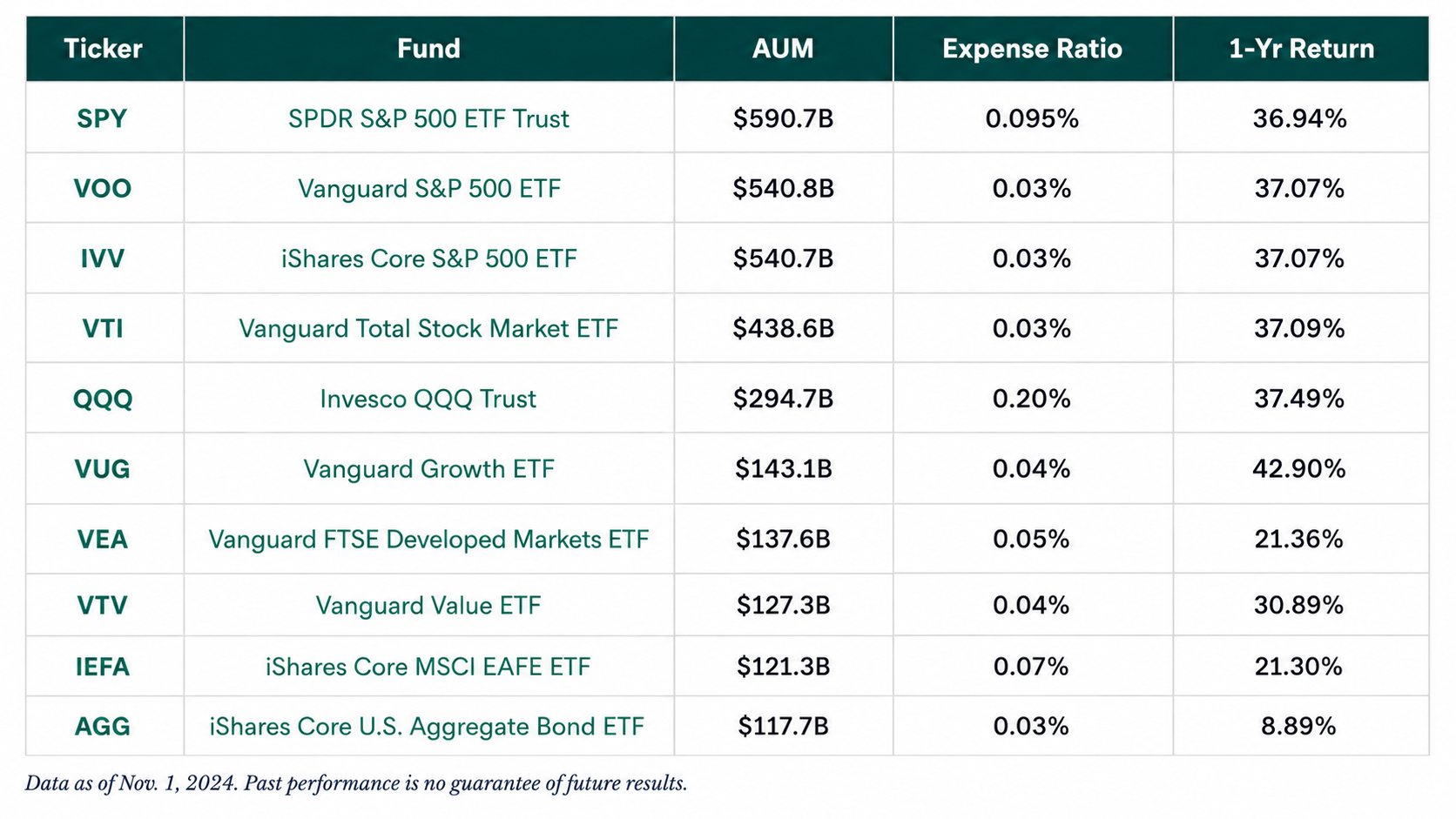
Most Popular ETFs by AUM Source: Etf.com
Bitcoin ETFs vs buying Bitcoin directly
The right choice depends on what you value.
Choose a Bitcoin ETF if you want simplicity, brokerage account compatibility, no self-custody responsibility, and access through tax-advantaged accounts like IRAs. The ETF structure suits investors who want Bitcoin price exposure without engaging with crypto infrastructure.
Choose direct Bitcoin ownership if you value sovereignty, zero counterparty risk, 24/7 trading access, participation in the Bitcoin network itself, and no annual management fees. Direct ownership requires engaging with a cryptocurrency exchange and managing your own security, but gives you genuine ownership of an asset that no fund manager can restrict or freeze.
Both approaches give you exposure to Bitcoin’s price. Only one gives you the properties that make Bitcoin unique.
The bottom line
Bitcoin ETFs did not water down Bitcoin. They opened a door that was previously closed to the vast majority of investors: retirees, pension funds, financial advisers, anyone operating inside traditional financial infrastructure.
BlackRock’s IBIT crossed $100 billion in assets faster than any ETF in history. When Bitcoin fell 40% in early 2026, ETF investors held. Morgan Stanley filed for their own product. Institutions bought more.
That is not speculation anymore. That is a track record.
If you want Bitcoin exposure inside a brokerage account, an IRA, or a 401k, spot ETFs from BlackRock or Fidelity are the most straightforward way to get it. If you want the real thing, with full sovereignty and zero counterparty risk, only self-custody delivers that.
Both are legitimate choices. Just know which one you are actually making.
This article is for informational purposes only and does not constitute financial advice.