
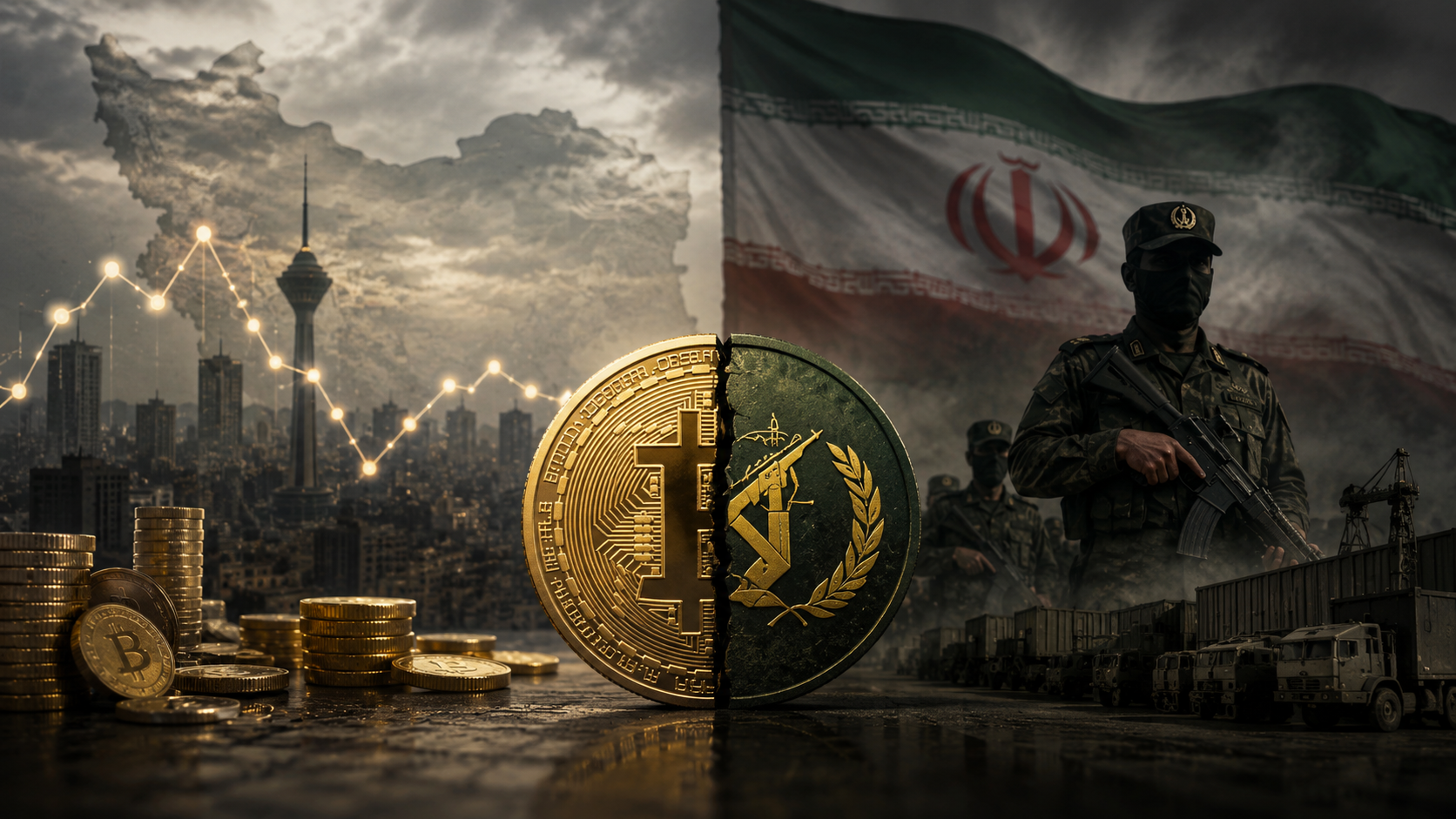
The Islamic Revolutionary Guard Corps controlled nearly 50% of Iran’s entire crypto economy in the fourth quarter of 2025. Chainalysis tracked $3 billion in IRGC-linked wallet activity for the full year. Their senior intelligence analyst described that figure as a lower-bound estimate based solely on publicly available data.
The real number is higher. Nobody knows how much higher.
This is not a sanctions evasion story. Every outlet covering the Chainalysis interview framed it that way. Kaitlin Martin, the analyst who conducted the research, buried the more important point in a single sentence: “the line between the military and a financial institution blurs.”
That line is not a closing thought. It is the entire story.
What Chainalysis Actually Found
Martin told BeInCrypto that Iran has developed a “vibrant” cryptocurrency economy as a direct result of sweeping international sanctions that cut off access to major global exchanges. Domestic Iranian exchanges have seen significant growth and high trading volumes in recent years.
The IRGC did not just participate in that growth. It consumed it. By Q4 2025, IRGC-linked wallets were processing roughly half of every crypto transaction in the country. A military wing built to project force and fund proxy operations across the Middle East now runs what amounts to a parallel central bank for a sanctioned nation of 90 million people.
The $3 billion figure covers only what Chainalysis could see. Blockchain analytics firms work from publicly identifiable wallet clusters. IRGC operational security has been improving for years. The wallets they cannot identify are not counted. Martin said explicitly the true scale is likely higher.
Stablecoins Are Doing the Work. Not Bitcoin.
We wrote in April that Iran’s Hormuz toll system accepted stablecoins and yuan, not Bitcoin. The operational logic was clear then. Stablecoins offer dollar-peg stability for large transactions, fast settlement, and minimal footprint compared to wire transfers. A $2 million payment in Bitcoin on a volatile day is a risk no toll operator wants to absorb.
The Chainalysis data confirms this at scale. US Treasury OFAC sanctions records and Israeli counter-terror seizure orders, more than 100 wallets seized by the National Bureau for Counter-Terror Financing of Israel, all show stablecoins as the primary instrument. Regulatory filings show Iran using stablecoins for trade and procurement. Martin was direct: “We do know in fact that the Iranian regime is using stablecoins.”
The stablecoin kill switch problem we identified in April has not been resolved. Circle can freeze USDC. Tether has frozen wallets dozens of times at law enforcement request. The entire stablecoin infrastructure sits within reach of OFAC. The IRGC is betting on operational speed, move the funds before the freeze arrives, rather than long-term resilience.
That bet has a shelf life. Martin acknowledged it: “I think that there is a place for Bitcoin in its use by regime actors as well as ordinary Iranians. But when we’re talking about a potential toll being collected, when we’re talking about trade being conducted at scale, stablecoins offer an attractive option.”
Stablecoins now. Bitcoin when the freeze pressure succeeds.
The Hormuz Toll System Is the Latest Layer
Iran’s Persian Gulf Strait Authority became operational this month. Ships pay up to $2 million per crossing. The PGSA does not publish official tariffs. It does not need to. Compliance is already happening.
The Chainalysis data gives that system its financial context. The IRGC that is collecting Hormuz tolls is the same organization that processed $3 billion in tracked crypto volume in 2025 and controlled half of Iran’s entire digital asset economy by year end. The toll system is not a new operation. It is an extension of existing infrastructure that has been building for years.
Martin framed the trajectory clearly: “We are really seeing nation states begin to integrate crypto into their financial instruments, into their financial rails, layer it with their traditional financial movements of funds.”
The IRGC tracked footprint grew from $2 billion to $3 billion in a single year. With the Hormuz toll now operational and processing real transactions, that trajectory accelerates.
What a Military Becoming a Bank Actually Means
The BeinCrypto article ended with the most important sentence and did nothing with it. The line between the military and a financial institution blurs.
That blurring is not accidental and it is not new. It is the logical endpoint of a decade of sanctions pressure on a state that refused to comply. Cut a country off from SWIFT, from correspondent banking, from dollar clearing, and its military apparatus does not sit idle. It builds replacement infrastructure. The IRGC built crypto rails because that was the only rail left.
What exists now in Iran is something the sanctions architecture was not designed to handle. Not a rogue actor using crypto to move money. A military organization that has become the dominant financial intermediary for an entire national economy, processing half of all crypto transactions, running toll collection at the world’s most critical energy chokepoint, and doing all of it outside every dollar-denominated system the US Treasury can reach.
OFAC can freeze wallets. It cannot freeze a blockchain. It can pressure Circle and Tether. It cannot pressure Bitcoin. The Chainalysis data shows the current system built on stablecoins. The progression Katlin Martin described points toward the system that replaces it when that pressure succeeds.
That system runs on Bitcoin. And Iran already knows how to mine it.