


ZEC crossed $1,000 on September 4 for the first time in its history. It touched $1,023 on Coinbase before settling back toward $1,001. Volume spiked to $1.2 billion in 24 hours. Roughly $34.5 million in short positions were liquidated as bearish traders got forced out and their buybacks added fuel to a move that had already started running.
We wrote about Grayscale’s fifth amendment filing on August 22 and flagged the regulatory paradox: the SEC was reviewing an ETF for an asset whose core technical feature is defeating the surveillance mechanisms the SEC relies on to approve ETFs. Three days later, the SEC let it through. Grayscale converted its nine-year-old Zcash Trust into the ZCSH spot ETF on NYSE Arca on August 25, the first US-listed spot ETF for a privacy coin. It launched with $304 million in AUM and has since grown past $414 million.
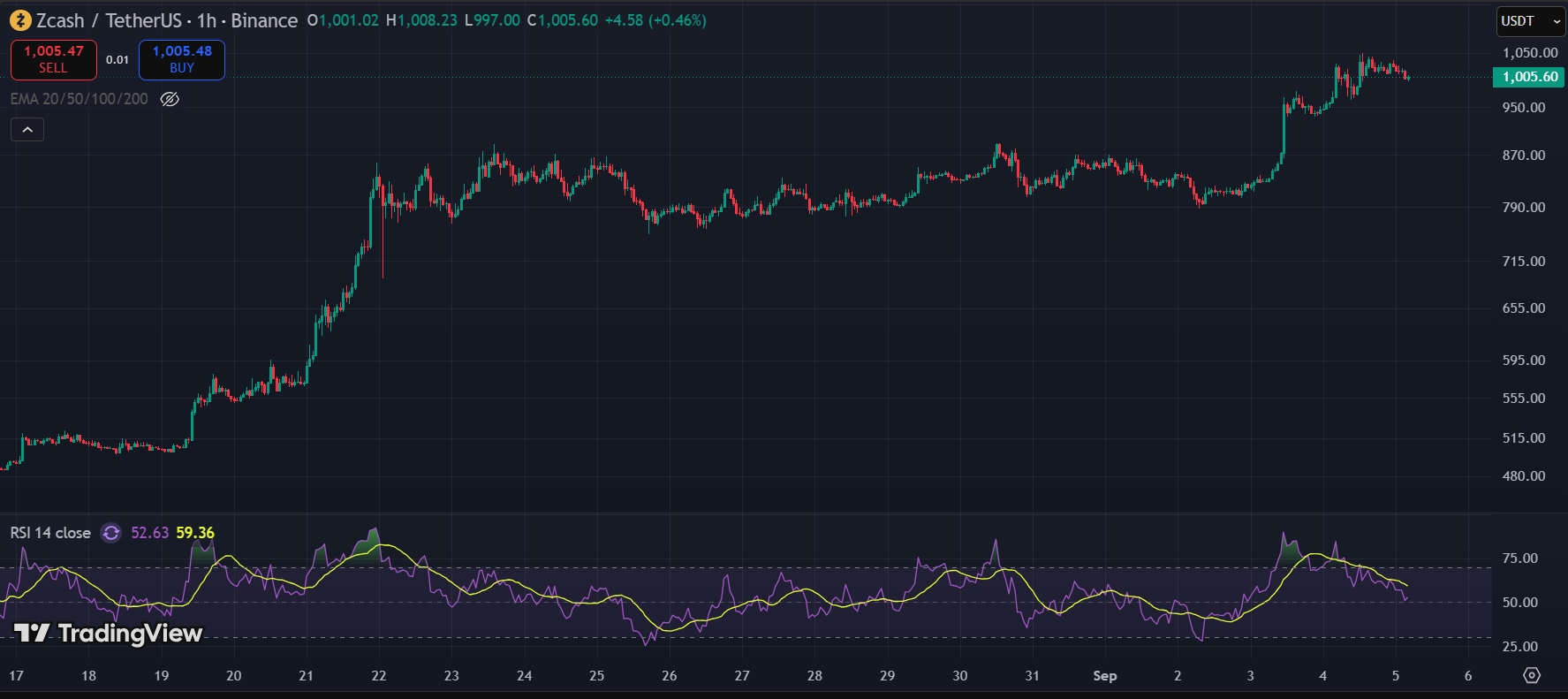
ZEC ran from $480 to above $1,000 in three weeks. The first leg on August 19 to 22 was the ETF filing. The second spike on September 3 to 4 was the ETF launch plus short liquidations. RSI has cooled to 59 after touching overbought levels during both moves. Source: Tradingview
What the Chart Is Saying
The move from $450 in early August to $1,001 today is a 122% gain in roughly four weeks. The chart shows three distinct phases.
The first leg ran from $450 to $850 between August 19 and 22, driven by the ETF filing news and the broader market short squeeze that sent Bitcoin toward $80,000 the same week. That move was partly sympathy, partly genuine ZEC-specific buying.
The second phase was consolidation. ZEC held between $840 and $920 for ten days while the ETF actually launched and the market decided whether the product had real demand. ETF inflows answered that question, $34.4 million in net inflows since August 25, which is not enormous by Bitcoin ETF standards but is real institutional buying for a privacy coin that most exchanges delisted over the past three years.
The third phase is today. ZEC broke above the $920 to $950 resistance zone, triggered $34.5 million in short liquidations, and printed $1,023. The 20-day EMA at $967 has now crossed above the 200-day, which is the technical confirmation that the trend has shifted from the grinding recovery that ran from $200 in March to the current breakout structure.
The daily RSI is close to 80. The four-hour RSI is around 70. Both are in overbought territory, which does not mean the move is over but does mean the easy money from this specific breakout has been made. A hold above $1,000 on a daily close would set up the next attempt at $1,045 to $1,055. A failure to hold $1,000 brings $935 to $955 back into play as the first support.
What the Fundamentals Are Actually Saying
ZEC is up 2,300% year over year from roughly $42 in September 2025. That is not a technical story anymore. That is a repricing of an asset that the market spent three years treating as unlistable.
The facts that made the repricing possible arrived in sequence. A nearly two-year SEC investigation into the Zcash Foundation closed in January 2026 with no enforcement action. That cleared the regulatory path that Monero has never received. Grayscale filed five amendments to convert the trust, each one narrowing the SEC’s objections. The fifth amendment landed August 21. The ETF launched August 25. ZEC crossed $1,000 on September 4.
The shielded pool now holds over 30% of all ZEC supply, valued above $1 billion. Shielded transactions account for 59.3% of all network activity. Both numbers are rising, which means the people who are actually using Zcash are using the private part of it, not treating ZEC as a transparent blockchain with extra features. That is the product working as designed.
The mining side is also responding. Solrate climbed from around 25 GSol/s in late August to above 30 GSol/s as new hardware came online chasing the higher ZEC price. Miner profitability has tightened as a result. A Bitmain Antminer Z15 Pro is currently generating an estimated $708 in gross revenue per MWh, slightly below the $727 it generated when ZEC was below $900. More hashrate competing for the same block rewards is what a healthy, growing network looks like.
The Question the Approval Actually Raises
The SEC approved Bitcoin ETFs in January 2024 by citing sufficient market surveillance mechanisms. Zcash’s shielded transactions exist precisely to defeat surveillance mechanisms. The agency approved the ZEC ETF anyway, using Coinbase Custody and transparent addresses to hold the underlying asset even though the asset itself is designed to make on-chain activity invisible.
That is a workable solution for the ETF structure. It is also a quiet acknowledgment that the agency’s surveillance argument for Bitcoin was always about custody and pricing, not about being able to track every transaction on the network.
If ZEC qualifies, the template exists for Dash, for Grin, and potentially for Monero if Monero’s developers were willing to build a compliant custody structure around it. Monero is not currently listed on Coinbase or Binance. ZEC is, and that exchange accessibility is one reason AI analysts are projecting ZEC will finish 2026 as the leading privacy coin by market cap ahead of XMR.
The question is not whether the SEC made a mistake. The question is whether approving a privacy coin ETF while framing it as a surveillance-compatible product is a distinction that holds up over time, or whether it is a door that, once opened, cannot be closed selectively.
ZEC at $1,001 means the market has already decided it does not care about that question right now. The chart agrees. Whether the regulators who approved this will agree in three years is a different conversation.