


Wallet 0xcf6 deposited $27,950 in early April. It is now sitting on nearly $3 million.
The trade was not complicated. The wallet bought leveraged longs on Micron and Intel stock perps on Hyperliquid, held through the AI chip rally, and did not blink. The Micron position alone shows $1.96 million in unrealized gains. Intel adds another $1.01 million. Both positions remain open.
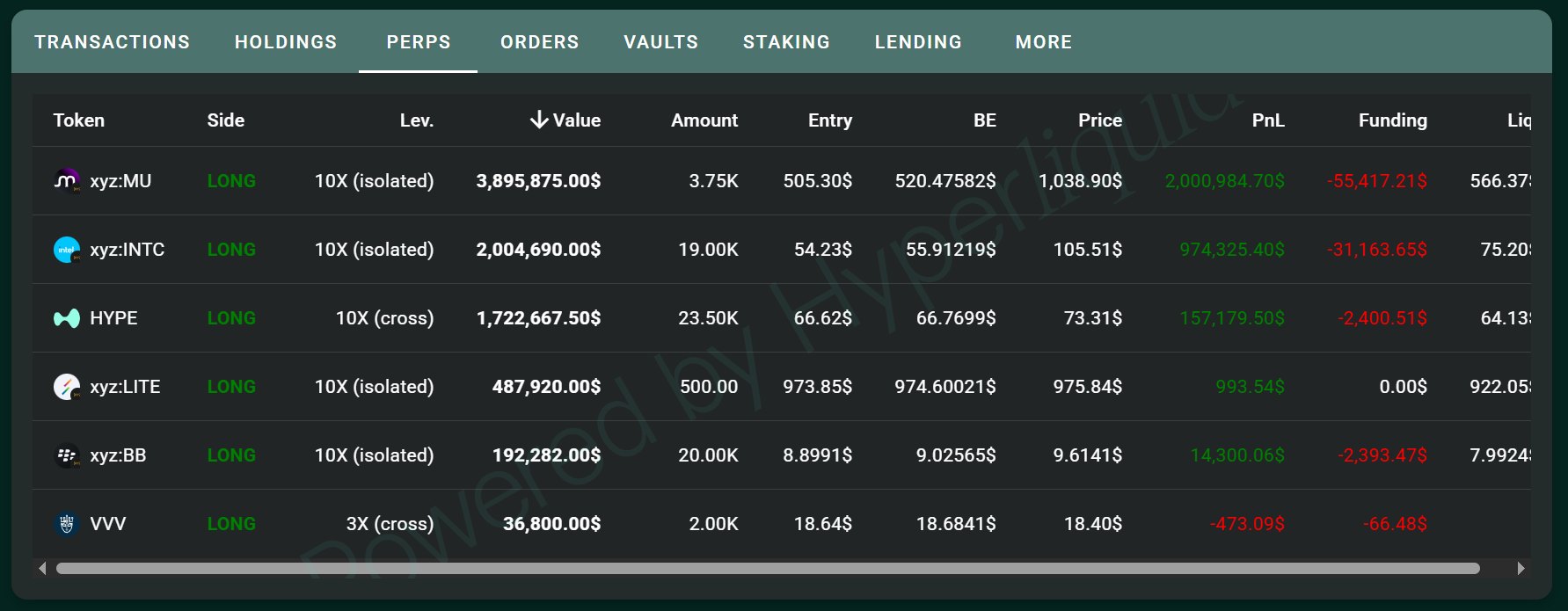
Wallet 0xcf6 perps positions showing $2 million unrealized gain on xyz:MU (Micron) at 10X leverage and $974,325 on xyz:INTC (Intel). Total position value across semiconductor stock perps exceeds $5.9 million. Source: hypurrscan.io
What Actually Happened Here
The wallet bought stock perps. Not Micron shares. Not an ETF. Perpetual futures contracts that track Micron’s price, settle in USDC, carry no shareholder rights, require no brokerage account, no KYC, no clearing house, no T+2 settlement. The position opened and closed on a blockchain. The profit settled in stablecoin.
A pseudonymous wallet just ran a $28,000 semiconductor bet to $3 million using the same market structure that Wall Street uses — leverage, derivatives, directional equity exposure — except the infrastructure was a decentralised exchange with an 11-person team and no venture capital backing.
That is not a crypto story. That is a market structure story.
The Survivorship Bias Nobody Is Accounting For
Most Hyperliquid traders lose money over time.
The wallet 0xcf6 story gets written because it won. The hundreds of wallets that opened leveraged Micron longs in April and got the timing wrong, or held through a bad week and got liquidated, do not get written because their stories end at zero. The architecture that made the $3 million possible is the same architecture that erased those wallets without ceremony.
Another trader built $42.2 million on perps over 10 months, then lost it all and an additional $5.19 million in 18 days shorting HYPE.
The democratisation is real. So is the liquidation engine.
What Hyperliquid Actually Built
Hyperliquid’s HIP-3 framework, which went live in October 2025, allows third-party developers to spin up perpetual futures markets for any asset on top of Hyperliquid’s infrastructure. Trade.xyz was the first to deploy under HIP-3, launching 24/7 perpetual markets for Tesla, Apple, Nvidia, Amazon, and a synthetic Nasdaq index.
As of May 21, 2026, Hyperliquid’s open interest in real-world asset perpetual futures reached a record $2.65 billion, doubling in roughly two months. HIP-3 now drives over 35% of all Hyperliquid trading volume. The platform processed $2.9 trillion in perpetual futures volume in 2025 and generated $800 million in revenue.
This is not a niche DEX. It is the largest decentralised perpetuals exchange on earth, and it is eating equity derivatives volume.
The Access Problem It Solves
To trade Micron with leverage through traditional infrastructure, you need a margin account, a broker, a jurisdiction that allows it, days for settlement, and markets that close on weekends.
On Hyperliquid: a crypto wallet and USDC. Open 24 hours. Seven days a week. Accessible from anywhere with an internet connection. The stock perps track real share prices but settle in USDC and carry no shareholder rights.
That distinction matters legally. It does not change what wallet 0xcf6 actually did: identified a semiconductor trade, sized it with leverage, and made $3 million from $28,000 in two months.
A retail investor in Lagos, Karachi, or Tirana could have made that exact trade. Not because they found a loophole. Because Hyperliquid built infrastructure that does not require permission from the financial system to use.
Why This Is Bigger Than One Wallet
Tokenized stocks today are where stablecoins were in 2020, around 0.001% of their underlying market, growing exponentially, with the regulatory framework just being drawn.
The SEC is finalising its Innovation Exemption for tokenised securities. Nasdaq already has SEC approval for tokenised stock trading. The DTCC begins facilitating tokenised production trades in July 2026. What wallet 0xcf6 used to make $3 million on Micron is not a grey market workaround. It is the prototype for what regulated equity markets look like in five years.
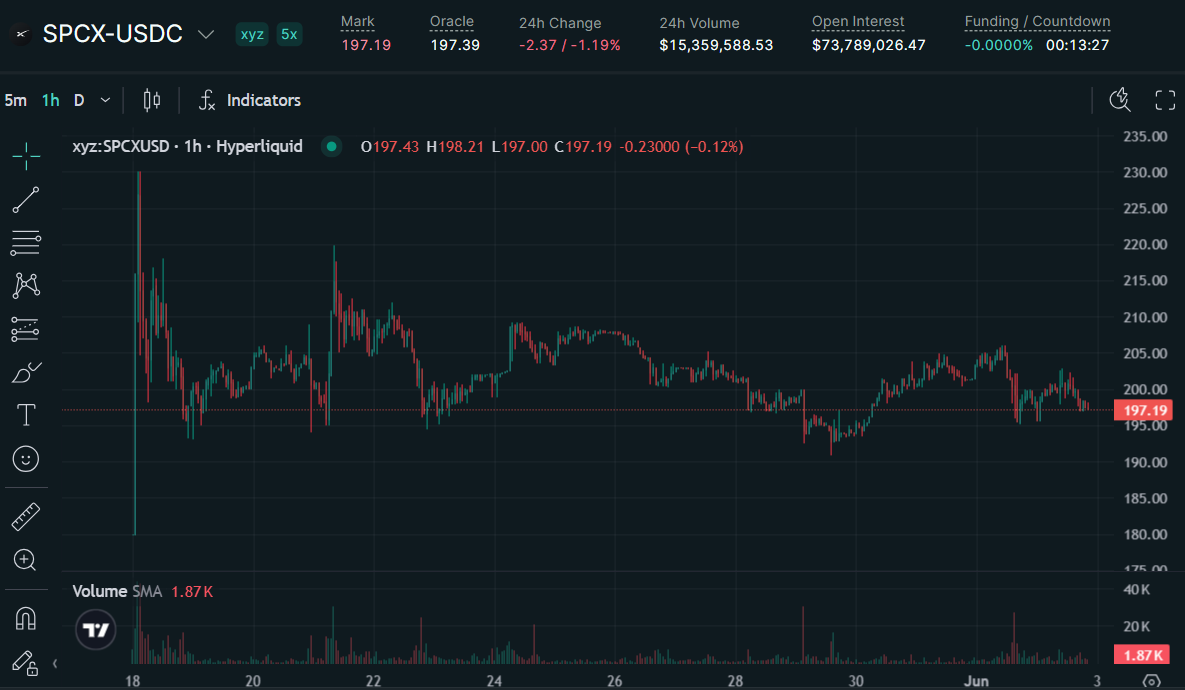
SpaceX perpetual futures trading live on Hyperliquid at $197.19, with $73.7 million in open interest. Available to anyone with a crypto wallet before SpaceX has gone public on any traditional exchange. Source: Hyperliquid
Hyperliquid is already offering pre-IPO trading for SpaceX, before the company goes public, before most retail investors can access it through any traditional channel.
The brokerage account was the gatekeeper. It is being disintermediated in real time.
An 11-person team with no venture capital built it in three years. Wallet 0xcf6 made $3 million on it in two months. The story is not the wallet. The story is what the wallet tells you about where markets are going.
Hyperliquid currently restricts US users. Leveraged perpetuals carry liquidation risk including total loss of capital. Nothing here is financial advice.