
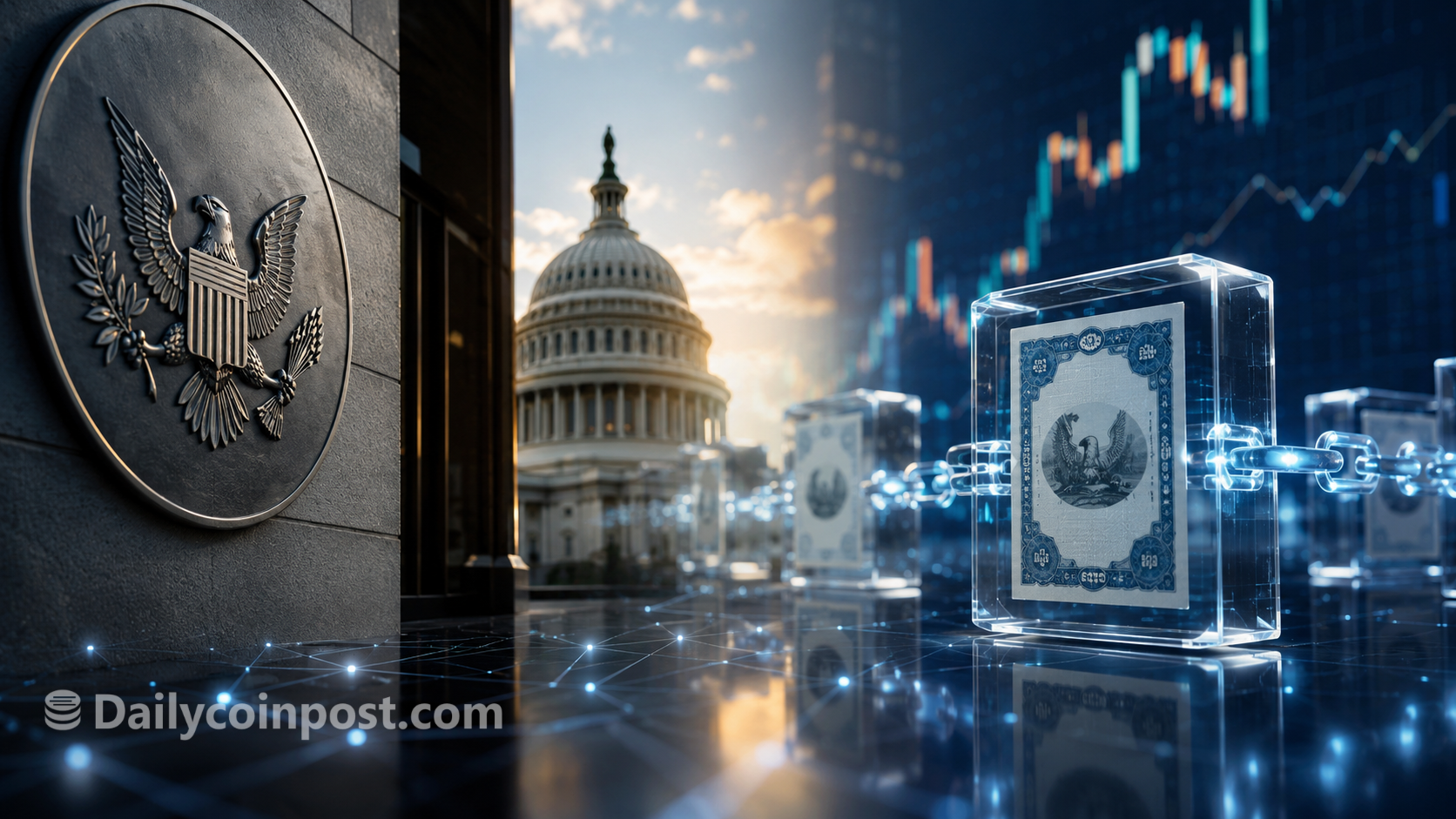
Apple. Tesla. Amazon. Tradeable on-chain, 24 hours a day, 7 days a week, by anyone on earth with a crypto wallet. No brokerage account. No clearinghouse. No settlement delay. Instant.
That is not a crypto dream. That is what the SEC is preparing to greenlight this week.
Bloomberg reports the Innovation Exemption framework could drop as soon as the next few days. Here is why it matters more than anything else that has happened in crypto regulation this year.
JUST IN: 🇺🇸 SEC prepares to allow blockchain-based tokenized stock trading.
— Watcher.Guru (@WatcherGuru) May 18, 2026
What the SEC Is Actually Doing
SEC Chair Paul Atkins has been telegraphing this for months. Speaking at the Economic Club of Washington in April he said the agency is “on the cusp of releasing” a framework allowing tokenized securities to trade directly on blockchain networks for the first time under formal regulatory cover.
The framework is a 12 to 36 month regulatory sandbox. Qualified firms can issue and trade tokenized securities on-chain without full SEC registration, subject to volume caps, KYC and AML requirements, and periodic reporting. Trading can occur on DeFi automated market makers and permissionless public blockchains. After the sandbox period, firms must come into full compliance or demonstrate sufficient decentralization.
The infrastructure was already being built while the exemption was being drafted. The New York Stock Exchange is developing a tokenized securities platform. Nasdaq already has SEC approval to support tokenized share trading. The Depository Trust Company is running a blockchain settlement pilot. BlackRock’s BUIDL tokenized fund hit nearly $3 billion and was accepted as collateral on Binance. The rails exist. The SEC is now saying the trains can run.
Why This Is Bigger Than the CLARITY Act
The CLARITY Act defines which crypto assets are commodities and which are securities. Enormous. The market rallied hard when it cleared the Senate Banking Committee 15-9.
The Innovation Exemption is a different animal. It does not just regulate existing crypto assets. It brings the entire US equity market onto blockchain rails.
An investor anywhere in the world could hold a tokenized Apple share or US Treasury bond with the same ease as a fund manager in New York. Settlement happens in seconds. Fractional ownership becomes trivially simple. Atkins said it plainly: “A stock remains a stock, whether represented on paper, through a DTCC entry, or as a blockchain token.”
What This Means for Crypto Infrastructure
This is the regulatory story that vindicates every DeFi infrastructure play of the past three years.
Hyperliquid built a decentralized exchange running faster than any traditional venue. We covered the 21Shares HYPE ETF launch and what it means that a DEX with 11 employees and $880 million in annual fees is getting institutional recognition. A framework allowing tokenized equities to trade on DeFi AMMs and permissionless blockchains legitimizes exactly what Hyperliquid, Uniswap and others built. They built the rails. The SEC just confirmed the trains are coming.
The Kevin Warsh Factor
Kevin Warsh took over the Federal Reserve on May 14. We argued Bitcoin-friendly and Bitcoin-bullish are not the same thing and that his QT for Cuts framework creates real uncertainty.
The Innovation Exemption shifts part of that calculation. A Fed chair who backed DeFi derivatives and a SEC chair greenlighting tokenized equities on DeFi AMMs moving in the same direction simultaneously is a policy posture, not a coincidence. The asset class becomes the rails. The rails are becoming regulated.
The Bottom Line
This is the most consequential regulatory development in the history of crypto finance. Not the most exciting. Not the one that moves Bitcoin’s price most in a single day. The most consequential.
When the SEC releases the Innovation Exemption, the question of whether blockchain and traditional finance are separate systems gets answered permanently. They are not. The only question was when the regulator acknowledged it.
This week, it appears, is when.