

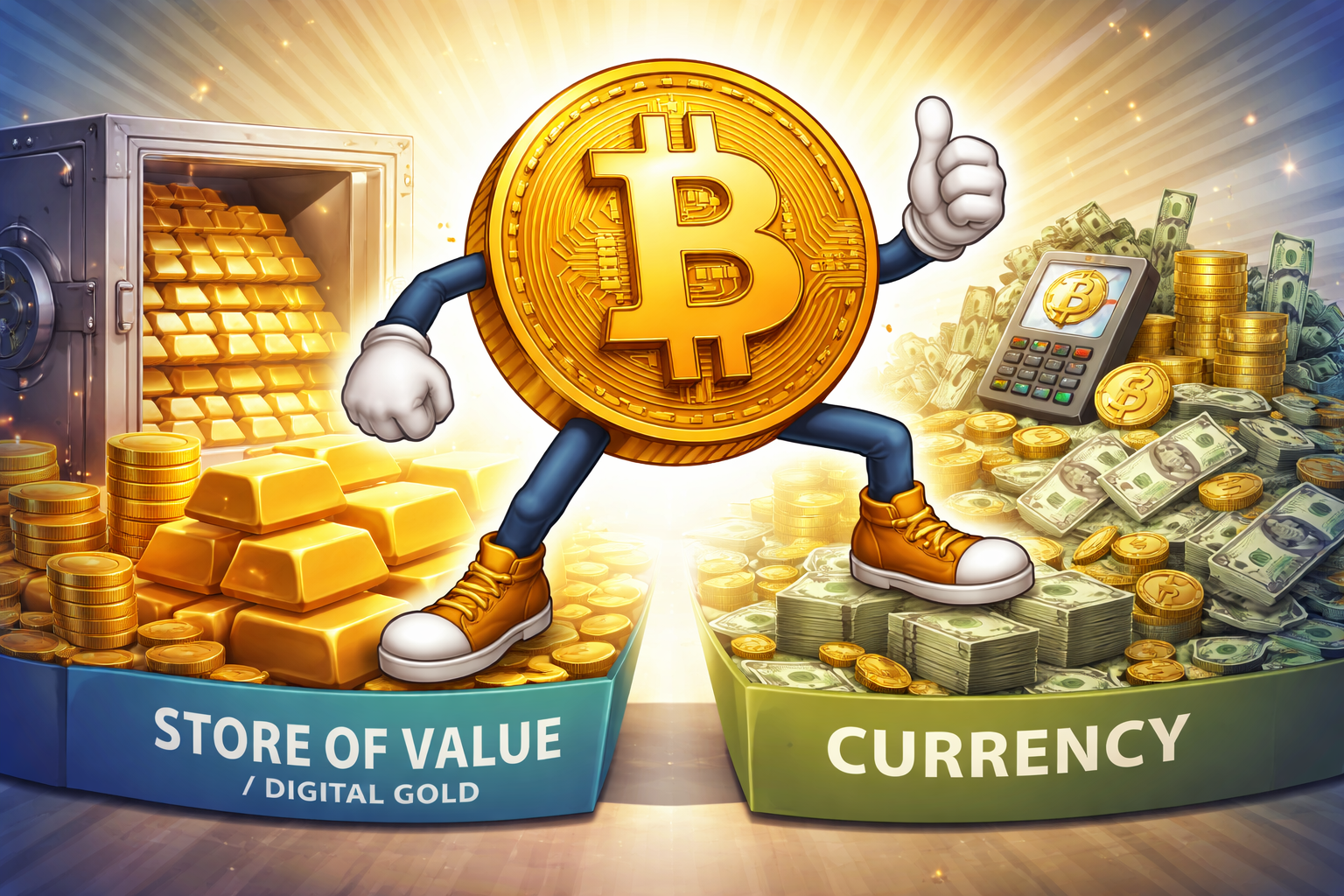
For five years the Bitcoin investment thesis has rested on one leg. Store of value. Digital gold. Scarce asset that protects wealth against debasement. Every price target, every institutional allocation memo, every ETF filing has been built on that single premise.
The Iran war just added a second leg. And the market is repricing Bitcoin because of it.
Since the US and Israel began striking Iran on February 28, Bitcoin has gained 12.25%. Gold has lost 10%. The S&P 500 is up just over 1%. In every previous geopolitical shock Bitcoin was treated as a high-beta risk asset that sold off with equities. This time it did not. That breaks the playbook and demands an explanation.
Bitwise CIO Matt Hougan offered one this week. He calls it two bets in one.
The Framework That Changes the Price Target
Hougan’s argument is straightforward. When you buy Bitcoin you are making two simultaneous bets. The first is that Bitcoin will continue to work as digital gold, a scarce store of value that protects against monetary debasement. That bet has been well understood for years. Markets have been pricing it.
The second bet is what he calls an out-of-the-money call option on Bitcoin functioning as an actual currency. A neutral settlement layer for international trade that sits outside any government’s control. Until recently Hougan said he treated this second bet as “borderline irrelevant,” a speculative possibility so remote it barely moved the valuation needle.
The Iran conflict changed the math on the second bet by delivering two things simultaneously. It raised the probability that Bitcoin gets used as a currency. And it increased the volatility of the global monetary order, which makes optionality more valuable. Both inputs drive the price of that call option higher.
If Hougan’s framing is right the implications run deep. “If bitcoin starts to take on a dual role as both a store of value and an actual currency, we may need to revise our targets higher,” he wrote. A Bitcoin that is digital gold has a price target anchored to gold’s market cap. A Bitcoin that is also a functional settlement currency has a total addressable market that dwarfs gold entirely.
What Actually Happened at Hormuz

We covered the IRGC toll system in March when it was still being treated as a rumor. We covered the official confirmation in April when Iran’s Oil, Gas and Petrochemical Products Exporters’ Union confirmed Bitcoin as an accepted payment. The story is no longer speculative.
A sovereign state controlling 20% of global oil supply built a payment system outside the dollar, outside SWIFT, and outside OFAC’s reach. Ships pay approximately $1 per barrel in Bitcoin to transit the strait. A fully loaded supertanker pays roughly $2 million per transit. The system could generate up to $20 million per day from oil tankers alone. Iran’s parliament formalized it in the Strait of Hormuz Management Plan approved March 30.
This is not a criminal network or a retail use case. It is a state-level commercial settlement mechanism for physical trade at one of the world’s most critical infrastructure chokepoints. The scale and the context are what make it different from everything that came before.
The Bitcoin Policy Institute noted the relevant precedent. When the US kicked Russian banks off SWIFT in 2022 following the Ukraine invasion, France’s finance minister called it a financial nuclear bomb. Countries that had previously taken dollar dominance for granted began building alternatives. China accelerated its Cross-Chain Interoperability Protocol. Russia shifted transactions to non-SWIFT rails. The global monetary order that had operated on a single set of rails since Bretton Woods started fracturing.
Iran at Hormuz is the next visible crack. Not because Iran chose Bitcoin out of ideological conviction. Because Bitcoin was the only available settlement layer that the US Treasury cannot freeze with a phone call.
The Part Nobody Wants to Say Out Loud
The Bitcoin Policy Institute published a careful analysis this week noting that evidence of actual on-chain Bitcoin settlement at Hormuz remains limited. The confirmed reports reference Bitcoin as an accepted payment method. The volume of confirmed Bitcoin transactions settling those specific tolls has not been independently verified at scale.
That caveat matters for accuracy. It does not change the directional argument.
As we wrote about Bitcoin’s performance across every major conflict since 2022, the pattern before the Iran war was that Bitcoin sold off during escalation and rallied during de-escalation, behaving as a risk asset rather than a safe haven. The Iran war broke that pattern. Bitcoin gained while gold lost. That behavioral shift is real regardless of whether every Hormuz toll has been paid on-chain.
What the market is pricing is not the confirmed transaction volume. It is the revealed preference. A sanctioned sovereign state with one of the world’s most valuable geographic assets chose Bitcoin as its settlement mechanism when pushed out of the dollar system. That revealed preference has never existed before at this scale. Options traders price probabilities, not certainties.
What the SWIFT Precedent Actually Means
Hougan traces the inflection point to 2022. The weaponization of SWIFT against Russia was the moment the global financial architecture revealed its dependence on a single political actor’s goodwill. Countries that had assumed dollar-based settlement was neutral infrastructure suddenly understood it was a policy instrument.
The response was predictable. Every country that could plausibly end up on the wrong side of US foreign policy began quietly building or adopting alternative rails. China’s CIPS network expanded. Russia’s MIR system grew. Bilateral trade agreements that settle in local currencies multiplied. The demand for neutral settlement infrastructure that no government controls has been building for four years.
Bitcoin is the only existing asset that fully satisfies that demand. It has no issuer. No correspondent bank requirement. No SWIFT dependency. No country that can be pressured into freezing it. The Iran war did not create this property. It put it on display at a moment when the entire world was watching the strait.
The addressable market for neutral global settlement infrastructure is not the gold market. It is the cross-border payments market, a market measured in tens of trillions of dollars annually. If Bitcoin captures even a fraction of that use case the long-term price implications make the digital gold targets look conservative.
The Honest Counterargument
Bitcoin’s volatility makes it a poor settlement currency for most commercial transactions. A ship captain negotiating a $2 million toll payment needs price certainty. The time between agreeing to pay and completing payment, Bitcoin can move 5% in either direction. Stablecoins solve this problem. Bitcoin does not, not yet.
The infrastructure required for smooth Bitcoin settlement at commercial scale, custody, exchange access, on-ramps, compliance, is nascent. Iran using Bitcoin as one of several payment options in a sanctions-pressure situation is not the same as Bitcoin functioning as a routine global settlement currency.
Hougan acknowledges this. He is not arguing Bitcoin has become a global currency. He is arguing that the option value of that possibility just became measurably more real. The difference between a possibility that is theoretical and a possibility that has a documented sovereign proof of concept is the difference in how much the market is willing to pay for that option.
The proof of concept happened at Hormuz. The price moved accordingly.
Whether the currency thesis compounds over the next decade or fades back into irrelevance depends on how many more cracks appear in the dollar-dominated monetary order and whether Bitcoin continues to sit at each crack as the available alternative.
Every geopolitical fracture makes the second bet easier to see. The Iran war made it impossible to ignore.