


On October 1, non-farm payrolls came in at 29,000. Economists expected between 84,000 and 90,000. Unemployment hit 4.2%. Bond yields dropped. Bitcoin spiked from $83,000 to $87,000 in hours.
Then it reversed. Bitcoin is at $82,937 today.
This is the third time this has happened since August.
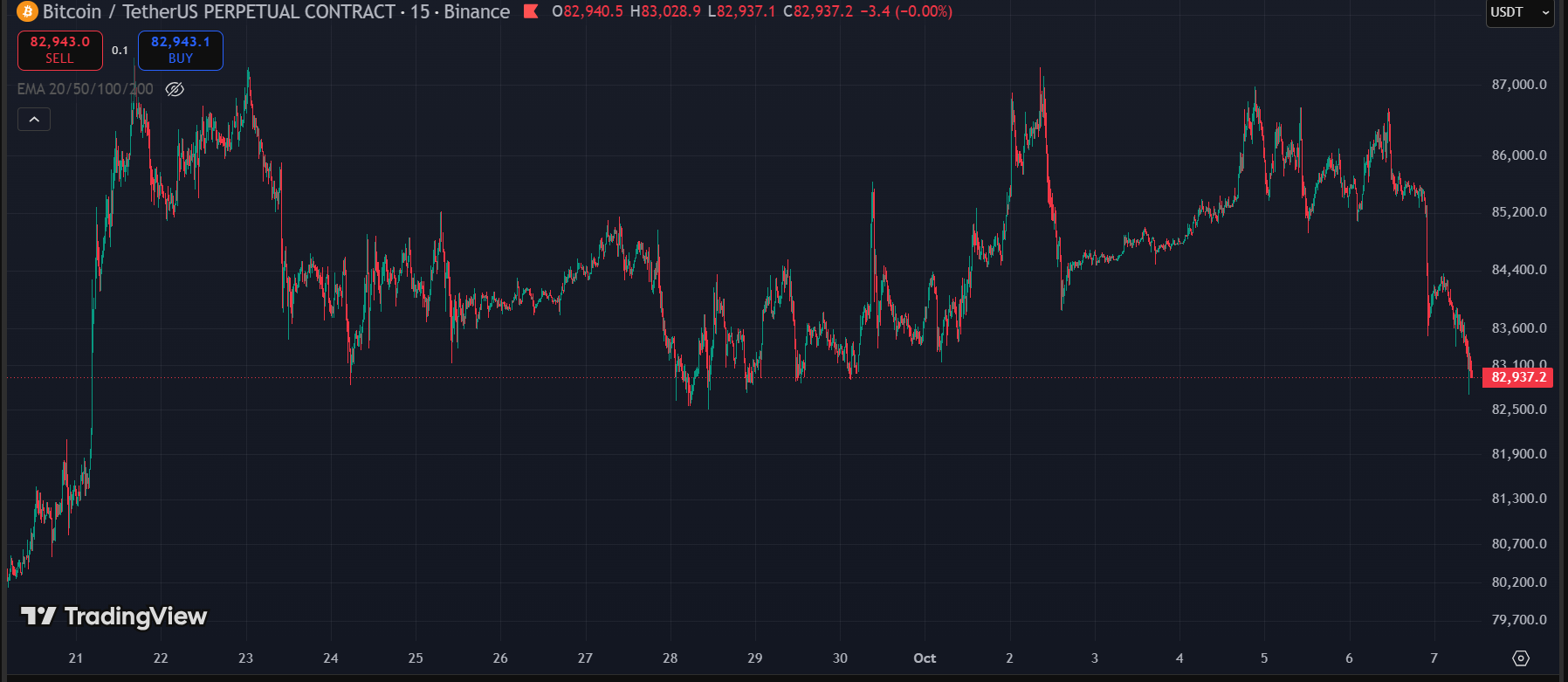
Bitcoin chart – Source: TradingView
The Pattern
August 19. The Treasury announced it would double bond buybacks in the 10 to 30 year sector. Bond yields dropped. Bitcoin spiked from $68,000 to $80,000. Then it ground sideways and pulled back.
September 15. The CLARITY Act cloture vote passed. Rate cut expectations repriced. Bitcoin tested $85,000. Then it faded back to $82,000 within 72 hours.
October 1. Jobs report miss. Bond yields dropped. Bitcoin hit $87,000. Then it reversed.
Three different catalysts. The same market behavior each time. A sharp spike on macro news followed by a fade within 48 hours. The spike is real. The follow-through is not.
What the Pattern Is Telling You
Bitcoin keeps spiking on soft macro data because soft macro data reduces rate hike probability and Bitcoin is trading as a rate-sensitive risk asset right now. That part is working correctly.
What is not working is the sustained buyer base above $85,000. Every time Bitcoin gets into the $85,000 to $87,000 range, the supply that has been waiting since the May and June lows shows up. People who bought at $63,000 in June and watched Bitcoin recover 38% are selling into strength. That is rational behavior. It is also a ceiling.
The August 19 move was driven by Treasury intervention and a heavily short market. That was the cleanest of the three spikes and it produced the most durable follow-through, Bitcoin held $80,000 for most of September.
The September 15 move was driven by CLARITY Act optimism on a bill that still has not passed. That produced less follow-through because the catalyst was political, not monetary.
The October 1 move was driven by a jobs miss that tells you the economy is weakening, which is good for rate cut expectations but bad for the underlying risk appetite that sustains Bitcoin above $85,000. Soft economic data is a double-edged input. It reduces rate hike fear and increases recession fear simultaneously.
We wrote in August that the Treasury intervention was the actual catalyst and the CLARITY Act was the amplifier. The October 1 spike had no Treasury component. It was pure macro reaction. Those moves fade faster.
Why This Is Not Rektember Sequel
In September we wrote that everyone calling Rektember might be why it would not happen. September ended with Bitcoin up from where it started. That call held.
October is a different setup. The consensus is now bullish. The CLARITY Act passed its cloture vote. Warsh held rates and softened his language. The Iran deal held through August and September. The macro headwinds that defined the February to June bear market have partially resolved.
Consensus bullishness with no sustained buyer above $85,000 is a different risk profile than the contrarian setup that made September survivable. Three spikes and three reversals at the same level is not a bull market pattern. It is a distribution pattern.
That does not mean Bitcoin goes lower from here. It means Bitcoin needs a new catalyst that produces sustained follow-through rather than another 48-hour spike and fade. The $87,000 to $90,000 zone is where the heavy supply from the October 2025 all-time high cycle sits. Getting through it requires more than a jobs report miss.
What Comes Next
The Fed meeting on November 5 is the next real catalyst. A rate cut at that meeting, which CME FedWatch now gives 34% probability following the October 1 jobs data, would be the first cut of Warsh’s tenure and a genuinely new input rather than a repricing of existing expectations.
That is different from the three catalysts that produced the spike and reverse pattern. A first Warsh rate cut is not a macro data point. It is a regime change signal. The market would price it differently.
Until then Bitcoin is ranging between $82,000 and $87,000 with sellers showing up reliably at the top of the range and buyers showing up reliably at the bottom. The third reversal from $87,000 in six weeks confirms the range. Breaking it requires something the jobs report was not.