


Oil fell 5% on the Iran deal. Brent dropped to $83. WTI slid under $80. Bitcoin bounced. Markets priced relief.
BREAKING: US oil prices drop below $79/barrel and hit the lowest level since March 10th. pic.twitter.com/xkCULu0TxO
— The Kobeissi Letter (@KobeissiLetter) June 16, 2026
Buried in the agreement is a detail that changes the math.
Iran plans to charge service fees on Strait of Hormuz transits once a 60-day grace period ends. President Trump says the reopening is permanently toll-free. Vice President Vance and Iran’s negotiators both point to fees starting on day 61. Those are not the same deal and the oil market is already quietly pricing the difference.
BREAKING: Iran says the US has agreed to permanently hand over the Strait of Hormuz to Iran under their full sovereign authority, with Iran collecting tolls called “service fees” from all commercial ships after a 60-day waiver period. The opening is planned for Friday, after the…
— The Hormuz Letter (@HormuzLetter) June 15, 2026
What the Fine Print Says
The deal reopens the strait, which carried roughly one-fifth of global oil before the war closed it in February. Ships pay nothing to pass for 60 days. After that, Iran’s position is that service fees apply.
The numbers are smaller than the PGSA toll system we covered in May, when some vessels were paying up to $2 million per crossing. The post-deal structure looks more like $1 per barrel, a service fee framed as administrative rather than a toll. On 20 million barrels per day transiting the strait, that is $20 million daily flowing to Tehran. Permanent. Structural. Baked into the cost of every barrel that moves through that chokepoint.
The PGSA does not disappear with a handshake. It converts.
What the Futures Curve Is Saying
The spot market priced relief. The futures curve is more cautious.
During the war, the spread between the first and second Brent contracts hit $10.27 in April, reflecting extreme near-term scarcity. That spread has collapsed to roughly $0.67 now, confirming the immediate shortage is easing. But the market has not flipped into contango, where later months trade above the front. Mild backwardation persists. Traders are not pricing a glut. They are pricing a pause.
Options positioning tells the same story. Traders are quietly buying calls on Brent for August and September, the months that fall after the 60-day grace period ends. The relief is real. The bet that it does not last is also real.
US strategic petroleum reserves sit at a 43-year low. That is the wildcard underneath all of this. If the toll question is not resolved cleanly before day 61 and supply uncertainty returns, there is no reserve buffer to absorb the shock the way there was in previous energy crises.
What This Means for Bitcoin This Week
Kevin Warsh gives his first press conference tomorrow inheriting a situation that looked cleaner on Sunday than it does today. The deal is signed in principle. The strait is reopening. Oil is at $83. That is meaningfully better than oil at $106 with the strait closed.
But the inflation chain we have been tracking since February does not fully resolve at $83 oil with a 60-day grace period and a contested fee structure starting in August. It eases. Warsh can soften his language. The dot plot can shift. Rate cut expectations can creep back in.
What it cannot do is deliver the clean resolution that $83 oil and a deal announcement implies if the fee dispute between Trump and Iran is not settled before day 61.
The three things that trapped Bitcoin since February just partially broke. The closed strait is open. Oil is falling. ETF inflows turned positive. That is real progress and Bitcoin at $65,000 reflects it.
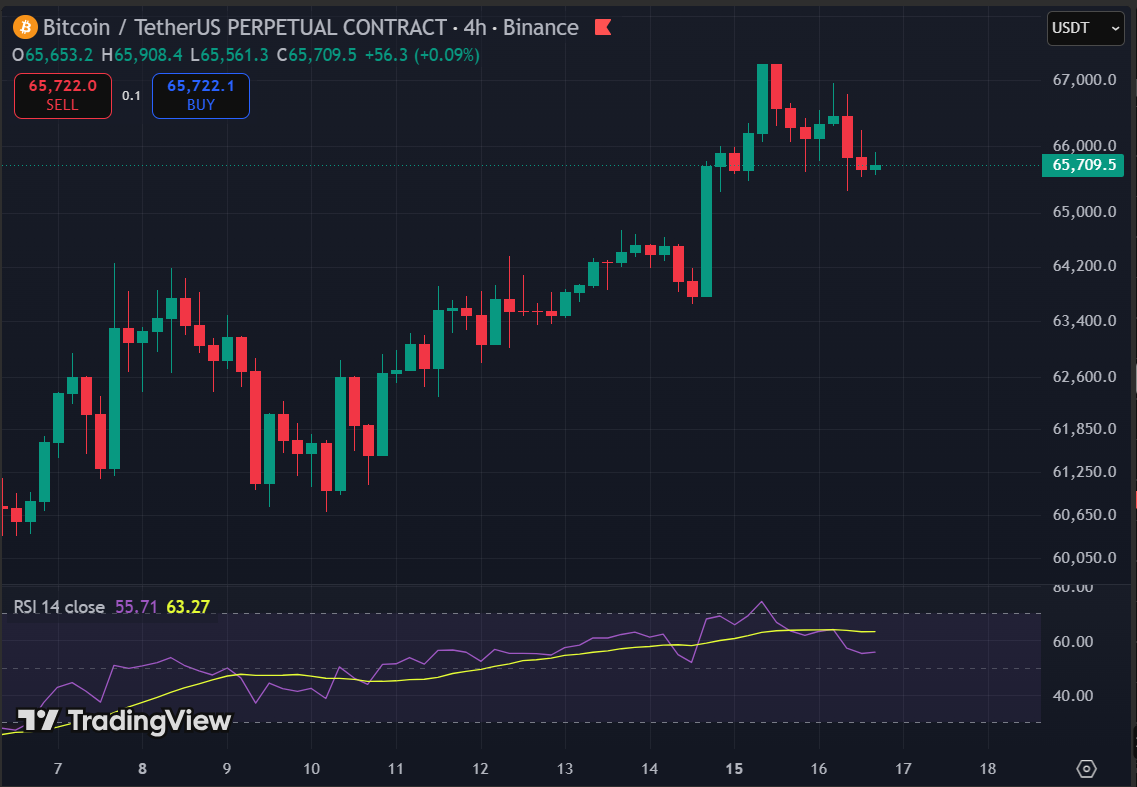
Bitcoin recovering steadily. The Iran deal bounce is holding so far. Source: TradingView
The 60-day clock starts today. What happens on day 61 is the next question nobody is asking yet.