

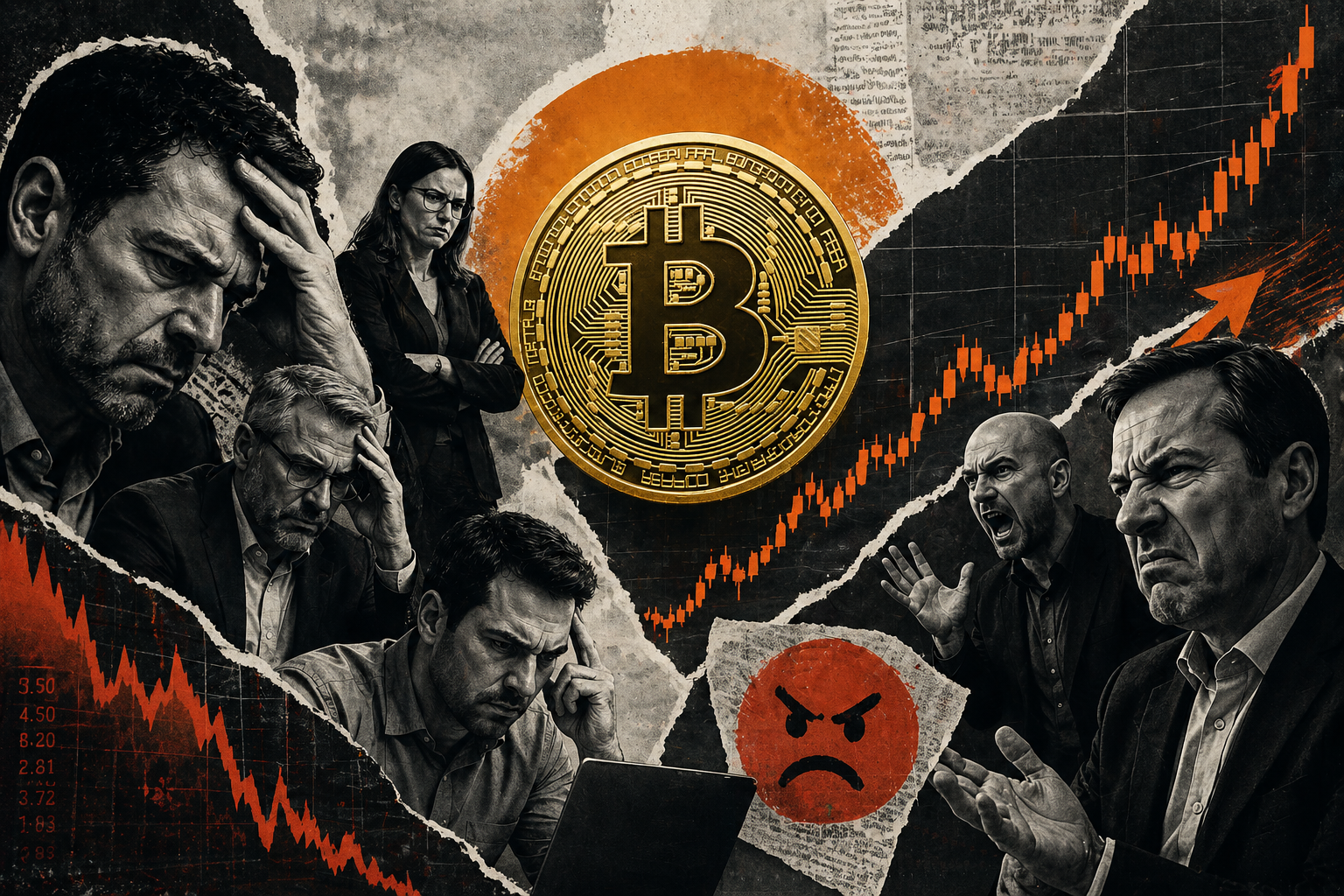
Bitcoin is up 22% since the Iran war started. The crowd called it wrong. The bears called it wrong. The four-year cycle analysts called it wrong. The altcoin holders waiting for rotation called it wrong.
And every single one of them is still paying for the privilege of being wrong. Eight hours at a time.
That is what makes this rally different from any other in recent memory. It is not being driven by believers. It is being driven by disbelievers who are running out of money to stay wrong with.
How a Hated Rally Works
When traders bet on lower prices using perpetual futures, they pay a periodic fee called the funding rate every eight hours to the traders on the other side. When markets are healthy and traders are optimistic, longs pay shorts. The positive funding rate signals confidence. Everyone believes prices are going higher.
For 46 consecutive days, the opposite has been true.
As we detailed when this setup first emerged, Bitcoin’s 30-day average funding rate has been negative since March 1, running at minus 0.005% per period according to Glassnode data. That means the bears have been writing a check every eight hours to the longs. At 6% annualized according to TFTC, a trader holding a short position from the start of this setup has paid a significant ongoing cost on top of whatever losses their position has accumulated as Bitcoin grinded from the mid-$60,000s to $78,000.
CNBC contributor Ran Neuner described the dynamic on a live broadcast this week. He called it a classic setup where the rally’s unpopularity is the very fuel keeping it alive. Every skeptic who shorted into the move, every analyst who called for a retest of $50,000, every four-year cycle believer waiting for October, has become involuntary rocket fuel.
CryptoQuant contributor CoinNiel framed it in blunter terms: “BTC is flowing out of exchanges while funding rates remain strongly negative, creating an increasingly crowded short positioning environment where the potential for a short squeeze is building.”
The Mechanical Reason This Does Not Stop Easily
Here is the part that matters more than the narrative.
Open interest across Bitcoin perpetual futures is rising while funding rates stay negative. That combination is specific and unusual. It means traders are not just holding existing short positions. They are opening new ones. Fresh capital is entering the short side of this trade at $75,000, $76,000, $77,000, $78,000.
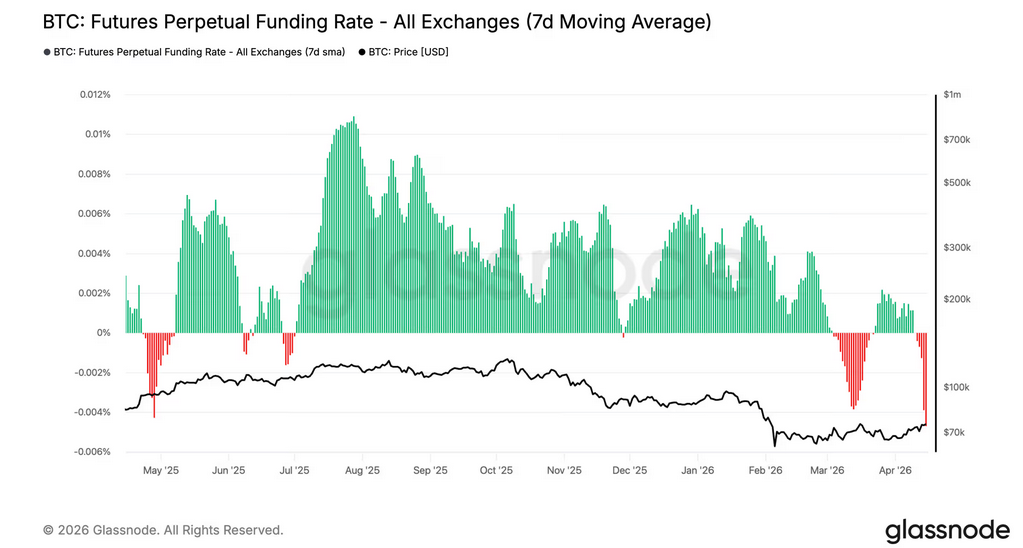
Source: Glassnode
Every one of those positions has a liquidation price above the entry point. As shorts accumulate at similar levels, the density of liquidation orders above current price increases. If Bitcoin breaks through that cluster, forced buybacks from liquidated shorts push price higher. Higher price forces more liquidations. More liquidations push price higher still. Derivatives traders have a name for this feedback loop. They call it a short squeeze. And crowded short regimes, like this one, are exactly where squeezes originate.
The historical record makes this concrete. The last two times Bitcoin saw a sustained negative funding streak of this length, both resolved with violent upside moves. Mid-2021 after China’s mining ban, Bitcoin went from $29,000 to $48,000. Post-FTX in late 2022, Bitcoin eventually went from below $16,000 to $30,000. The sample size is small. The mechanical logic is sound.
Who Is Still Betting Against It and Why
The skepticism is not irrational. It is just expensive.
The four-year cycle analysts point out that Bitcoin has never had a sustained bull market that did not include a deep October retest. Many are still forecasting a move back to $50,000. Altcoin holders are frustrated because Bitcoin dominance has stayed elevated, leaving SOL, ETH, and most altcoins at multi-month lows against Bitcoin. The macro picture remains genuinely uncertain. Oil is at $103. Inflation has not been solved. The Fed is not cutting.
These concerns are real. The bears holding shorts are not stupid. They are making a coherent argument about macro conditions that historically precede Bitcoin weakness.
They are also paying 6% annualized to make that argument. And the market keeps proving them wrong eight hours at a time.
CryptoQuant contributor Gaah put the risk plainly: “Bears trapped? Likelihood of a short squeeze is increasing.” Glassnode analyst Chris Beamish noted that Bitcoin is likely to experience a squeeze where rising prices force short sellers to buy back positions, adding that the current environment has not yet seen a meaningful deleveraging phase. The fuel is still loaded.
The Warning the Label Actually Contains
Most hated rally is a description. It is also a warning. But not a warning to buyers.
When a rally is hated, when sentiment is this skeptical while price keeps grinding higher, the historical pattern is that the move extends further than anyone expects. The bears who should have covered at $70,000 hold into $75,000. The bears who should have covered at $75,000 hold into $80,000. Each level that should have broken them becomes the next level they defend. And when the break finally comes it does not come gradually.
It comes when the last short capitulates all at once.
Whale accumulation over the past 30 days has reached its highest level since 2013, with 270,000 Bitcoin purchased. Stablecoin supply has climbed to an all-time high of $320 billion. Strategy raised $6.3 billion and directed every dollar toward Bitcoin purchases. ETF inflows came in at $186 million in a single day last week.
The buyers are quiet and systematic. The bears are loud and getting squeezed.
That asymmetry is not permanent. When the short positioning finally clears, when funding rates flip positive and open interest drops, the fuel that has been powering this move will be gone. What happens after a short squeeze resolves depends entirely on whether organic demand is waiting underneath.
The most hated rally can become the most embarrassing rally. For the people who missed it.