


On March 20, Bitcoin’s mining difficulty is set to drop from 145.04 trillion to an estimated 139.24 trillion. A 4% decrease. The network’s automated correction after blocks have been coming in slightly slower than the 10-minute target.
Four percent doesn’t sound like much. But the miners still standing after the last three months will take it.
What the Difficulty Adjustment Actually Does
Every 2,016 blocks, roughly two weeks, Bitcoin automatically recalculates how hard it is to mine a new block. If blocks arrive too fast, difficulty goes up. Too slow, it goes down. The target is always 10 minutes per block.
No committee decides this. No regulator approves it. The math runs on schedule, and the network self-corrects without anyone’s permission. It’s one of the most quietly elegant pieces of Bitcoin’s design, and it’s been running without interruption since 2009.
When difficulty drops, every miner on the network earns a larger share of block rewards for the same computing power. For miners operating on thin margins, which describes most of the industry right now, that difference can determine whether machines stay on or go dark.
The Year That Broke Mining Margins
To understand why March’s adjustment matters, you need to go back to April 2024.
The halving cut the block reward from 6.25 BTC to 3.125 BTC overnight. Miners who had built their business models around the higher reward suddenly had half the revenue with identical costs. Electricity bills, hardware debt, facility leases, none of it halved with the reward.
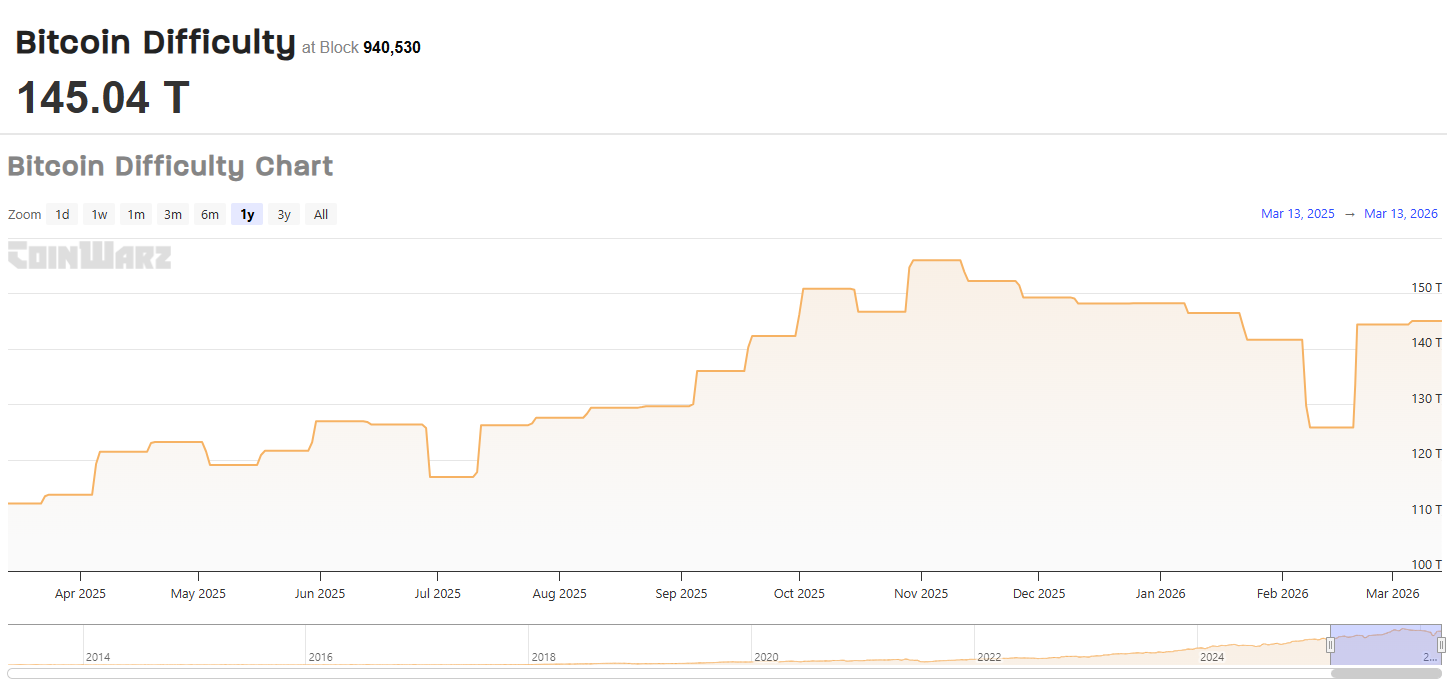
Mining difficulty peaked at 155.9 trillion in November 2025 an all-time high, as new hardware came online despite the post-halving squeeze. More machines competing for a shrinking reward drove hash price, the measure of daily revenue per unit of computing power, below $35 per petahash per second. For operations running older hardware, that’s below breakeven. Daily mining revenue across the network dropped to yearly lows of around $28 million in late January 2026.
Then a storm arrived.
Winter Storm Fern and the Biggest Difficulty Drop Since China
In late January 2026, Winter Storm Fern swept across the United States. Temperatures crashed across Texas and the Southeast. Heating demand surged. Grid operators scrambled.
Bitcoin miners, concentrated heavily in Texas, faced a choice: keep running and pay electricity prices that had spiked to $1,200 per megawatt-hour on the ERCOT grid or shut down, sell power back to the grid, and wait it out.
Most of them shut down.
MARA, one of the largest public Bitcoin miners, curtailed approximately 770 MW across ERCOT, PJM, and SPP grids nearly 70% of its global hashrate. Foundry USA, the largest mining pool in the US, saw its pool hashrate collapse roughly 60%. Luxor Mining reported its users collectively curtailed around 50% of their power consumption. In total, over 455 EH/s went offline between January 23 and January 25 a 40% drop in network hashrate in under 48 hours.
Block production slowed to an average of 12.4 minutes. The Bitcoin network kept running, slower but uninterrupted.
On February 9, the difficulty adjustment registered the damage. Difficulty dropped 11.16% to 125.86 trillion at block height 935,424 — the steepest single adjustment since China banned Bitcoin mining in July 2021 and wiped out roughly half the network’s hashrate overnight.
The comparison is instructive. China’s ban was a geopolitical shock. Winter Storm Fern was a weather event. The scale of the impact was similar.
The Snapback Nobody Predicted
What happened next surprised analysts.
When the storm passed, miners didn’t trickle back. They reconnected fast. Hashrate surged from a storm-induced low of 826 EH/s back toward 1 zettahash per second within days. Blocks started arriving faster than the 10-minute target. The network protocol registered the recovery and prepared its correction.
On February 19, difficulty jumped 14.73% to 144.4 trillion , the largest absolute increase in Bitcoin’s history and the biggest percentage jump since the post-China recovery in 2021. The drop and the snapback happened within two weeks of each other.
This sequence tells you something important about what Bitcoin mining has become. The operations that shut down did so within hours of grid stress signals, not days. They restarted just as fast. This is not the mining industry of 2017, running hobbyist rigs in basements. This is industrial infrastructure managed with the same operational discipline as power plants which, in a sense, is exactly what large Bitcoin mines have become.
MARA’s curtailment during Winter Storm Fern was not a crisis response. It was a planned operational procedure. The company earned revenue by selling curtailed power back to the grid during peak demand, partially offsetting the lost mining revenue. The miners who stayed online during the drop, meanwhile, briefly earned a significantly larger share of block rewards as difficulty adjusted downward.
Where Things Stand Now and What March 20 Changes
Difficulty recovered from the February storm and climbed back to 145.04 trillion at block 940,530 nearly back to the November 2025 all-time high. The network absorbed the largest coordinated hashrate withdrawal since 2021 and returned to near-record security within a month.
The March 20 adjustment brings it back down to an estimated 139.24 trillion. Not dramatic, but meaningful for miners still fighting the margin math from the 2024 halving.
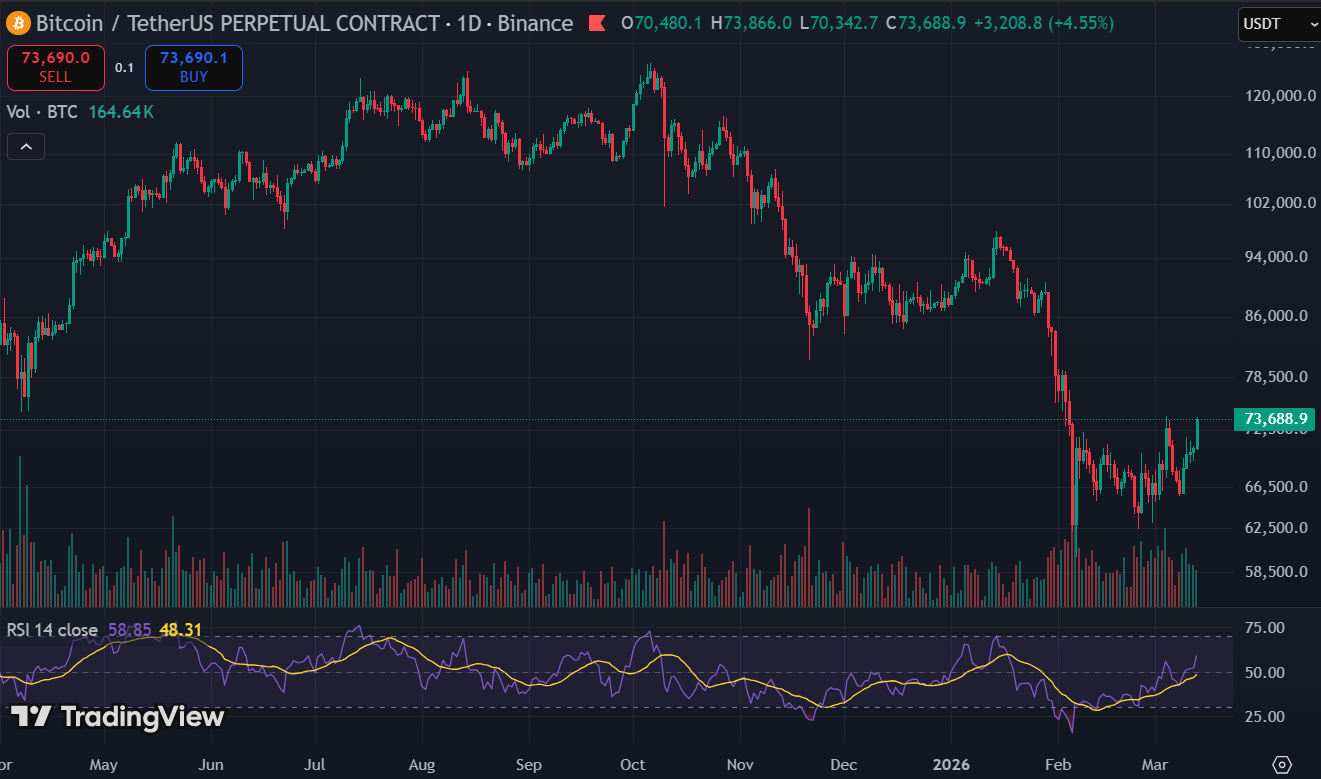
Bitcoin currently trades around $73,700 roughly 15% below what analysts estimate as the average cost to produce one Bitcoin with current hardware and electricity prices. Every miner operating right now is doing so at a loss or near breakeven. Any relief from the difficulty side extends their runway.
The Bigger Problem Nobody Has Solved
Mining difficulty is not the existential question facing miners. The 2028 halving is. Governments have already started positioning the US Strategic Bitcoin Reserve was built partly with this long-term supply squeeze in mind.
When the block reward drops again to 1.5625 BTC, miners will need transaction fees to cover a significantly larger share of their costs. That transition is already underway during periods of high network demand, fees have briefly exceeded the block subsidy itself. But sustained fee revenue at that level requires sustained network activity that nobody can guarantee.
There is also the AI infrastructure question. Large Bitcoin mining sites with their power infrastructure, cooling systems, and high-density compute buildouts are increasingly attractive targets for conversion to AI data centers. Morgan Stanley has estimated significant AI power demand growth in 2026, and some mining operators have begun exploring infrastructure repurposing. If significant hashrate migrates permanently to AI, Bitcoin’s security budget faces a structural challenge that a difficulty adjustment cannot fix.
The March 20 adjustment addresses none of this. It is a 4% mechanical correction based on recent block times. The network’s protocol is working exactly as designed.
For miners who survived the February storm, the April 2024 halving, and a year of compressed margins, that’s the whole point. The system adjusts. The blocks keep coming. The math holds.
Whether the economics hold long enough for the fee market to develop is the open question. The difficulty adjustment runs on schedule regardless of the answer.