
The United States has spent 75 years building the most powerful financial weapon system in human history. It can freeze bank accounts, confiscate gold, disconnect entire countries from global payment networks, and block stablecoin wallets with a single phone call to a company’s compliance team.
It has used every one of these tools. Some of them many times.
And then there is Bitcoin.
Here is the complete map. Every kill switch the US government controls, how it works, when it has been used, and why one asset sits outside all of it.
The Gold Confiscation of 1933
On April 5, 1933, President Roosevelt signed Executive Order 6102. Every American was required to turn in their gold coins, gold bullion, and gold certificates to the Federal Reserve. The penalty for noncompliance was a $10,000 fine, roughly $230,000 in today’s dollars, and up to ten years in prison.
It worked. Gold held by private citizens was transferred to government control in weeks. The mechanism was simple. Gold is physical. It has to be stored somewhere. And governments can search, seize, and demand surrender of physical objects at gunpoint.
The lesson from 1933 is not that gold failed. Gold preserved wealth for those who held it internationally or hid it effectively. The lesson is that any asset that must be stored physically, or held with a custodian subject to government jurisdiction, can be taken.
The Bank Account Freeze
Bank accounts are the oldest and most frequently used financial weapon. The mechanism requires nothing more than a court order or OFAC designation sent to the institution holding the funds.
When the US froze North Korean assets in 1950 it did so through the Foreign Assets Control Regulations, making any financial transaction involving North Korea illegal. Every dollar held by North Korean entities in any institution subject to US jurisdiction became inaccessible overnight.
The same mechanism has been applied to Cuba since 1963, Iran since 1979, Russia in 2022, and hundreds of individuals and organizations in between. Sanctions can deny a foreign government access to the US financial system or freeze an entity’s assets under US jurisdiction.
The vulnerability is simple. Bank accounts exist within institutions. Institutions are legal entities subject to jurisdiction. Jurisdiction means the government can compel compliance. There is no bank account anywhere in the world that a sufficiently motivated US Treasury cannot reach through correspondent banking relationships, secondary sanctions, or direct legal process against the holding institution.
The SWIFT Disconnection
On February 26, 2022, the European Union, United States, United Kingdom, and Canada announced that major Russian banks would be removed from SWIFT, the Society for Worldwide Interbank Financial Telecommunication. The announcement was made on a Saturday. By Monday, Russian banks could no longer send or receive international payment messages through the dominant global network.
French Finance Minister Bruno Le Maire called it a financial nuclear bomb. Russia’s central bank called it unprecedented in scale.
The mechanism is different from asset freezing. SWIFT does not hold assets. It transmits messages. Removing Russia from SWIFT did not confiscate Russian money. It made international transfers significantly more difficult by forcing Russian banks to use alternative, less efficient, and less connected networks.
The lesson from the SWIFT disconnection is that infrastructure control is as powerful as asset control. You do not need to freeze someone’s money if you can prevent them from moving it.
The Stablecoin Freeze
This is the newest and fastest kill switch the US government has developed, and it operates through a completely different mechanism than any of the above.
USDT is issued by Tether. USDC is issued by Circle. Both are US-incorporated companies subject to US law and OFAC enforcement. Both stablecoins contain a smart contract function that allows the issuer to freeze any wallet address at any time. The frozen funds remain on the blockchain, visible to everyone, but immovable by their owner.
When the US Treasury froze $344 million in USDT linked to Iran, the process required a phone call and a compliance team. No court order. No warrant served on a foreign entity. No complex international legal process. Tether complied because it is a US company and the alternative is losing its operating license.
Circle has frozen wallets following OFAC orders dozens of times. The Tornado Cash sanctions in 2022 resulted in Circle freezing $75,000 in USDC held in smart contracts before the owners could react. Speed is measured in hours, sometimes minutes.
The vulnerability of stablecoins is architectural. They are designed to be freezable. That is not a bug introduced by regulators. It is a feature implemented by the issuers to maintain regulatory compliance. Unlike Bitcoin, stablecoins like Tether and Circle are smart contracts controlled by centralized companies. The freeze function exists in the contract code. Any wallet can be frozen by the issuer at any time for any reason the issuer accepts.
The Crypto Exchange Seizure
When cryptocurrency is held on an exchange, the situation is legally identical to a bank account. The exchange holds the private keys. You hold a claim against the exchange. If a court orders the exchange to transfer your funds to a government wallet, the exchange complies. The transaction does not touch the blockchain. It happens in the exchange’s internal ledger.
If your cryptocurrency is held on platforms like Coinbase or Binance, seizure is surprisingly straightforward. These exchanges function like traditional banks. They hold your private keys, and when law enforcement arrives with a seizure warrant, the exchange simply transfers the funds to a government-controlled wallet.
The US government seized over $15 billion in cryptocurrency in 2025 alone through this mechanism. The Silk Road Bitcoin, the Bitfinex hack proceeds, the Iranian assets seized last week. All of these seizures involved cryptocurrency held in wallets where law enforcement could obtain the private keys, either through warrants served on custodians or through recovery of physical devices holding seed phrases.
The One Asset That Has Resisted All of It
Bitcoin held in self-custody has not been frozen by OFAC. It has not been confiscated through executive order. It cannot be disconnected from SWIFT because it does not use SWIFT. It cannot be frozen by an issuer because it has no issuer.
This is not a theoretical property. It has been tested against the most powerful sanctions apparatus in human history and held.
Iran accepted Bitcoin for Hormuz transit payments precisely because the US Treasury called Circle and froze the USDT. The Hormuz toll system chose Bitcoin not for ideological reasons but because the USDT option was demonstrably unreliable. The kill switch existed. It was used. Bitcoin was the alternative that did not have one.
When the KelpDAO attacker converted $175 million in stolen Ethereum to Bitcoin, the choice was deliberate. The Arbitrum Security Council froze the ETH. Nobody could freeze the Bitcoin. The most sophisticated hackers operating at scale in 2026 consistently convert to Bitcoin as their final exit because they have learned the same lesson Iran learned at Hormuz.
The US government knows this too. The GAO has warned Congress that the effectiveness of economic sanctions is at risk from digital asset growth, noting that sanctioned entities are using digital assets like Bitcoin to hide their transactions and allow countries to generate funds from cybercrime and other illegal activities the US looks to stem through sanctions.
The Strategic Bitcoin Reserve is the US government’s response. If you cannot freeze Bitcoin, accumulate it. The executive order signed in March 2025 established a policy of retaining all forfeited Bitcoin rather than auctioning it. The US government currently holds more than 200,000 Bitcoin acquired through seizures and is no longer selling it.
That decision tells you everything about what the US government actually believes about Bitcoin’s properties. They are collecting the asset they cannot freeze.
The Map
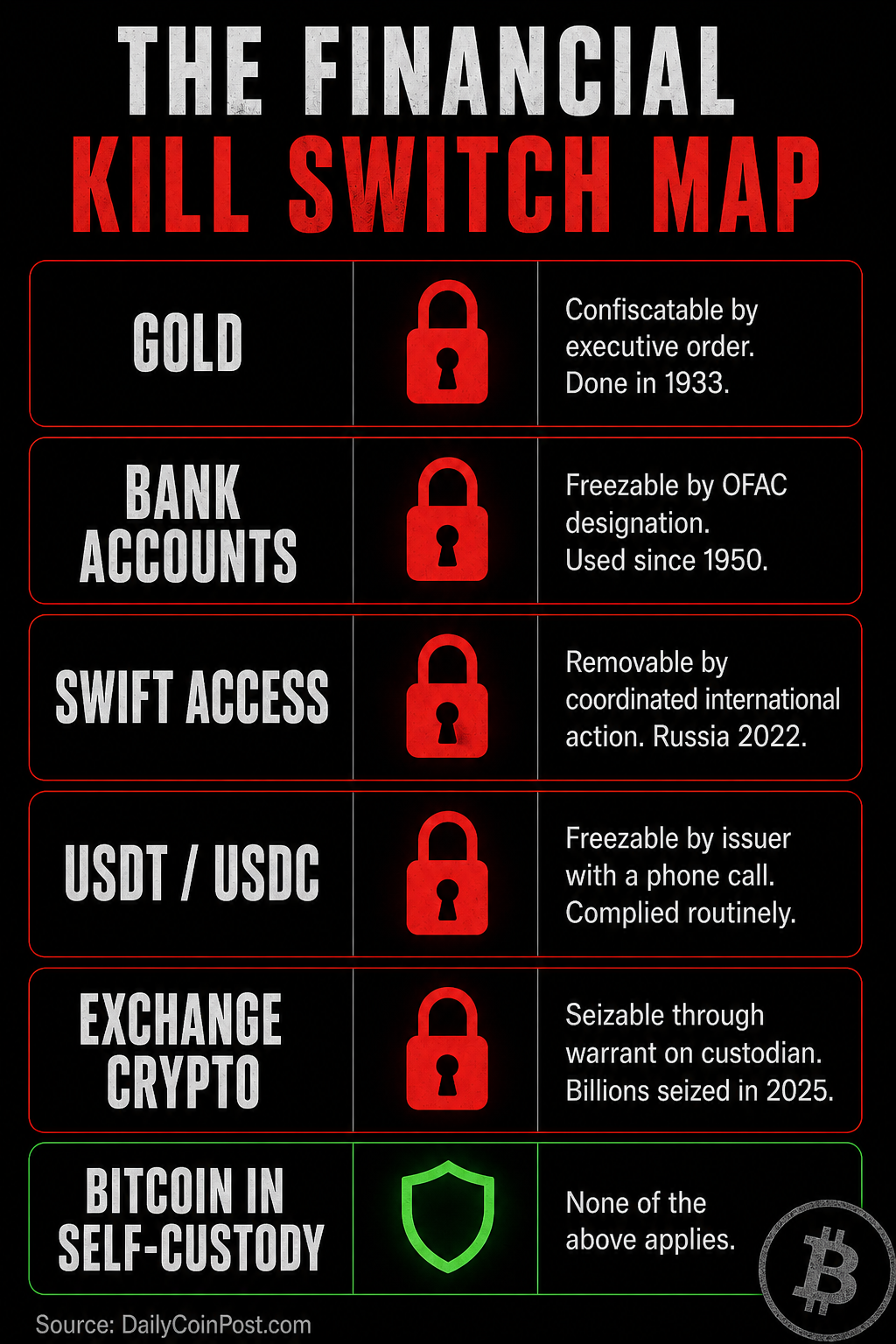
- Gold: confiscatable through executive order. Done in 1933. Could be done again.
- Bank accounts: freezable through OFAC designation or court order. Used continuously since 1950.
- SWIFT access: removable through coordinated international action. Done to Russia in 2022.
- Stablecoins: freezable by the issuer with a phone call. Circle and Tether comply routinely.
- Exchange-held crypto: seizable through warrant served on the custodian. Used to seize billions in 2025 alone.
- Bitcoin in self-custody: none of the above applies.
This is not an argument that Bitcoin is risk-free. It is volatile. It is technically complex. Losing your private keys means losing your Bitcoin with no recourse. The property that makes it resistant to government confiscation is the same property that makes it unrecoverable if lost.
But every geopolitical crisis of the past three years has independently arrived at the same conclusion. When sovereign states, criminal networks, and sanctioned entities need to move value outside the reach of US financial infrastructure, they choose the asset at the bottom of this list.
That is not a coincidence. That is a stress test. And Bitcoin has passed it every time.