

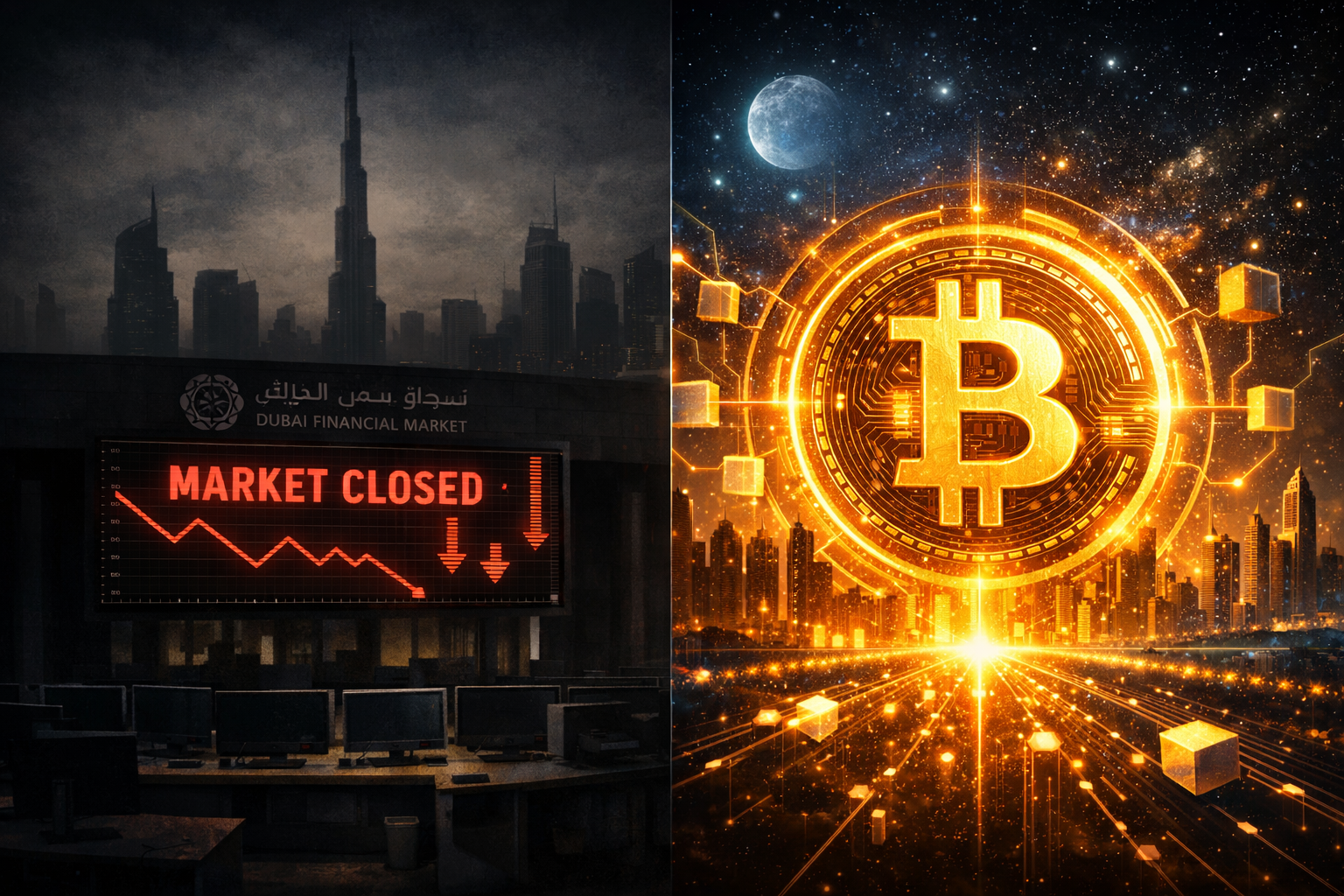
This weekend, governments across the Gulf made a decision that their citizens had no say in. They turned off the markets.
Abu Dhabi Securities Exchange — closed. Dubai Financial Market — closed. Both shut for two full days after Iranian missiles struck the UAE. Kuwait suspended trading entirely. Qatar’s exchange dropped 3.7% before the opening bell. Saudi Arabia fell nearly 5%. Millions of people who held assets in those markets woke up Monday morning and found out they couldn’t do a thing about it. No selling. No moving money. No protecting themselves. The decision had been made for them.
Bitcoin processed every transaction this weekend without interruption.
No government authorized it. No regulator flipped a switch. No missile strike, no political crisis, no emergency decree touched it. While the Gulf’s most powerful financial institutions were shutting their doors, Bitcoin was settling trades at 3am on a Saturday the same way it settles trades on a Tuesday afternoon in New York. Exactly the same. Without asking anyone’s permission.
That is not a speculative feature. That is Bitcoin working as designed.
What Actually Happened This Weekend
The conflict that has been building since the US and Israeli strikes on Iran last week escalated sharply over the weekend. Iranian missiles hit targets across the UAE including infrastructure near Dubai and Abu Dhabi airports. Three people were killed. The Strait of Hormuz — the shipping chokepoint that moves roughly 20% of the world’s oil — is now under direct threat. Oil surged more than 7%. Gold climbed back above $5,400 per ounce.
And the Gulf’s financial regulators made the only call they had available to them. They closed the exchanges and told investors to wait.
Bitcoin dropped to $63,000 on the initial shock. That is the honest part of this story and worth acknowledging — Bitcoin is not immune to fear. When panic hits and people need liquidity fast, they sell whatever they can sell. In the first hours of a geopolitical shock, Bitcoin often takes the hit before traditional markets even open because it is the only liquid asset trading at 2am on a Saturday. It absorbs the panic that has nowhere else to go.
But here is what happened next. Bitcoin bounced back to $68,000 by Sunday after news broke that Iranian Supreme Leader Khamenei had been killed in the strikes. Then it pulled back again to $65,000 as Iran stepped up retaliatory attacks on Saudi oil infrastructure Monday morning. Through all of it — the drops, the bounces, the uncertainty — Bitcoin kept trading. Every person who wanted to move their position could move their position. At any hour. From any country. Without asking anyone.
The people holding assets on the Dubai Financial Market did not have that option.
The Question Nobody Is Asking
Most of the coverage this week is asking whether Bitcoin is a good hedge against geopolitical risk. The charts get pulled out. The correlation studies get cited. Analysts debate whether Bitcoin behaves more like gold or more like a tech stock when wars start.
That is the wrong question.
The right question is not whether Bitcoin goes up during a war. It is whether Bitcoin keeps working during a war. And the answer to that question is already settled. It does. It has. It will.
Stock markets close because they are run by institutions that answer to governments. Governments close markets to prevent panic selling, to protect financial stability, to maintain order. Those are legitimate goals. But the mechanism for achieving them is the same in every case — they take control away from you. Your assets are still your assets on paper. You just cannot touch them until someone in an office somewhere decides you can.
Bitcoin has no office. There is no one to call. There is no emergency decree that reaches it. The 21 million coin hard cap is enforced by mathematics and the most powerful computing network ever assembled by human beings — not by a regulator who can change their mind when missiles start flying.
That is what decentralization actually means in practice. Not as a philosophical argument. As a live demonstration, happening right now, in the most volatile financial week the Middle East has seen in a generation.
The Timing Is Not Lost on Anyone
Two weeks ago we wrote about Emirates NBD — the UAE’s second largest bank, managing $272 billion in assets — publicly calling Bitcoin digital gold and beginning the process of building portfolio allocations. The bank’s CIO explained that Bitcoin’s value as a monetary instrument cannot be disrupted the way technology products can be disrupted. The UAE financial system was already moving toward Bitcoin before this week.
Now Dubai’s stock exchange is closed and Bitcoin is trading.
The institutions that called Bitcoin digital gold are watching this play out in their own backyard. The argument they were making in boardrooms last month is being made by reality this week — with far more force than any presentation deck could manage.
The US Strategic Bitcoin Reserve was not created because Bitcoin is a speculative bet. It was created because the people making long-term decisions about national financial resilience looked at what Bitcoin actually is and decided they wanted exposure to an asset that no adversary, no crisis, and no government order can freeze. The Gulf crisis this week is a live stress test of that thesis. Bitcoin is passing it.
Western banks noticed the same thing. Citi is now building the infrastructure to make Bitcoin accessible to its institutional clients — not because it is exciting, but because the demand from serious money is real and growing. The institutions that dismissed Bitcoin as a speculative toy are quietly building the pipes to hold it. They are not doing that because of the price chart. They are doing it because of weekends like this one.
What Comes Next
The conflict is not over. Iran has vowed retaliation and the Strait of Hormuz situation remains unresolved. Oil prices will stay elevated as long as the shipping route is threatened. Traditional markets will continue to absorb the volatility in ways that are managed, controlled, and decided by people other than the investors holding the assets.
Bitcoin will keep trading.
At some point the dust settles, the Gulf exchanges reopen, and analysts write about whether Bitcoin underperformed or outperformed during the crisis. The correlation studies will get updated. The debate about whether Bitcoin is a safe haven or a risk asset will continue for another cycle.
But the underlying reality will not change. Dubai closed. Bitcoin didn’t. That is not a talking point. It is a fact that now lives permanently in the historical record of how these two systems behaved when the pressure was on.
The 21 million coin limit was set in 2009. No war has changed it. No government has changed it. No crisis has touched it. That is either the most important financial property of our time or it is not. There is no middle position that makes sense.
Sources:
- Bitcoin, U.S. Stock Futures Give Up Early Gains as Iran Conflict Intensifies — CoinDesk, March 2 2026
- Bitcoin Tops $68,000 After Iran Confirms Leader Killed — CoinDesk, March 1 2026
- Qatari Stocks Slide as Iran Retaliates, Abu Dhabi and Dubai Markets Shut — Reuters, March 2 2026
- Crypto News Today Live Updates March 2 2026 — CoinPedia