

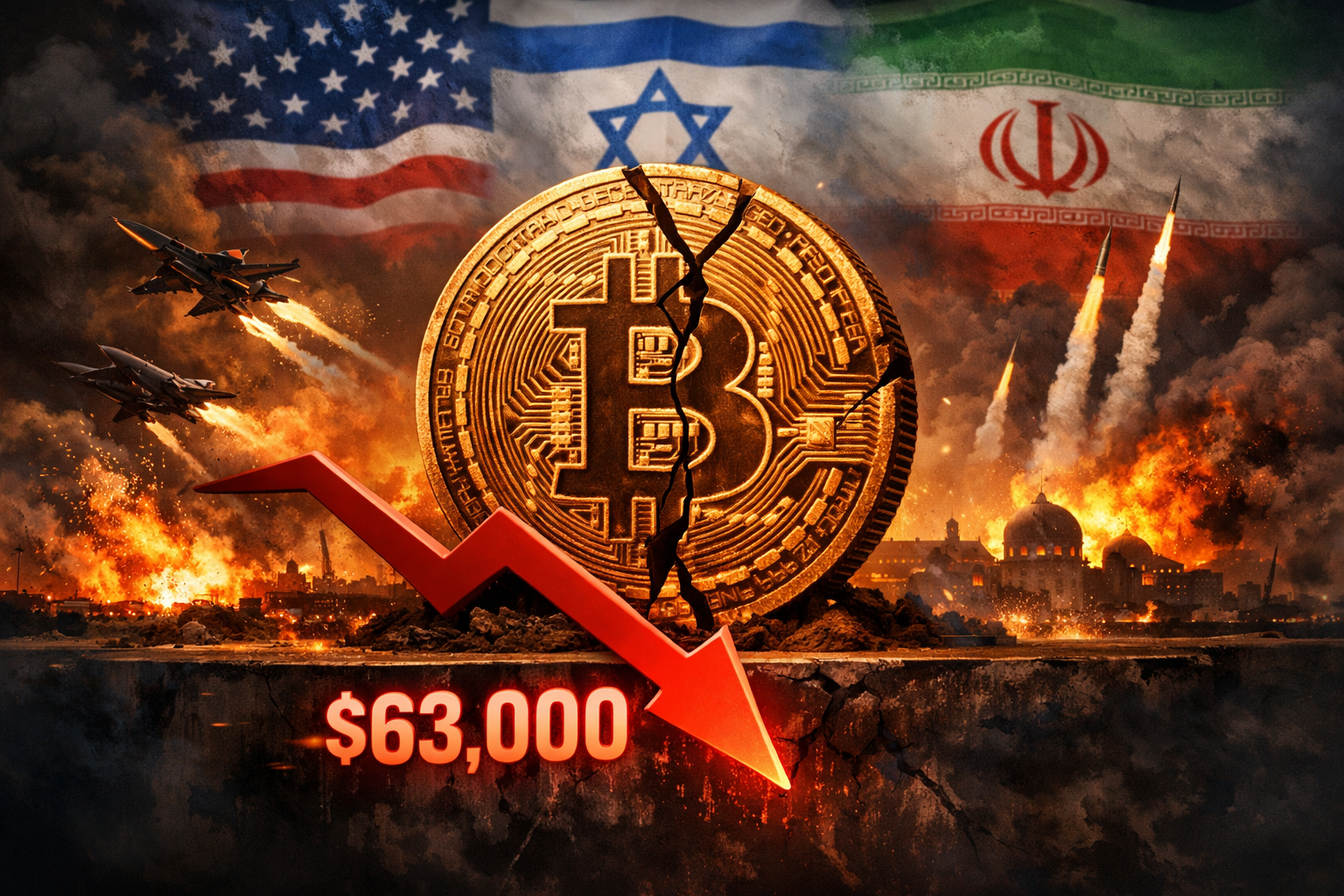
Bitcoin was trading quietly in the $65,500 range on Saturday morning when the world changed. At approximately 6:00 UTC on February 28, 2026, news broke that the United States and Israel had launched coordinated military strikes on Iran. Within minutes, Bitcoin dropped nearly 4% to $63,000, and the broader crypto market lost $128 billion in value before most of America had finished their morning coffee. Here is everything that happened and what it means for Bitcoin going forward.
What Happened This Morning
US President Donald Trump announced that the United States had begun what he called “major combat operations” against Iran, citing missile threats and stalled nuclear negotiations with Tehran. Israeli Defence Minister Israel Katz confirmed a preemptive strike had been launched against Iran, with explosions reported in Tehran shortly after. A state of emergency was declared across all of Israel, with the Israel Defense Forces warning citizens to stay close to shelters in anticipation of retaliatory missile launches.
— Donald J. Trump (@realDonaldTrump) February 28, 2026
The geopolitical shock was immediate and severe. Iran’s officials stated the country was preparing a response, warning that counterattacks could be severe. The situation had been building for weeks — US military buildup in the region had been visible, and nuclear talks between Washington and Tehran had ended without resolution, with further discussions expected this week. Those discussions are now effectively off the table.
What It Did to Bitcoin
The price action was fast and brutal. Bitcoin had been drifting lower through the final days of February, trading in the $65,500 to $66,000 range in the early hours of the 28th. Shortly after 6:00 UTC the bottom fell out. Bitcoin broke through $65,000 and accelerated toward $63,000 in a matter of minutes — a nearly 4% drop driven not by organic selling but by forced liquidations cascading through leveraged long positions across major exchanges.
Within 15 minutes of the headlines breaking, roughly $100 million in long positions were liquidated. Within one hour, total liquidations across all crypto assets reached $515 million, with 152,275 traders wiped out according to CoinGlass data. The largest single liquidation was an $11.17 million BTCUSDT position on Aster. Ethereum dropped 4.5% to $1,835. Solana fell over 10% to $78. XRP dropped over 9%. The total crypto market cap shed 5.42% in a single hour.
Bitcoin is now trading at its lowest level since the February 5th crash, when BTC briefly dipped below $60,000. The key support zone between $62,800 and $64,000 is now the line in the sand. If that level breaks, the door opens for a deeper move toward $60,000 as Monday’s traditional market open approaches and institutional players reassess their risk exposure.
Why Bitcoin Sold Off Instead of Acting as a Safe Haven
This is the question every Bitcoin holder is asking right now. If Bitcoin is digital gold, a censorship-resistant store of value immune to government intervention, why did it dump the moment bombs dropped?
The answer is nuanced but important. In the immediate aftermath of geopolitical shocks, Bitcoin does not behave like gold — it behaves like a high-beta risk asset. Gold rose on the Iran news. Oil spiked. Bitcoin fell. This is not a new pattern. It has repeated consistently across every major geopolitical shock since Bitcoin became a liquid asset. The market structure explains why: a significant portion of Bitcoin’s open interest sits in leveraged derivatives positions. When risk spikes, those positions get liquidated regardless of any longer-term thesis. The selling is mechanical, not ideological.
The derivatives data confirms this. Futures volume on Bitcoin surged to $68.27 billion during the sell-off, dwarfing spot volume of $7.02 billion. This was not long-term holders selling their Bitcoin. This was leveraged traders getting stopped out and margin called. The spot market was relatively calm. The derivatives market was chaos.
Why Long-Term Holders Aren’t Worried
Here is what actually matters. Bitcoin is the only major financial asset trading 24 hours a day, 7 days a week, including during wars. When the US and Israel launched strikes on Iran on a Saturday morning, equity markets were closed, bond markets were closed, and gold could only be traded in limited after-hours windows. Bitcoin was open. That is not a bug — it is Bitcoin’s most underappreciated feature.
The forced liquidations that drove the price down were a derivatives market problem, not a Bitcoin problem. The underlying asset did not change. The 21 million coin hard cap did not change. The Strategic Bitcoin Reserve the US government built did not change. The institutional infrastructure — BlackRock’s IBIT, Fidelity’s ETF, Strategy’s 400,000+ BTC treasury — did not waver. ETF outflows during the sell-off were minimal compared to the derivatives carnage, which tells you exactly who was selling and who wasn’t.
Long-term Bitcoin holders have seen this movie before. March 2020. COVID hits, Bitcoin drops 50% in 48 hours. Six months later it was at all-time highs. Every geopolitical shock that has hit Bitcoin since 2013 has ultimately resolved the same way — short-term pain, long-term irrelevance to the fundamental thesis.
The Iran situation adds a layer of complexity that does not exist in normal market sell-offs. A prolonged US-Iran conflict could push oil prices significantly higher, drive inflation back up, and force the Federal Reserve to delay rate cuts. That macro backdrop — higher inflation, rates held higher for longer — is historically bullish for Bitcoin, not bearish. The short-term liquidation panic and the medium-term macro setup are pointing in opposite directions.
What Happens Next
The immediate priority for Bitcoin is holding the $62,800 to $64,000 support zone through the weekend. If that level holds, the market has a chance to stabilize before traditional markets open Monday morning. If it breaks, $60,000 becomes the next target and the conversation shifts from “buying the dip” to “how deep does this go.”
Monday’s market open is the next critical moment. If US equity futures open sharply lower on Iran war fears, Bitcoin will likely follow. If markets digest the geopolitical shock and stabilize — as they often do after the initial panic — Bitcoin has a strong technical case for a recovery back toward $65,000 to $67,000.
The broader context matters here. Bitcoin enters this crisis with more institutional support than it has ever had. The US government holds 328,000 BTC and has pledged never to sell. Publicly traded treasury companies hold another 400,000+ BTC combined. The ETF structure has introduced a class of buyers who dollar-cost average regardless of headlines. These are structural buyers who were not present during previous geopolitical shocks.
The $515 million in liquidations cleared out weak hands fast. That is actually how Bitcoin bottoms are formed — forced selling exhausts itself, and the buyers who remain are the ones who understand what they own. Watch $62,800. Watch Monday’s open. And remember that every prior time the world looked like it was ending, Bitcoin eventually hit a new all-time high.
Sources:
- Bitcoin Slides Under $64,000 as US and Israel Launch Strikes on Iran — CoinDesk, Feb 28 2026
- Bitcoin Tumbles After Israel Launches Strike on Iran, $100M in Longs Liquidated — CryptoBriefing, Feb 28 2026
- US and Israel Strikes Iran Trigger Crypto Crash, Bitcoin Drops to $63K — CoinPedia, Feb 28 2026
- Iran-Israel War Escalates, Triggers Crypto Market Drops — CryptoTimes, Feb 28 2026