

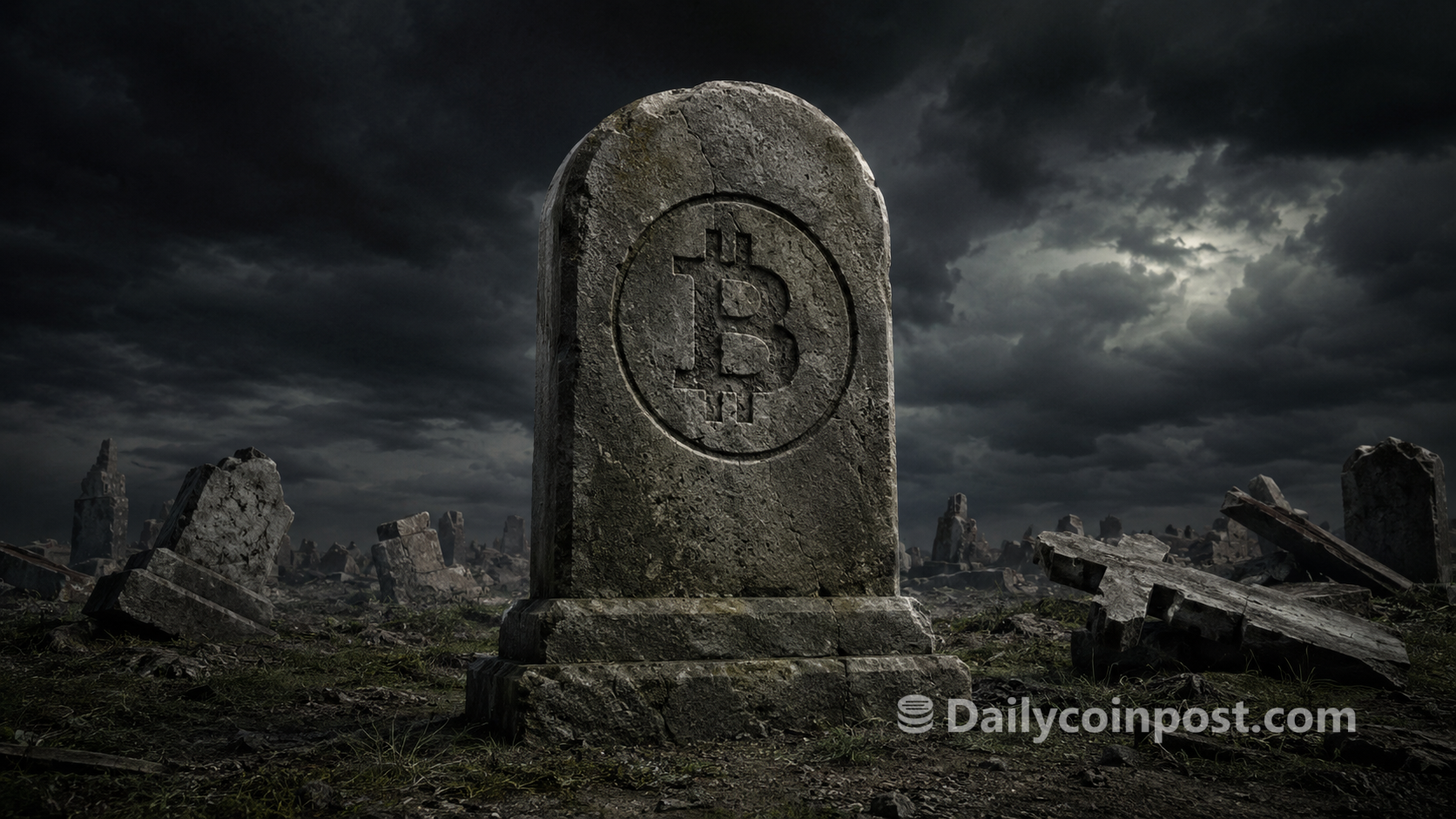
Bitcoin has been declared dead 472 times since 2010. The first obituary ran in December 2010 when Bitcoin was worth $0.11. The most recent ones are being written right now while it trades at $61,000, down 45% from its all-time high.
Every crash produces the same cycle. Price drops. Headlines appear. Obituaries are filed. Bitcoin keeps producing blocks every ten minutes.
The question underneath the obituaries is worth taking seriously. Not whether Bitcoin is dead right now. Whether it can die. And if so, what that actually looks like.
The ICU Analogy
A patient in the ICU has multiple systems keeping them alive simultaneously. A ventilator. A heart monitor. IV lines. Each failure mode is different. Losing enough of them at once changes the outcome.
Bitcoin has something structurally similar. At any given moment, completely different groups of people are using it for completely different reasons. Those who distrust governments, those who see it as digital gold, those moving wealth across borders, institutions hedging dollar debasement, developers building on top of it.
Most of these groups do not agree with each other. But together they create overlapping demand that has absorbed every shock. The 2022 crash wiped out retail speculation. Long-term holders absorbed it. The ETF outflows of 2026 are real. Institutional accumulation continues alongside them.
Bitcoin’s death requires most of those systems to fail simultaneously. Here is what each failure actually looks like.
Scenario 1: The Protocol Is Broken
Bitcoin’s security rests on two assumptions. SHA-256 hashing cannot be reversed efficiently. Elliptic curve cryptography protecting private keys cannot be broken. If either fails, the protocol fails.
Two papers in March 2026 narrowed the quantum hardware gap. The threat is real and accelerating. But a computer capable of breaking Bitcoin would almost certainly not be used to steal it. If such a machine became known, prices would collapse before any theft occurred. The more realistic threat is harvest-now-decrypt-later, recording encrypted data today and decrypting it when capable machines arrive. BIP-360, a post-quantum address standard, is already in development. NIST guidance deprecates current encryption after 2030 and bans it after 2035.
What this death looks like: A cryptographic breakthrough becomes public. Panic selling begins before any theft. The price collapses. Developers emergency fork to quantum-resistant standards. Pre-fork Bitcoin becomes worthless. Post-fork Bitcoin may or may not carry value depending on whether confidence rebuilds.
Scenario 2: The Global Ban
China banned Bitcoin mining in 2021 and wiped out 50% of global hashrate overnight. The network did not flinch. Hashrate relocated within months.
Since then the US established a Strategic Bitcoin Reserve. The EU created MiCA across 27 member states. The network runs on tens of thousands of nodes across more than 180 countries. Every country that bans Bitcoin hands an advantage to every country that does not.
What this death looks like: It does not. Not from a ban alone. A coordinated crackdown drives Bitcoin underground, craters the price, and reduces liquidity. The network keeps running. The price depends on whether enough demand survives in jurisdictions that do not participate.
Scenario 3: The Fee Market Fails
This is the death scenario nobody talks about loudly enough.
Bitcoin’s security budget comes from block subsidies and transaction fees. The subsidy halves every four years. In 2140 it reaches zero. After that, miners survive on fees alone.
The 2028 halving cuts the block reward to 1.5625 BTC. Daily miner revenue is already at multi-year lows. The fee market has not proven it can replace the subsidy at scale. If it cannot, hashrate falls, the network becomes cheaper to attack, more miners leave, and the spiral accelerates.
What this death looks like: Slow, over decades. Hashrate declines gradually. A 51% attack that currently costs billions becomes achievable at millions. An attacker reorganizes the chain, double-spends, and destroys confidence. The spiral completes. This is the death nobody wants to discuss because it happens on a timeline that makes it easy to ignore.
Scenario 4: Something Better Replaces It
Ethereum is larger by developer activity. Solana is faster. Hyperliquid is larger by derivatives volume. None have absorbed Bitcoin’s core use case as a censorship-resistant, fixed-supply store of value requiring no trusted third party.
Any system that replicates those properties fully becomes Bitcoin by definition. Any system that modifies them becomes something different.
What this death looks like: A slow market share transfer over decades. No such system has emerged.
What Would Actually Kill It
No single scenario kills Bitcoin. The simultaneous convergence of several does. A quantum breakthrough, a coordinated global response, a sustained fee market failure, and the collapse of every major holding institution. All at once.
The path to zero exists on paper. The probability is extremely low. Extremely low is not zero.
The Honest Answer
Bitcoin’s death would not look like a crash. Crashes happen and recover. It would look like a gradual withdrawal of the overlapping systems keeping it alive.
The developers stop maintaining the code. The miners stop securing the network. The institutions stop accumulating. The retail holders lose faith. The last exchange delists it quietly.
Not a moment. A process.
Despite 472 death predictions, the network has never failed to process a transaction. Every group who thought they were buying the top bought something that eventually went higher. Every obituary was eventually wrong.
That record does not guarantee the future. It just establishes what the base rate actually is.
Bitcoin’s closest analog is not a patient in the ICU. It is a patient who has walked into the emergency room 472 times and walked back out every time. Every major bear market has ended the same way.
The question is not whether it can die. The question is what would have to fail simultaneously for the overlapping systems to collapse together.
The answer is: quite a lot.