


SpaceX opened at $150 on June 12, roughly 12% above its $135 IPO price. By some measures demand was unprecedented with orders outnumbering available shares four to one. The largest IPO in history.
Binance had collected $557 million in customer subscriptions for tokenized SpaceX shares. Bybit and Bitget had their own campaigns running. Combined, more than $1 billion in customer orders sat waiting for SpaceX exposure through crypto platforms.
When underwriters finalized allocations, many of those requests went unfilled. Binance Wallet, Bybit and Bitget Wallet received no shares and canceled their offerings.
CZ’s public response to the Binance cancellation: “Protect users when things don’t go as planned.” No explanation of how the sourcing breakdown occurred.
Meanwhile Hyperliquid, with no shares to source and no allocations to chase, cleared $1.4 billion in SPCX perpetual futures in a single session.
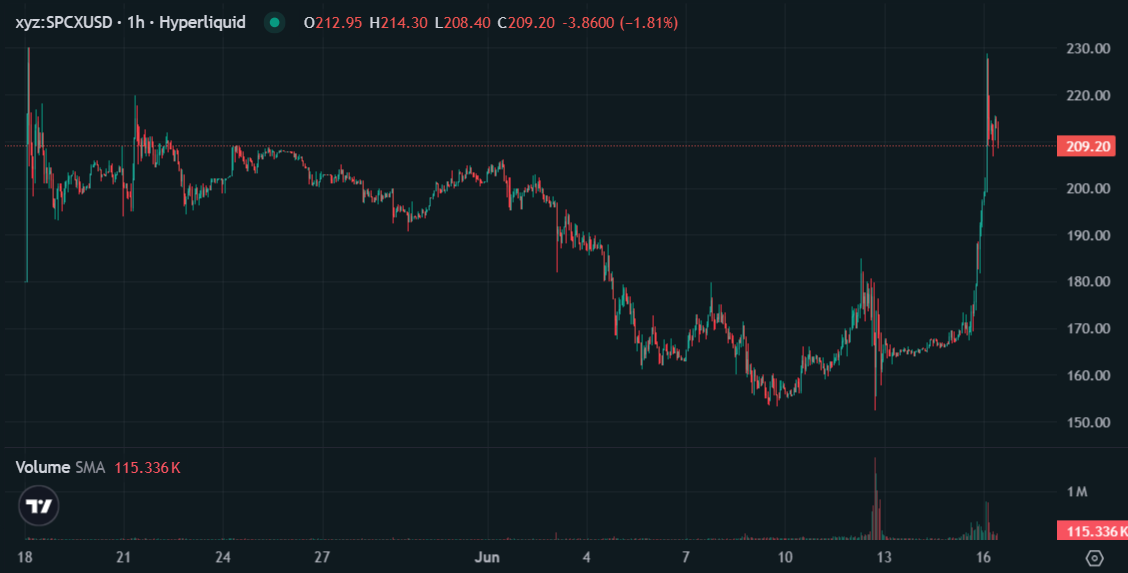
SPCX-hyperliquid – Source: Hyperliquid
How the Collapse Happened
All three exchanges had relied on xStocks, a Kraken product that converts real equities into blockchain tokens. The platforms had marketed the offering as a way for retail investors to gain access to one of the most sought-after IPOs in years through tokenized shares. One person familiar with the matter told CoinDesk that xStocks and its distribution partners gathered more than $1 billion in customer orders. But when underwriters finalized allocations, many of those requests went unfilled.
Bybit moved first, telling subscribers that “due to xStocks’ inability to deliver the underlying assets, no SpaceX allocations were received.” Binance followed citing “circumstances outside of our control.” Bitget also canceled and refunded.
xStocks has made no public statement explaining why it could not deliver the shares. The silence from the middleman that broke the chain is the part nobody has answered.
The damage to customers was concrete. Retail crypto users who subscribed for IPO-priced exposure missed SpaceX’s roughly 19% first-day gain. They watched the stock move while their funds were locked in a subscription campaign that delivered nothing.
A separate problem hit preStocks users differently. They had received actual allocations but discovered a 180-day lockup on their shares only after trading opened. While the stock gained 19% they were unable to sell.
Why Hyperliquid Had No Problem to Solve
Hyperliquid’s SPCX perpetual contract tracks SpaceX’s share price through funding rates without requiring actual stock custody. No need for allocations, intermediaries, lockups, or dependence on xStocks.
SPCX perps generated $1.4 billion in volume on Hyperliquid on IPO day, around 30% of all HIP-3 ecosystem trading that session. HYPE gained roughly 10% on the day. HIP-3 stock perps had already posted $18.8 billion in volume in the first half of June, outpacing WTI and Brent crude perpetuals on the same platform.
Meanwhile, rival onchain protocols from Ondo, xStocks’ DeFi arm, and Backpack launched successfully on the same morning, showing that the failure was not in the concept of onchain stock exposure. It was specifically in the centralized custody model that Binance, Bybit, and Bitget had built their products around.
The onchain tokens went live. The synthetic perps went live. Only the share-sourcing route through the three exchanges broke down.
What This Proves
Tokenized equity built on real-share custody has a structural ceiling that shows up exactly when demand peaks. When the hottest IPO in history hits and every institution in the world is chasing the same shares, the middleman that was supposed to source those shares for retail crypto users is last in line.
Synthetic perpetuals have no ceiling of that kind. Synthetic perpetual futures cannot run out of shares because they never needed them.
SpaceX opened at $150, roughly 11% above the $135 IPO price, and SpaceX raised $75 billion from the share sale at a valuation of approximately $1.77 trillion, making it the largest IPO in history. The $1.4 billion in Hyperliquid perps represents about 1.7% of the roughly $80 billion in day-one Nasdaq equity volume. Not a rival to traditional markets yet.
But the comparison that matters is not Hyperliquid versus Nasdaq. It is Hyperliquid versus Binance. On the biggest IPO day in history, one of them delivered. Three of them did not.
The customers who wanted SpaceX exposure through crypto got one of two outcomes: a refund and a consolation airdrop, or a 180-day lockup they did not know about.
The customers who traded SPCX perps on Hyperliquid got exposure to a 19% move on the largest IPO in history.