

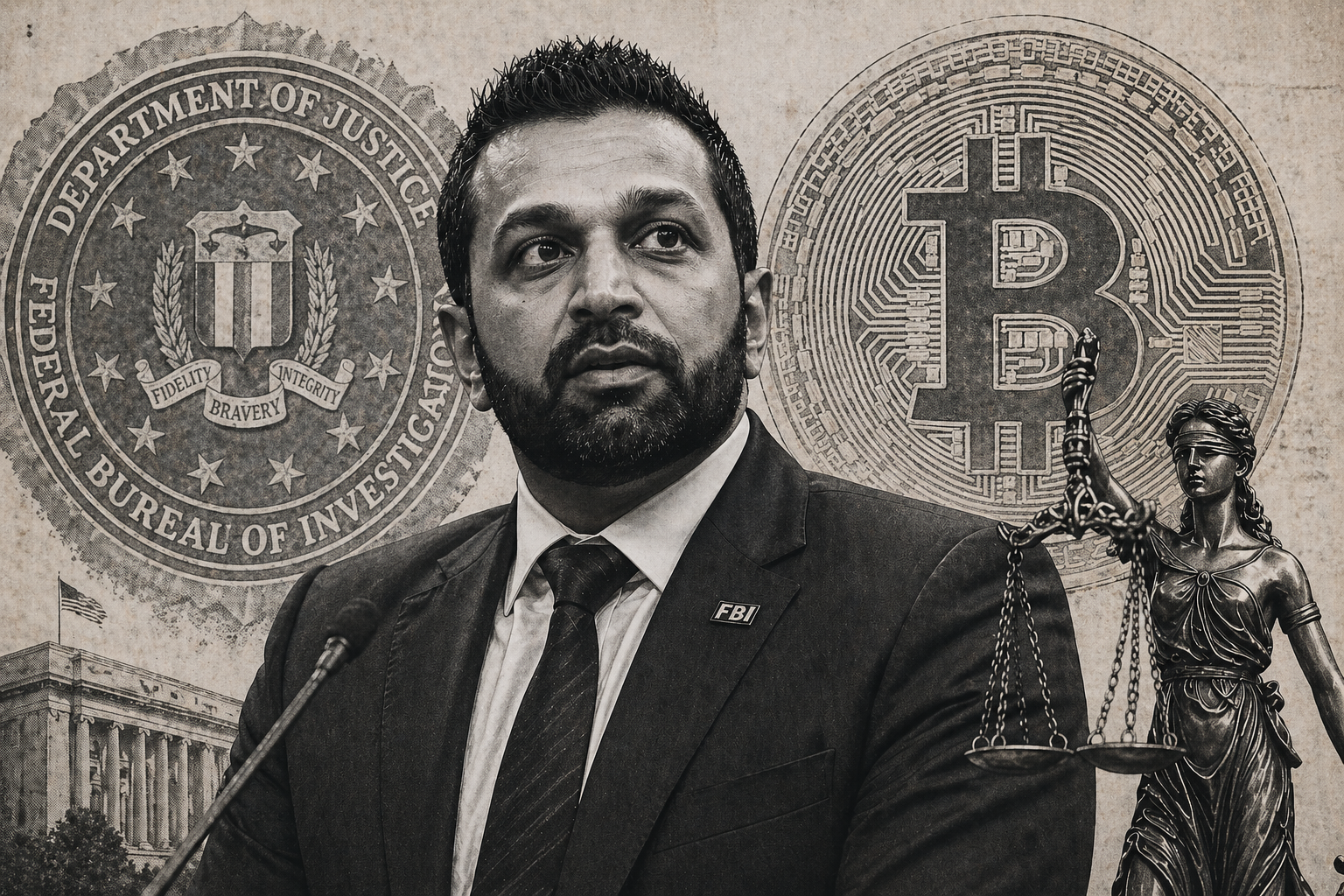
Sunday morning, Las Vegas. The Venetian Resort. Forty thousand people who own Bitcoin gathered in one building, and the person standing at the podium was the Director of the Federal Bureau of Investigation.
Kash Patel did not come to warn them. He came to apologize.
Not in those words. Government officials do not apologize. But the session was titled “Code is Free Speech: Ending the War on Bitcoin,” and the message was clear enough. The same institution that spent the better part of a decade treating Bitcoin developers as money laundering suspects, that prosecuted Tornado Cash developers, that raided crypto companies under the premise that writing code equals operating an unlicensed financial business, sent its director to the world’s biggest Bitcoin conference to say: we were wrong, and it is over.
Acting Attorney General Todd Blanche sat beside Patel in the fireside chat. Both officials stated that open-source cryptographic code is protected speech under the First Amendment, according to reporting from crypto.news. That is not a press release. That is the two most powerful law enforcement officials in the country drawing a legal line in front of 40,000 witnesses.
For Bitcoin developers who spent years watching colleagues get indicted for writing software, it was a significant moment. Whether it was a victory is a different question.
What Actually Changed
The practical implication of Patel and Blanche’s statement is significant. Categorizing open-source code as protected speech creates a legal argument that developers who write non-custodial tools cannot be prosecuted simply for the existence of their code, regardless of how third parties use it. This is the argument Tornado Cash developer Roman Storm has been making in his own defense. His legal team pushed back sharply after Blanche suggested last week that Tornado Cash cases could be elevated, arguing the DOJ cannot claim policy change while still pursuing Storm’s prosecution. That contradiction remains unresolved.
Senator Cynthia Lummis announced from the same stage that the CLARITY Act markup will happen in May, the most concrete legislative timeline commitment since the bill stalled. SEC Chair Paul Atkins unveiled Project Crypto, a Commission-wide initiative to modernize securities rules and establish a new token taxonomy. Patrick Witt from the President’s Council of Advisors for Digital Assets teased an upcoming announcement on the US Strategic Bitcoin Reserve, hinting at legal mechanisms to hold digital assets on the national balance sheet beyond the current executive order.
In a single conference, the FBI, the DOJ, the SEC, and the White House all showed up to say the same thing. Bitcoin is legitimate. Building on it is not a crime. The regulatory framework is coming.
That is a lot of institutional validation for an asset that was built to need none.
The Part the Press Release Did Not Mention
Simon Dixon has been involved in Bitcoin since before most of the people at The Venetian had heard of it. He was an inaugural speaker at the conference when it was small enough that you could fit the whole crowd in a single room. On the eve of Bitcoin 2026, he posted: “Let’s face it, this Bitcoin conference is compromised. Bitcoin is open source code. It’s a big mistake not to understand the difference.”
His point was not about the FBI or the AG. It was about what the conference had become. The speaker list included BlackRock’s head of digital assets, the SEC Chair, the Acting AG, the FBI Director, Strategy’s Michael Saylor, and the Governor of the Czech National Bank. What it did not include, in any prominent position, was the kind of person who built Bitcoin’s foundational infrastructure because they believed in a world without trusted third parties.
Bitcoin ETFs now collectively hold more than one million coins. More Bitcoin is held through ETFs, corporate treasuries, and custodial platforms than directly by individuals using self-custody wallets. The conference celebrated this as adoption. Dixon called it a betrayal. It is the same irony we wrote about when BlackRock accumulated 800,000 Bitcoin while Satoshi’s coins sat untouched.
Both things can be true simultaneously. Institutional adoption is real and it is growing. The ethos that produced Bitcoin in the first place is also being quietly sanded down by the same process. We explored this tension in depth when we asked whether Satoshi himself would have shut Bitcoin down by now.
The Pattern Nobody Is Naming
Think about what the US government has done in the past thirty days.
The military confirmed it runs a live Bitcoin node and called it power projection. The White House is evaluating legal mechanisms to hold Bitcoin on the national balance sheet. The FBI Director flew to Las Vegas to declare Bitcoin code is protected speech. The SEC Chair unveiled a comprehensive regulatory framework to legitimize the entire industry. The Acting AG sat beside the FBI Director on a Bitcoin stage.
This is not a coincidence. This is a coordinated posture shift by the US government toward an asset it spent years fighting. The question worth asking is not whether this is good for Bitcoin. The question is why it is happening now, and what the government expects to get in return.
When an institution that spent years treating something as a threat starts treating it as an ally, it is worth understanding what changed. Sometimes the answer is that they were simply wrong and they corrected course. Sometimes the answer is that they found a way to use it.
The FBI Director declaring code is free speech is good for Bitcoin developers. It is also exactly what a government would say before it tried to become Bitcoin’s most important stakeholder.
Both of those things can also be true simultaneously.