


Crypto Twitter got a rare thing this week: a major influencer pointing at fundamentals instead of narrative.
Ansem, one of the most followed traders in the space, posted a comparison between $CARDS, the native token of Solana-based card trading platform Collector Crypt, and $VVV, the token behind Venice AI. The argument was simple. Collector Crypt generates nearly the same revenue as Venice. Venice’s market cap is sitting close to $800 million. CARDS is trading at a fraction of that valuation.
CARDS moved 17.5% within hours.
$CARDS generates almost the same revenue as $VVV which is at 1B+ market cap but because its on solana instead of base & the zoomers have decided to only bid memes it still sits at $40M
differentiated app in its own vertical with very little competition https://t.co/MdTVJleUOX pic.twitter.com/GxmtUWOhNU
— Ansem (@blknoiz06) May 25, 2026
What Collector Crypt Actually Is
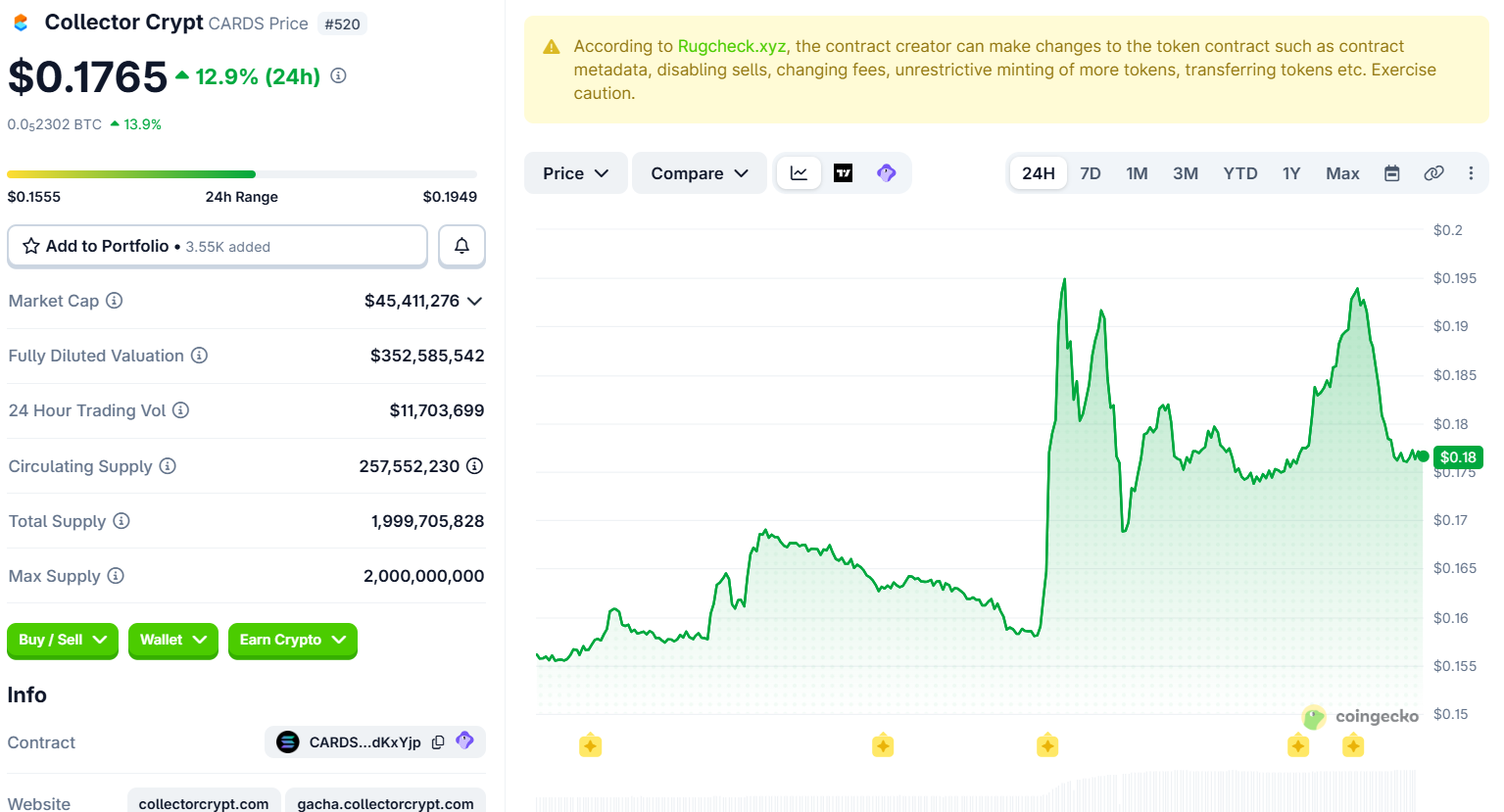
Collector Crypt (CARDS) trading at $0.1765, up 12.9% on the day. Market cap $45M against a fully diluted valuation of $352M. Source: CoinGecko
Most people who saw CARDS trending today have no idea what Collector Crypt does. That is part of the story.
The platform lets users buy, trade, and collect tokenized trading cards through a Gacha-style pack opening mechanic on Solana. It is a consumer app with a real product, real users, and real revenue. The platform has processed over $145 million in total transactions. In March 2026 alone, weekly spending hit a record $21.5 million. Monthly gross volume is running at roughly $87 million. According to a May 7 analysis flagged by CoinMarketCap, the token was trading at approximately a 1.0x price-to-earnings ratio.
A 1.0x P/E ratio in crypto. Let that sit for a moment.
The platform expanded to BNB Smart Chain in March, confirmed $30 million in tokenized real-world asset backing in May, and has been building partnerships with Metaplex and SolNFTs. These are not vaporware announcements. They are operational updates from a product people are actually using.
The VVV Comparison
Venice Token is a legitimate project. A decentralized AI inference platform built by Erik Voorhees, it lets users access private, uncensored AI models by staking VVV. The token has run over 1,500% since December 2025, recently hit an all-time high above $22, and sits near a $800 million market cap today with strong institutional interest and a growing user base.
The revenue picture is what Ansem was pointing at. Venice had its strongest revenue day ever on May 11, 2026. But Collector Crypt is posting $87 million in monthly gross volume with real transaction fee capture. Both are generating meaningful revenue from real product usage. One is valued at $800 million. The other, before today’s move, was an afterthought.
That gap is what moved the price.
One Risk the Chart Does Not Show
One caveat worth noting. CoinGecko flags a Rugcheck.xyz warning on the CARDS contract: the creator retains the ability to modify contract metadata, disable sells, change fees, and mint additional tokens. That does not make the revenue story false. It does mean the risk profile is different from what the fundamentals alone suggest. Anyone looking at CARDS as a value play should weigh the contract risk against the revenue argument.
Why It Matters Beyond the Trade
Crypto has been conditioning participants to ignore fundamentals for years. Narrative wins. Meme wins. Influencer endorsement wins. The idea that you could look at a token the same way you would look at a small-cap business, check the revenue, check the multiple, and find something genuinely undervalued, has been treated as unsophisticated for most of the bull market.
What happened today with CARDS is a reminder that it does not always stay that way.
The meme coin exhaustion playing out across the market in 2026 has pushed some capital toward a different question: which crypto apps are actually making money? CARDS was a reasonable answer to that question before Ansem said anything. The 17.5% move is the market catching up to math that was already sitting in the open.
Whether CARDS holds the move or gives it back depends on whether the platform can sustain its volume trajectory. The fundamentals support the attention. The gacha mechanic drives recurring spending. The multi-chain expansion broadens the addressable user base. The $30 million in tokenized asset backing gives the buyback mechanism real collateral.
None of that is guaranteed to keep working. Consumer crypto apps have collapsed before. But the valuation argument that Ansem made was not a prediction. It was a comparison. And comparisons like that are increasingly what this market is paying for.