

The Crypto Fear and Greed Index reads 18 out of 100 today. That puts it firmly in Extreme Fear territory, a zone it has barely left since Bitcoin’s all-time high of $126,000 last October. The index hit a historic low of 5 on February 6 — the deepest fear reading ever recorded, worse than the 2022 bottom, worse than any crash before it.
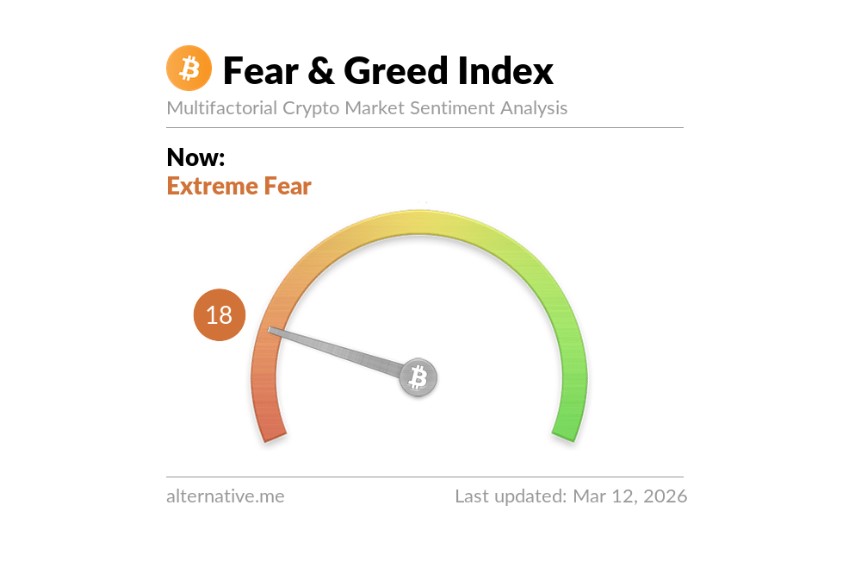
Bitcoin’s price right now: roughly $70,000.
That tension is worth sitting with. The sentiment gauge is screaming panic. The asset it measures is holding a price that would have seemed impossible three years ago. Something does not add up, and figuring out what is the more useful exercise than watching the index move.
What Actually Happened
Bitcoin peaked at $126,000 in October 2025. It then fell to $60,062 on February 6 — a 52% drawdown that wiped $2 trillion from total crypto market cap in weeks. Over $1.26 billion in positions were liquidated in a single day at the bottom. The Fear and Greed Index collapsed alongside the price.
Since then Bitcoin has recovered to $70,000 and is holding there despite a war in the Middle East, oil above $100, equity markets under pressure, and sentiment that has barely moved off the floor.
The people who sold at the bottom sold to someone. That someone was not retail.
Whale wallets accumulated 270,000 BTC over the past 30 days according to Glassnode data. That is roughly $18.7 billion worth of Bitcoin bought quietly while the Fear and Greed Index was flashing its loudest warning. On one single day in early March, whales purchased 66,940 BTC in a single session.
What the Fear Index Actually Measures
The Fear and Greed Index captures how people feel. It measures volatility, social media sentiment, Bitcoin dominance, search trends, and market momentum. It is a sentiment tool, not a price prediction tool.
The historical context matters here. When the index drops below 15, Bitcoin has delivered positive 30-day returns roughly 80% of the time according to data tracked by Alternative.me. The 2022 low of 6 preceded a recovery that took Bitcoin to new all-time highs by 2024.
None of that makes the index a buy signal. It means fear and price are not the same thing. The index measures emotional temperature. The price measures what buyers and sellers actually agreed to do with real money. Right now those two things are telling different stories.
The Bear Case Is Real
The honest version of this article includes the bear arguments.
Citi analyst Alex Saunders has warned of potential downside to $39,000 to $53,000 if Bitcoin breaks below $70,000. Canary Capital’s Josh Olszewicz is forecasting a prolonged bear market through Q4 with stabilization around $50,000 to $60,000. K33 Research expects Bitcoin to consolidate between $60,000 and $75,000 for weeks or months before a directional move.
ETF inflows, which drove the 2024 to 2025 bull run, have turned to outflows. Roughly $7.8 billion has left Bitcoin ETFs since November 2025 — about 12% of total assets under management. Funding rates across major exchanges are negative, meaning leveraged traders are positioned short.
The war premium in oil is also inflationary, which pushes the Fed toward staying tighter for longer, which pressures risk assets. Bitcoin is not immune to macro.
The Part That Does Not Fit the Bear Narrative
If this were a genuine capitulation, you would expect whales to be selling. You would expect Bitcoin dominance to be falling as money exits crypto entirely. Instead, Bitcoin dominance is sitting at 56.8% — near multi-year highs. Money is leaving altcoins but staying in Bitcoin specifically.
That is flight to quality within crypto, not flight out of crypto entirely.
The US Strategic Bitcoin Reserve exists because the US government made a long-term bet on Bitcoin before this selloff. Strategy bought 7,000 more Bitcoin this week. Citi is building infrastructure for institutional Bitcoin access. These are not the actions of entities pricing in $39,000.
What This Moment Actually Is
Bitcoin fell 52% from its peak and is now recovering. That is not unusual. Bitcoin fell 83% in 2018 and 77% in 2022 before reaching new all-time highs both times. A 52% drawdown from $126,000 lands at $60,000 — which is exactly where the February low was.
The Fear and Greed Index at 18 tells you most people in the market are scared. It does not tell you the scared people are right.
Tom Lee at Fundstrat has a 2026 Bitcoin price target of $200,000 to $250,000 and called March a turnaround month. The whale accumulation data supports the idea that large holders used the February fear to build positions at prices they considered attractive.
Whether that plays out or the bears are right about $39,000 is genuinely unknown. What is known is this: the last time the Fear and Greed Index was this low, the people who held or bought came out ahead. That has been true every single time in Bitcoin’s history.
The index is at 18. Bitcoin is at $70,000. One of those numbers is going to be wrong about what happens next.