


MemeCore’s M token fell from $2.66 to an intraday low of $0.50 on Thursday, a 76% drop in a single session that wiped its market cap from roughly $3.5 billion down to under $1 billion. Most of the coverage today is treating that number as the story.
It isn’t. Pull up the three-month chart and the real story is sitting right there in plain view. M peaked above $4.50 in April. By mid-June, before Thursday’s crash even started, it had already ground down to somewhere between $1.50 and $2.00. Thursday’s move was not a sudden break in a healthy chart. It was the final leg of a slide that had been running for ten straight weeks.
From the April peak to today’s intraday low, M is down somewhere around 89%. The 76% figure everyone is reporting is just the part that happened to land in a single news cycle.
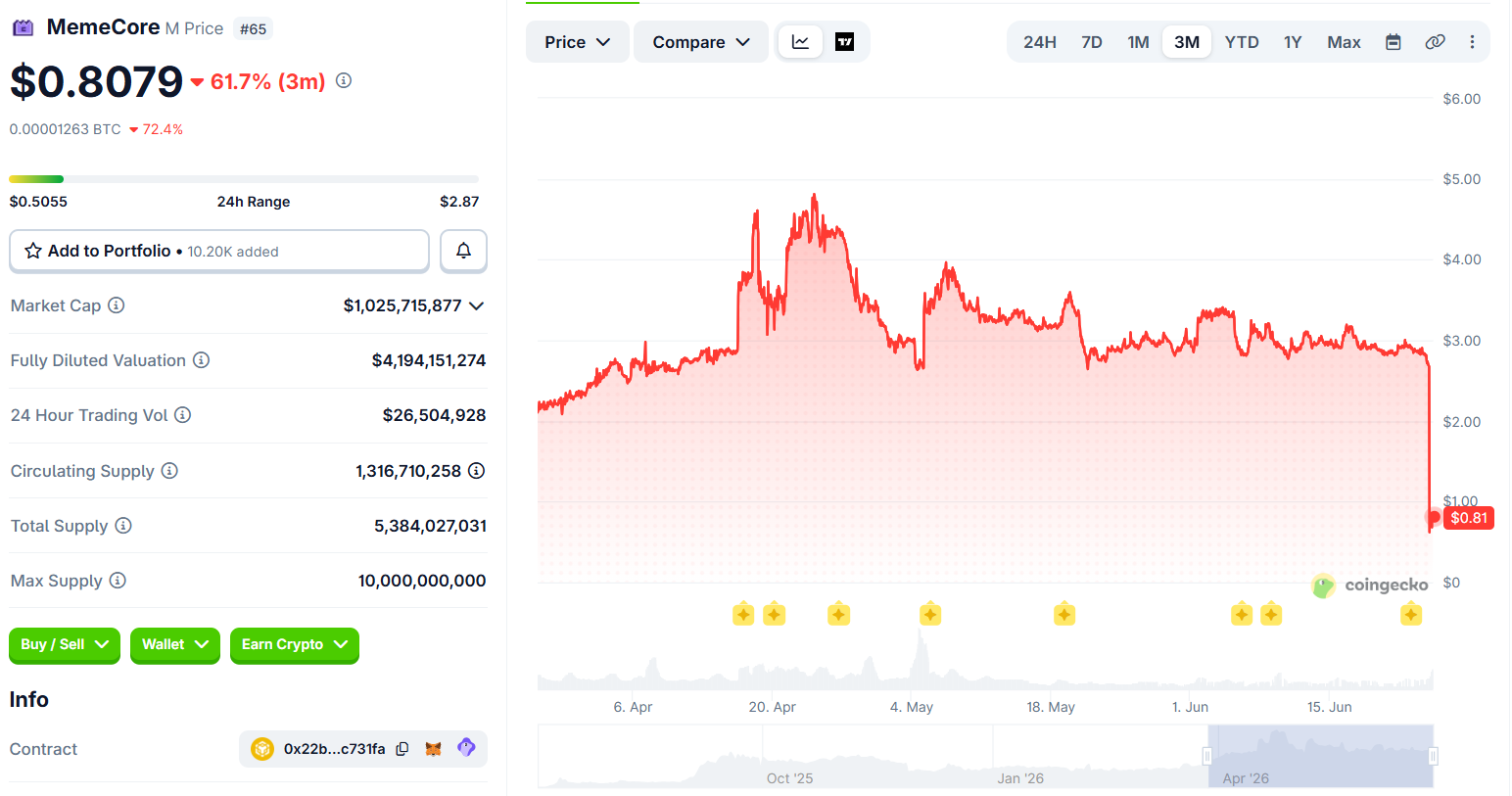
M had already drifted down to roughly $3 before the final leg gave way. The crash everyone is reporting today is the right edge of this chart, not the whole story. Source: Coingecko
The Warnings Were Already on the Record
Onchain investigator ZachXBT addressed the crash directly in a post to his Telegram channel. The numbers he cited tell a sharper version of the story than the headline figures circulating elsewhere. M’s fully diluted valuation fell from $14 billion to $3.8 billion. That drop knocked the token out of the top 25 by market cap entirely.
He and two other researchers, Mlm and Wazz, had already flagged this token months earlier. They pointed to inorganic supply concentration. They also called out deceptive practices by the MemeCore team to inflate user numbers.
The onchain data behind those warnings was not subtle. According to data ZachXBT cited from Arkham, there had not been a single transfer above $50,000 on BNB Smart Chain in more than two weeks. Dexscreener data showed under $100,000 in total onchain liquidity on that chain. A token carrying a multi-billion dollar valuation with that little liquidity underneath it is not a token that can absorb real sell pressure. It is a token waiting for the first person who tries.
ZachXBT’s question after the crash was not really a question. “The community needs answers from Binance & Bybit about why M was listed for perps and why Kraken & Bitget listed M spot,” he wrote, “as these highly manipulated tokens continue to give our industry a bad reputation and extract from retail.” Four major exchanges had access to the same liquidity numbers a Telegram channel could pull up for free, and listed the token anyway.
Why did Kraken list $M (Memecore) on July 3, 2025 for spot and how did it pass due diligence?
$7.9M in suspicious Kraken withdrawals to 18 newly created addresses with 11.7 $M sitting total (valued at $39.8M now).
Insiders have manipulated the price to $6B market cap ($18B FDV)… pic.twitter.com/pL7oroZ4lJ
— ZachXBT (@zachxbt) April 20, 2026
What Actually Happened Here
There was no news catalyst Thursday. No hack, no regulatory action, no founder scandal breaking that day. The absence of a trigger is itself the answer. A token sitting on under $100,000 of real onchain liquidity does not need a catalyst to fall 76% in an afternoon. It needs someone willing to sell into a market that was never deep enough to hold the weight it was carrying. That was always going to happen eventually. Thursday is just the day it did.
The token is now ranked 72nd by market cap. The wider market moved 1.64% over the same stretch. M’s loss was roughly 46 times that, in the same window, with no external reason to point to. The reason was already sitting in the liquidity numbers ZachXBT published in April, the same numbers that were visible to every exchange that decided to list it anyway.
Retail traders bought a token with a multi-billion dollar valuation built on less liquidity than most people keep in a checking account. The exchanges that listed it for both spot and perpetual trading had access to the same onchain data the rest of us did. The warning was not hidden. It just was not load-bearing enough to stop four major platforms from listing it anyway.