


Bitcoin has crashed and recovered three times in the past decade. Each crash looked different on the surface. The causes were different, the catalysts were different, the headlines were different. But the recovery mechanism was the same every time. The same indicators fired at the same point in the cycle, the same type of holder capitulated, and the same signal preceded the turn.
Understanding that pattern does not tell you when the bottom is. It tells you what conditions need to be present before one is possible. Right now some of those conditions are in place. Some are not.
Here is the full picture.
The Three Bear Markets and What Killed Them
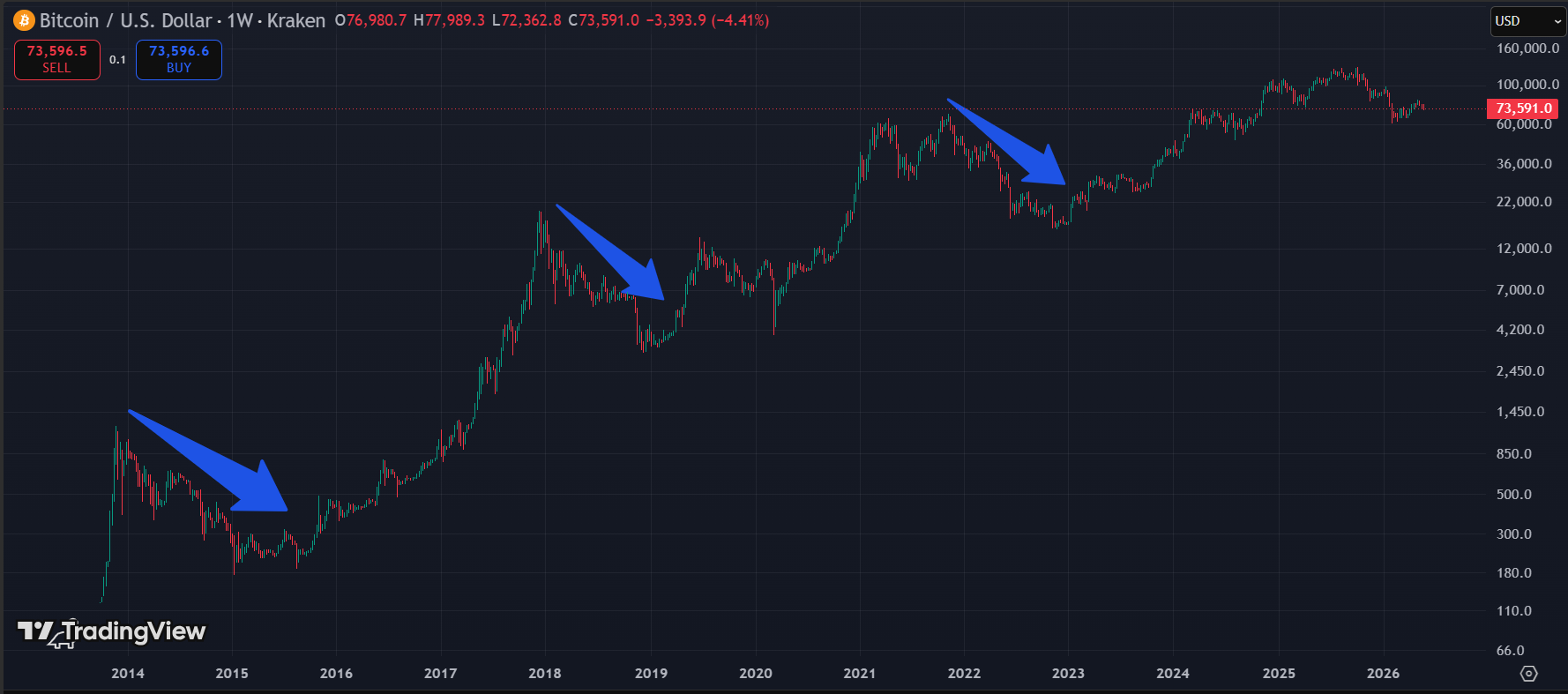
Three bear market bottoms marked with arrows: 2015 near $150, 2018 near $3,100, and 2022 near $15,476. Each bottom was followed by a new all-time high. Source: TradingView / Kraken
2015: The “Bitcoin Is Dead” Bottom
Bitcoin peaked near $1,200 in November 2013 and spent the next 14 months in a grinding decline that took it to $152 in January 2015. The 2015 bear cycle lasted 406 days and bottomed at an 86% retracement. At the low, major publications were writing Bitcoin’s obituary. Mining was unprofitable for most operators. The Mt. Gox collapse had destroyed retail confidence the year before.
What ended it was not a news event. It was a chart signal. As price stabilized and began recovering, the 50-day moving average crossed back above the 200-day moving average on the daily chart. That crossover, known as the golden cross, confirmed that near-term momentum had finally overtaken the longer-term downtrend. BTC subsequently rallied from $200 to nearly $20,000 by the end of 2017.
2018: The ICO Hangover Bottom
Bitcoin peaked at $20,000 in December 2017 on the back of the ICO bubble. The 80% drawdown from $20,000 in late 2017 took Bitcoin to $3,100 in December 2018. The collapse was driven by regulatory crackdowns on ICOs, the unwinding of leveraged futures positions opened at the peak, and the slow exit of retail investors who had bought the top of the cycle.
The 50-day moving average spent months below the 200-day, the death cross structure that defined the entire decline. When the golden cross finally reformed in early 2019, it marked the end of the bear phase. From that crossover, Bitcoin ran from roughly $4,000 to $14,000 before consolidating ahead of the next cycle.
2022: The Contagion Bottom
Bitcoin peaked at $69,000 in November 2021. The 78% collapse from $69,000 in November 2021 took Bitcoin to $15,476 in November 2022. The causes were specific and severe: Terra/Luna collapsed in May 2022, wiping $40 billion in a week. Three Arrows Capital failed. Celsius, BlockFi, and FTX all collapsed within months of each other. The defining features of the 2022 bear market were exchange collapses, balance-sheet failures, and contagion from overleveraged platforms.
The death cross, where the 50-day fell below the 200-day, had been in place since early 2022. The golden cross reformed in early 2023 as price recovered from the lows. BTC later rallied to $126,000 by October 2025.
Three bear markets. Three death crosses that defined the decline. Three golden crosses that confirmed the turn. Each time the crossover reformed, it happened near a major bottom that the price has never revisited since.
The Indicators That Fire at Every Bottom
The golden cross is the most visible signal but it is not the only one. Three on-chain metrics have converged at every major bottom in Bitcoin’s history.
Long-Term Holder Supply in Loss
In the 2015 bear market, around 53% of the long-term supply was at a loss. At the 2018 bottom it was 45% and at the 2022 bottom it was 44%. These levels were times of peak capitulation, when the weak hands were forced out and long-term investors were taking losses. When long-term holders, defined as wallets that have held Bitcoin for at least 155 days, are selling at a loss in significant numbers, it signals that even the committed buyers have exhausted their patience. That is the final flush.
LTH SOPR Below 1.0
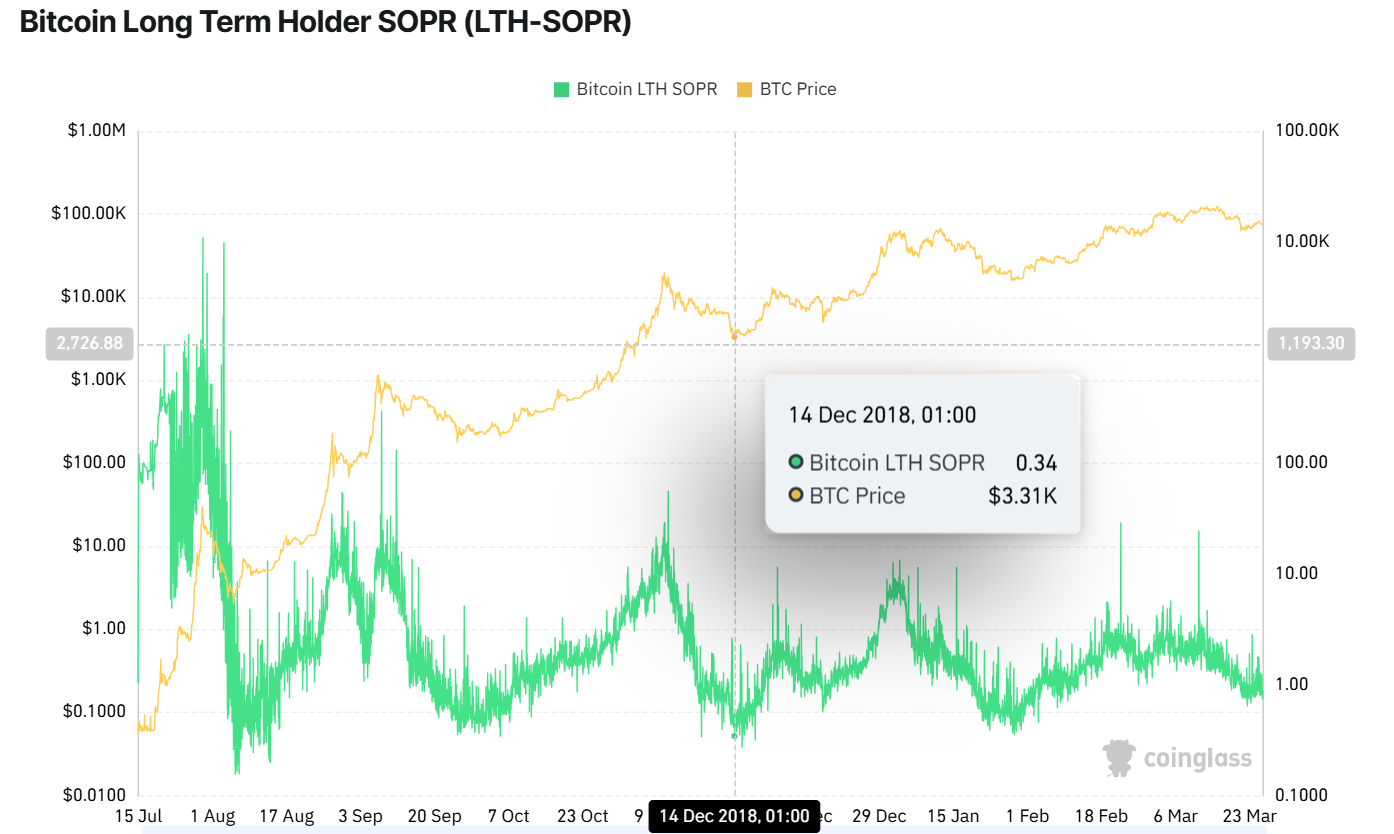
LTH-SOPR hit 0.34 on December 14, 2018 as Bitcoin traded at $3,310 — the 2018 bear market bottom. Readings below 1.0 indicate long-term holders are selling at a loss, historically a late-stage capitulation signal. Source: Coinglass
The Realized Profit/Loss Ratio has historically broken below 1.0 during confirmed bear markets and stayed there for months before recovering. It stayed sub-1.0 for seven months in 2015, eight months in 2018 to 2019, and six months in 2022. A reading below 1.0 means long-term holders are spending Bitcoin at a loss. When that persists for months rather than days, it marks the exhaustion phase that precedes recovery.
MVRV Z-Score Below Zero
During confirmed bear market bottoms in 2015, 2018, and 2022, the MVRV Z-Score plunged below zero, meaning the network was valued below its aggregate cost basis. When Bitcoin’s market value falls below what all holders collectively paid for it, the market is pricing in unrealized losses across the entire holder base. That is historically where the buyers with long time horizons step in.
Where We Are Now
Realized profit collapsed 96% from the July 2025 peak of roughly $3 billion per day to under $100 million per day. Exchange reserves are at a seven-year low of roughly 2.21 million BTC. Short-term holder realized losses totaled $1.2 billion over a single week, reflecting aggressive panic selling by investors who bought during the late-2025 rally above $90,000.
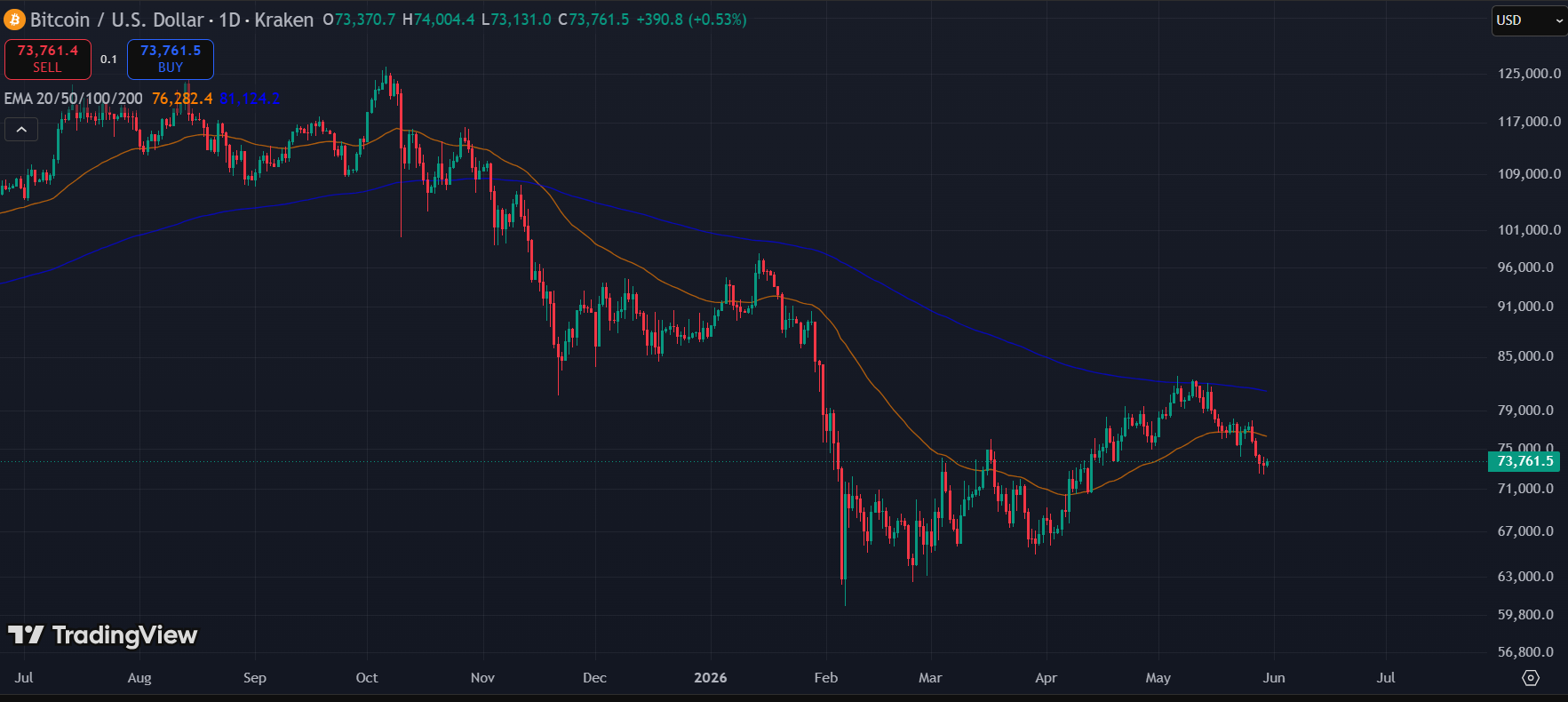
Bitcoin daily chart showing the 50 EMA at $76,282 and 200 EMA at $81,134 converging as price holds near $73,761. The gap between the two averages has been closing since the February 2026 low at $61,000. A golden cross would form if the 50 EMA continues rising toward the 200. Source: TradingView / Kraken
The 50-day moving average and 200-day moving average are currently converging but the golden cross has not yet formed. The 50-day sits at $76,286 and the 200-day at $81,125. The gap is closing but price is below both averages, still in death cross territory. The defining signal that marked every previous recovery has not fired.
The MVRV Z-Score sits at 1.2, in a neutral-to-cooling zone. At confirmed bear market bottoms it plunged below zero.
The Realized Profit/Loss Ratio fell below 1.0 earlier this year. Historical patterns suggest a sustained recovery above 1.0 may not materialize until August to September 2026.
The honest reading: some signals are in the late-stage bear market zone. The golden cross has not yet formed. Bernstein Research noted the current selloff lacks the defining features of the 2022 bear market. There have been no major exchange failures or systemic credit events this cycle. That may mean the bottom comes at a shallower drawdown than previous cycles. It may also mean the recovery comes faster once it does.
What Is Different This Cycle
Three things separate 2026 from the previous bear markets in ways that matter.
The first is ETFs. In 2015, 2018, and 2022 there were no spot Bitcoin ETFs. Institutional redemptions now create mechanical selling pressure that did not exist in previous cycles. The recent bounce toward $75,000 is likely a temporary recovery rather than the start of a full-fledged bull run, based on on-chain readings alone.
The second is the geopolitical layer. The Iran conflict, oil above $100, and the stalled GENIUS Act are creating macro headwinds that have no equivalent in previous cycles. Bitcoin’s previous bear markets were primarily crypto-driven. This one has external inputs.
The third is the golden cross forming on the daily chart, where the 50 and 200 EMAs are converging. In previous cycles the golden cross confirmed the bottom after the on-chain indicators had already shown capitulation. Right now the on-chain signals are in late-stage bear territory but the golden cross has not yet formed. When it does, history says it will matter.
The Pattern Has Not Failed
Every Bitcoin bear market has ended. Every one. The causes of each crash were unique. The recovery mechanism was not.
Long-term holders accumulate through the decline. Short-term holders exhaust their selling. Exchange reserves drain. The 50-week average crosses the 100-week. Realized losses peak and reverse. And then, at a moment that is only obvious in retrospect, the market turns.
Bitcoin typically takes 24 to 26 months to surpass previous highs and peaks 35 months after hitting a bear market bottom. The 2022 low of $15,476 was followed by a 704% rally to $129,000, reinforcing the cyclical predictability of Bitcoin’s market structure.
The indicators that called every previous bottom are showing late-stage bear market conditions in 2026. The defining signal has not yet fired. That is the honest position: not confirmed, but not far.
The pattern has not failed. It is just not finished yet.