

On Tuesday morning, one unknown investor sold $1.29 billion of BlackRock’s IBIT in a single dark-pool block trade. One transaction. One unidentified party. Executed at 10:30 a.m. ET. Galaxy Research’s Alex Thorn called it the largest single institutional Bitcoin ETF print on record.
The next morning, the US military struck Iran.
That is the sequence. Hold it in your head.
What Happened, in Order
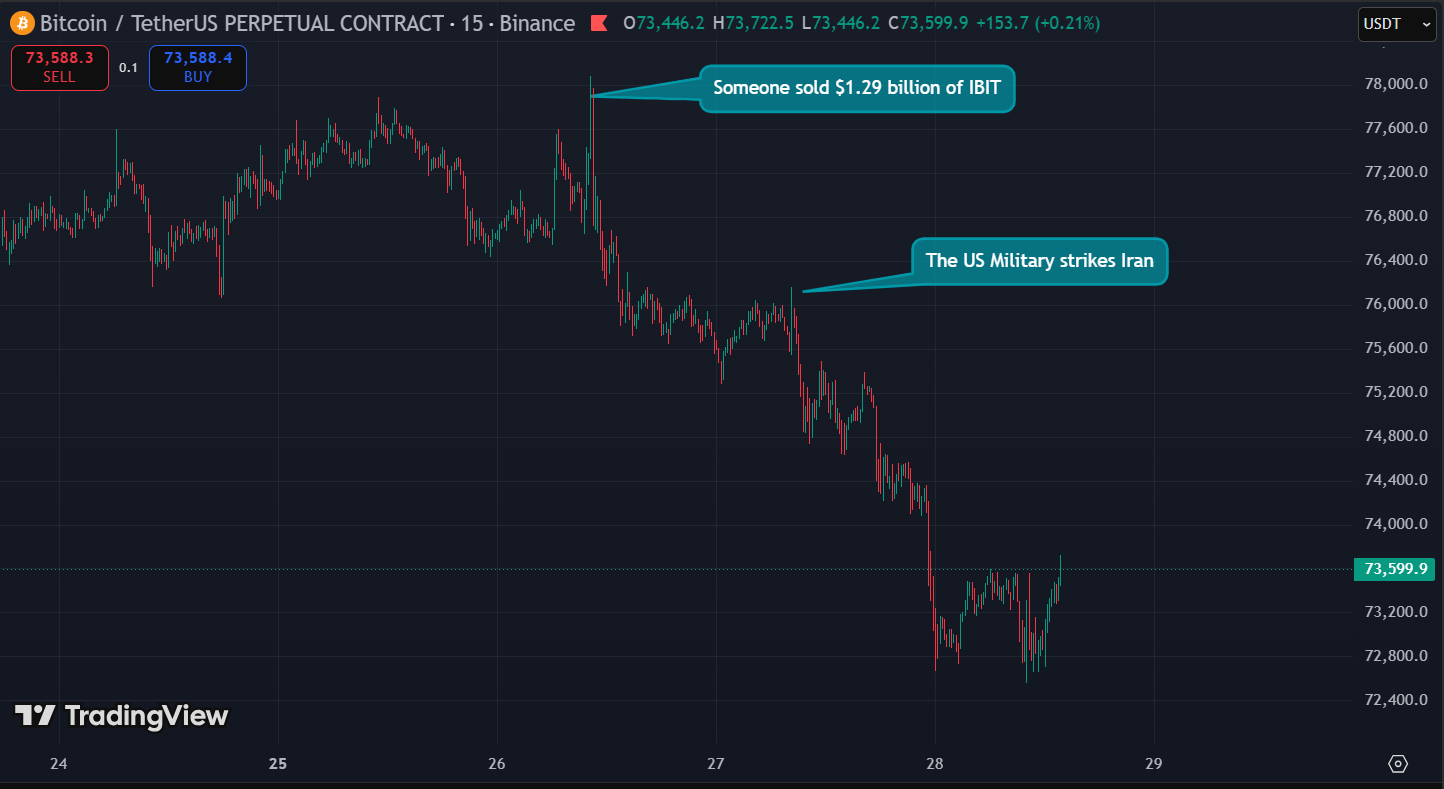
Chart: Tradingview
Tuesday, May 27, 10:30 a.m. ET. An unknown party sold $1.29 billion of IBIT in one privately negotiated dark-pool block, roughly 29 million shares at $43.16 each. Bitcoin immediately reversed from just under $78,000 and dropped 2%. Bloomberg ETF analysts Eric Balchunas and James Seyffart confirmed the transaction.
Wednesday, May 27–28, overnight. The US military struck a site near Bandar Abbas, drones, a ground control station, a threat to the Strait of Hormuz. Iran’s IRGC fired back at a US base in Kuwait.
Wednesday, May 28. Bitcoin fell below $73,000. The 11 US spot Bitcoin ETFs lost $733.43 million in combined outflows, the largest single-day total in four months. IBIT alone shed $527.84 million. Its second-largest outflow on record. Within $500,000 of its all-time daily redemption high.
Someone sold $1.29 billion of Bitcoin exposure in private. The next day, a military escalation erased over $500 million from that same fund in public.
What a Dark Pool Actually Means Here
This isn’t a standard market order. A dark-pool block trade is a privately negotiated transaction built specifically so a large seller can exit without alerting anyone to their intentions. The number hits the tape. The identity does not.
The block sale itself isn’t the same as an outflow, buyers absorb the other side, and IBIT’s Tuesday net redemptions were $192.44 million. The $527 million came the day after, once the strikes were confirmed.
That distinction is important for the legal question. It doesn’t change the timing question.
The timing question is: who sells $1.29 billion in Bitcoin ETF exposure at 10:30 a.m. on a Tuesday, and what did they know about Wednesday?
The Context Everyone Is Skipping
Analysts covered the outflows. They cited rising Treasury yields, macro uncertainty, geopolitical tensions. All accurate.
None of it explains a $1.29 billion block trade by a single unidentified institution executed the morning before a military strike.
Here is what the broader data looked like. Eight consecutive days of net ETF outflows going into Wednesday. Over $2 billion pulled from the complex in two weeks. Bitcoin down from $82,000 on May 6 to under $73,000 by Thursday. Of the 11 spot Bitcoin ETFs, only Morgan Stanley’s MSBT posted inflows Wednesday, $4.3 million. Everyone else bled. Fidelity’s FBTC lost $60.30 million. Grayscale’s GBTC shed $104.76 million. IBIT shed half a billion.
The outflow streak has a macro explanation. The single block trade does not.
The Pattern
This isn’t isolated.
In June 2025, in the hours before US strikes on Iran, 19 longshot Polymarket bets totaling $164,000 were placed on contracts that resolved YES. Eight wallets split roughly $1.8 million. In early 2026, a single Polymarket trader won 93% of five-figure wagers on unannounced US military operations against Iran.
Now a single anonymous institution sold $1.29 billion in Bitcoin ETF exposure the morning before a US military strike near the Strait of Hormuz.
The asset class changed. The information problem did not.
Dark pools and pseudonymous prediction market wallets are built on different infrastructure. They share one feature: they allow large players to make large directional bets without disclosing who they are or what they know. In both cases, the number is visible. In both cases, the name is not.
The Question
IBIT controls roughly 4% of Bitcoin’s total supply. A $1.29 billion block sale followed by a $527 million outflow the next day is not a footnote. It moved the price. It moved it before retail knew what was coming.
The SEC cleared IBIT. Dark-pool transactions inside regulated infrastructure leave a paper trail, a broker, a counterparty, a record. Unlike Polymarket’s pseudonymous wallets, this trade sits inside a system where regulators have subpoena power.
Nobody has announced they are using it.
The 93% Polymarket trader hasn’t been identified. The IBIT block seller hasn’t been identified. The data is public record. The question is the same: who knew, and when?
So far, nobody with authority has decided that question is worth asking.