


On May 24, HYPE hit $64.21. A new all-time high. Up 143% year to date. Up 63.5% in a single week.
In April we wrote that four asset managers were racing to launch a HYPE ETF and Arthur Hayes was frontrunning all of them. At the time HYPE was trading around $40. The thesis was simple: Hayes was not buying the current Hyperliquid. He was buying what the institutional wrappers were about to deliver.
The ETFs launched. The ATH happened. Here is what actually drove it and why the next chapter is more complicated than the headline suggests.
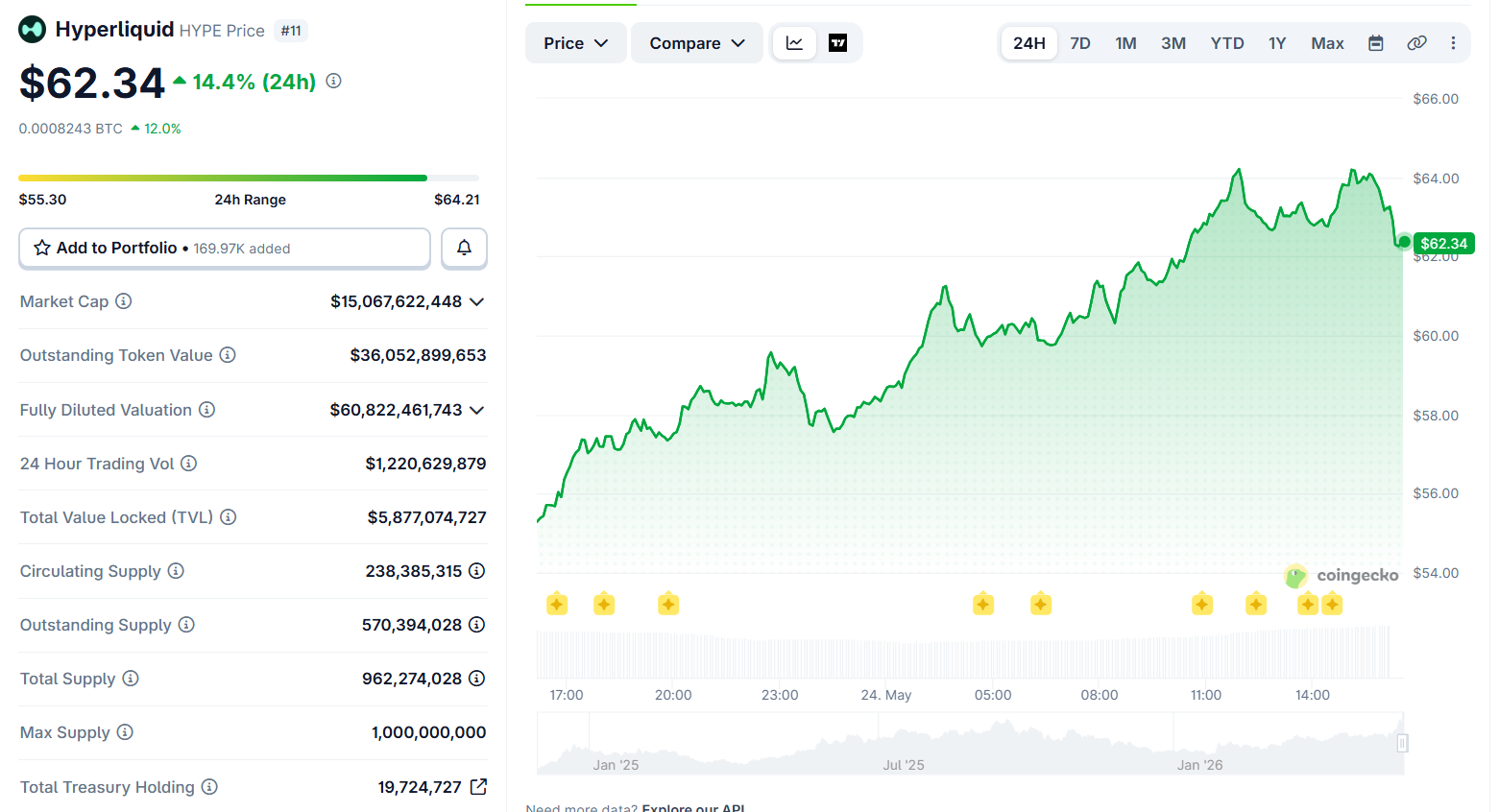
HYPE hits $64.21 all-time high on May 24, 2026. Market cap $15 billion. TVL $5.87 billion. Circulating supply 238 million of 1 billion maximum. Source: Coingecko
The ETF Timeline
21Shares launched its THYP product on May 12. Bitwise launched BHYP on May 15. The two funds drew approximately $54 million in net inflows over their first seven trading days. Grayscale-linked wallets accumulated more than 510,000 HYPE worth approximately $24.95 million in the same window.
That is the institutional wrapper delivering exactly what the pre-launch positioning predicted. Capital that cannot hold HYPE directly through a crypto wallet now has a regulated access point.
Bitwise added one feature that amplifies the mechanism permanently. The fund committed to allocating 10% of its ETF management fees toward holding HYPE on its balance sheet. Every basis point of AUM generates fee income that goes back into HYPE. The bigger the fund grows, the more HYPE it buys from its own fees.
The Part Nobody Is Writing About Correctly
HYPE is climbing in large part because Hyperliquid spends almost everything it earns buying HYPE back. The buyback is written into the protocol, runs continuously, and has very little to do with whether outside investors believe in the asset.
The protocol routes the majority of perpetual futures fees into its Assistance Fund, which buys HYPE from the open market every hour. When daily perpetual volume hits $8.8 billion as it did this week, that fee pool is substantial.
The ETFs brought institutional attention and fresh capital. The protocol buyback created the floor that made the ATH possible. Most analysis conflates them into one institutional demand narrative. The distinction matters because one is temporary and one is permanent. ETF inflows can reverse. Protocol buybacks run as long as the exchange generates volume.
The Arthur Hayes Update
A wallet linked to Arthur Hayes deposited 115,453 HYPE worth $6.33 million into Bybit on May 23. That move came after his $150 price target by August 2026 had been widely circulated and after HYPE reached $64.
Moving tokens to an exchange is the standard preparation for a sale. Hayes has not confirmed his intent.
The timing is worth noting. Hayes accumulated at $40, called $150 by August, watched the price hit $64, and then moved $6.3 million to an exchange. Whether that is profit-taking, rebalancing, or preparation for a larger exit determines how much of his frontrunning thesis he still believes. The market will find out when the Bybit wallet moves.
What the Protocol Numbers Actually Show
Total value locked in Hyperliquid reached $5 billion with perpetual trading volume hitting $8.8 billion in 24 hours. Open interest hit a six-month high of $9.5 billion. HYPE’s fully diluted valuation briefly surpassed Solana’s during the peak.
This is not a memecoin. Hyperliquid is running a derivatives exchange that generates real fees from real volume. The token’s value accrual mechanism is direct and visible on-chain. Hayes evaluated it in March on volume-to-open-interest ratio and called it the tightest execution for large orders in the $100,000 to $10 million range. That assessment has not changed.
The Honest Remaining Questions
Circulating supply is 238 million against a maximum of 1 billion. That means 762 million HYPE tokens do not yet exist in the market but will eventually. How that supply comes to market determines whether the buyback program can absorb it without price suppression.
Hayes’ $150 target implies a roughly $38 billion market cap at current circulating supply. The gap between $64 and $150 requires either continued ETF inflow acceleration, sustained volume that keeps the buyback engine running at scale, or a narrative expansion that brings new buyers not currently in the market.
The ETF launch delivered the catalyst the positioning predicted. What comes next depends on whether the underlying exchange keeps growing faster than the token’s supply.
We wrote the frontrunning thesis in April when HYPE was $40. The more interesting question now is whether Hayes’ Bybit deposit is the signal that the institutional catalyst trade is complete.