


Every few years a health scare hits the news before anyone knows how serious it is. The market reacts before the science does. Bitcoin moves before either.
Right now that scare is a Hantavirus outbreak on a cruise ship off Cape Verde. WHO currently assesses the global risk as low, seven cases, three deaths, a confined environment, a rare strain with limited human-to-human transmission. This is a serious situation for the people involved. It is not COVID.
But the pattern it is triggering is one that has played out before and will play out again. Understanding it is worth more than any price prediction anyone will publish this week.
What Is Actually Happening
On April 18, passengers aboard the MV Hondius, a Dutch expedition cruise ship, began falling ill with fever, gastrointestinal symptoms, and rapid progression to pneumonia. By May 2, WHO had been notified. By May 4, seven cases had been identified including three deaths. On May 6, confirmation arrived that the strain is the rare Andes variant, the only known hantavirus capable of limited human-to-human transmission.
#Hantavirus cluster linked to cruise ship travel:
Since 1 April when the boat set sail, of the 147 passengers and crew, 7 people have become ill, among whom 3 have died, 1 is critically ill and 3 are reporting mild symptoms.Based on the current information, including how… pic.twitter.com/KDKwmrNeBt
— World Health Organization (WHO) (@WHO) May 5, 2026
The ship is now anchored off Cape Verde. Cape Verde refused to let it dock. The infected have been evacuated by air ambulance to the Netherlands and Germany. Contact tracing is underway for everyone on the flight from Saint Helena to Johannesburg where one passenger deteriorated mid-air.
Hantavirus is primarily transmitted through contact with rodent urine, feces, or saliva. It is not a respiratory pathogen in the traditional sense. The fact that it appeared on a ship is unusual. The Andes strain connection to South America, where two of the confirmed cases had traveled before boarding, is the most likely explanation. This is not an airborne pandemic virus. It is a zoonotic spillover event in a contained environment.
That is the science. Now here is the market reality.
The Market Does Not Wait for Science
When COVID was first reported in late December 2019, Bitcoin was trading around $7,200. In January 2020, as the first cases emerged and WHO began monitoring the situation, Bitcoin initially jumped to $7,300 as analysts speculated it might serve as a safe haven asset. The early narrative was that a geopolitical or health crisis would drive demand for a non-sovereign asset. That narrative lasted about six weeks.
Then on March 12, 2020, when it became clear COVID was a genuine global pandemic and not a contained regional event, Bitcoin crashed 39% in a single day, hitting a low of $3,850. It did not behave as a safe haven. It sold off with everything else as investors rushed to cash. Research confirmed that pandemic attention, measured by Google search volume for “coronavirus,” was a direct cause of Bitcoin returns and volatility throughout 2020. The more people searched the pandemic, the more Bitcoin moved.
The pattern has three distinct phases and understanding them is the whole point of this article.
Phase One: The Safe Haven Bid
In the first days and weeks of an unknown health event, Bitcoin tends to catch a bid. The narrative of a non-sovereign, censorship-resistant asset with a fixed supply sounds compelling when traditional systems feel fragile. Gold does the same thing. This is the phase where Twitter fills with “Bitcoin is the answer to the system failing” takes.
This phase is almost always wrong about the near-term direction.
Phase Two: The Correlation Collapse
When the scale of the event becomes clearer and markets move from uncertainty to fear, Bitcoin sells off with everything else. This happened in March 2020. Total cryptocurrency market capitalization dropped roughly 40% in a matter of days as COVID was confirmed as a global pandemic. Bitcoin fell 53% in a single day, crashing from around $7,900 to a low of $3,850. The safe haven narrative evaporated. Investors sold whatever they could sell to raise cash.
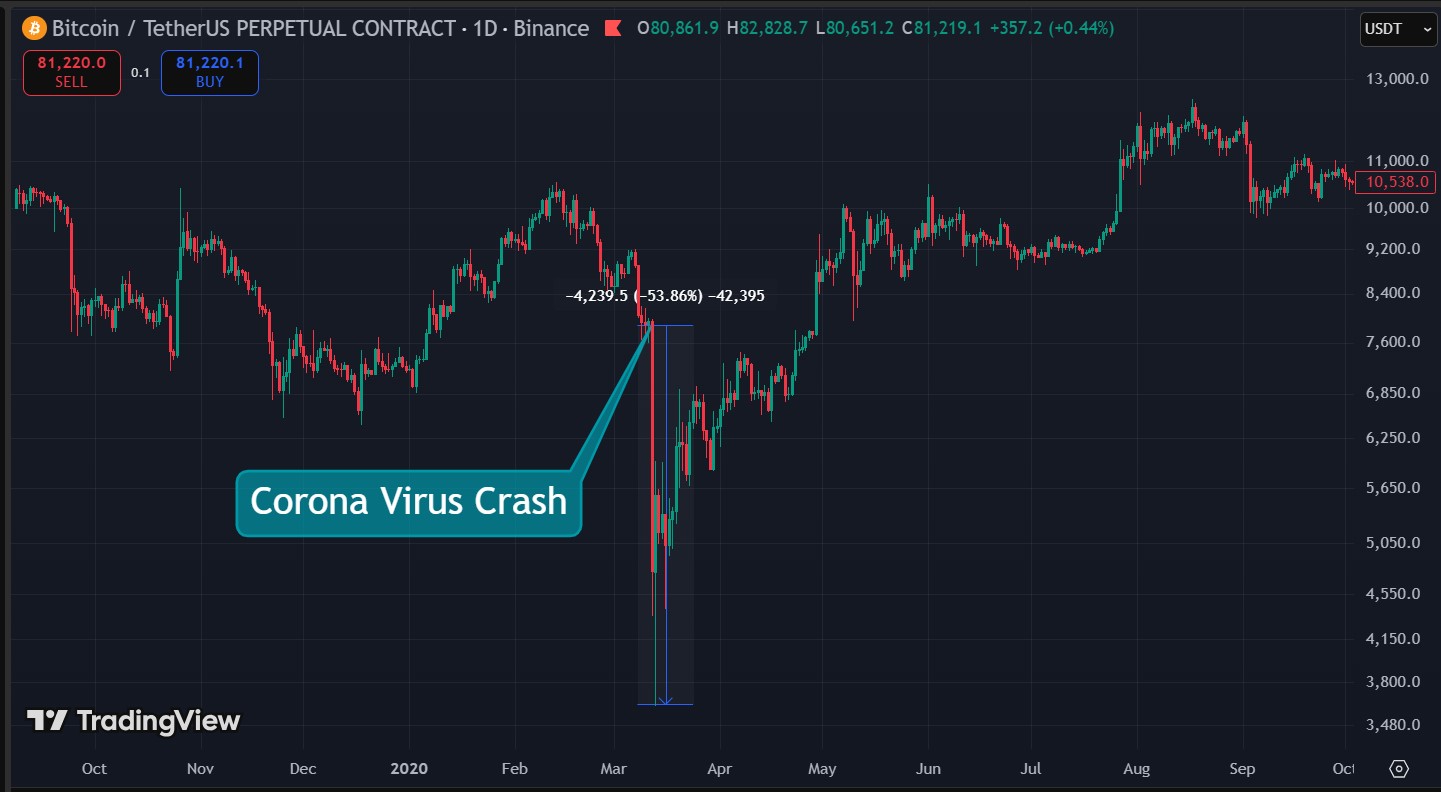
Bitcoin crashed 53.86% on March 12, 2020 as COVID was confirmed as a global pandemic. Source:TradingView
The reason is structural. Bitcoin is still primarily held by retail investors who panic alongside every other retail investor during a genuine crisis. Institutional holders with Bitcoin ETF exposure treat it like a risk asset in a risk-off environment. When fear is high enough, everything goes down together.
Phase Three: The Recovery Premium
Within six weeks of the March 2020 crash, Bitcoin had more than doubled to around $8,600. By the end of 2020 it was trading above $29,000. The money printing that governments deployed to fight the economic consequences of the pandemic, trillions of dollars in stimulus, created exactly the monetary conditions that make a fixed-supply asset attractive. The pandemic that was supposed to kill Bitcoin ended up being one of its most powerful catalysts.
This is the phase where the safe haven narrative was actually correct. Just not in the timeframe most people expected.
What the Hantavirus Situation Means Right Now
Bitcoin is currently trading above $81,000, near a three month high, driven by ETF inflows, CLARITY Act momentum, and improving geopolitical sentiment around the Iran ceasefire. It is not in a fragile position. The market is not looking for reasons to sell.
A contained outbreak with a low WHO risk assessment is not going to move Bitcoin meaningfully on its own. There are not enough fear searches, not enough mainstream media coverage, and not enough genuine uncertainty about transmission to trigger Phase Two dynamics.
What would change that calculation is if the Andes strain shows sustained human-to-human transmission beyond the ship environment. If cases appear in the Netherlands, Germany, or South Africa in people with no connection to the MV Hondius, the risk assessment changes. If that happens the search volume spikes, the media coverage escalates, and Bitcoin enters Phase One within hours.
The market is watching. It is not panicking yet.
The Lesson That Never Gets Learned
Every time a health scare emerges, the same cycle plays out. Overconfident safe haven narrative in Phase One. Brutal reality check in Phase Two. Vindication of the long-term thesis in Phase Three. Most retail investors buy Phase One, panic-sell Phase Two, and miss Phase Three entirely.
Bitcoin has survived every pandemic scare, every war, and every financial crisis since 2009. The supply schedule did not change during COVID. It will not change if Hantavirus spreads beyond a single ship. The Phase Three outcome has been consistent across every major crisis of the past fifteen years.
The variable is not whether Bitcoin survives. It is whether you are still holding it when Phase Three arrives.
Right now the Hantavirus situation does not meet the threshold for Phase Two. Monitor it. Do not trade it. And if the news gets worse, remember that you have seen this movie before and you already know how it ends.
Note: This article covers financial market dynamics and historical price behavior. It does not constitute health or medical advice. For the latest health information on the MV Hondius outbreak follow WHO updates at who.int.