


Bitcoin crossed $80,000 on May 4 for the first time since January 31. It has been rejected at this level twice before in 2026. The question worth asking is not whether it broke through. It is whether this time is structurally different from the last two attempts.
The answer is partially yes and partially no. Here is the full picture.
The Chart First
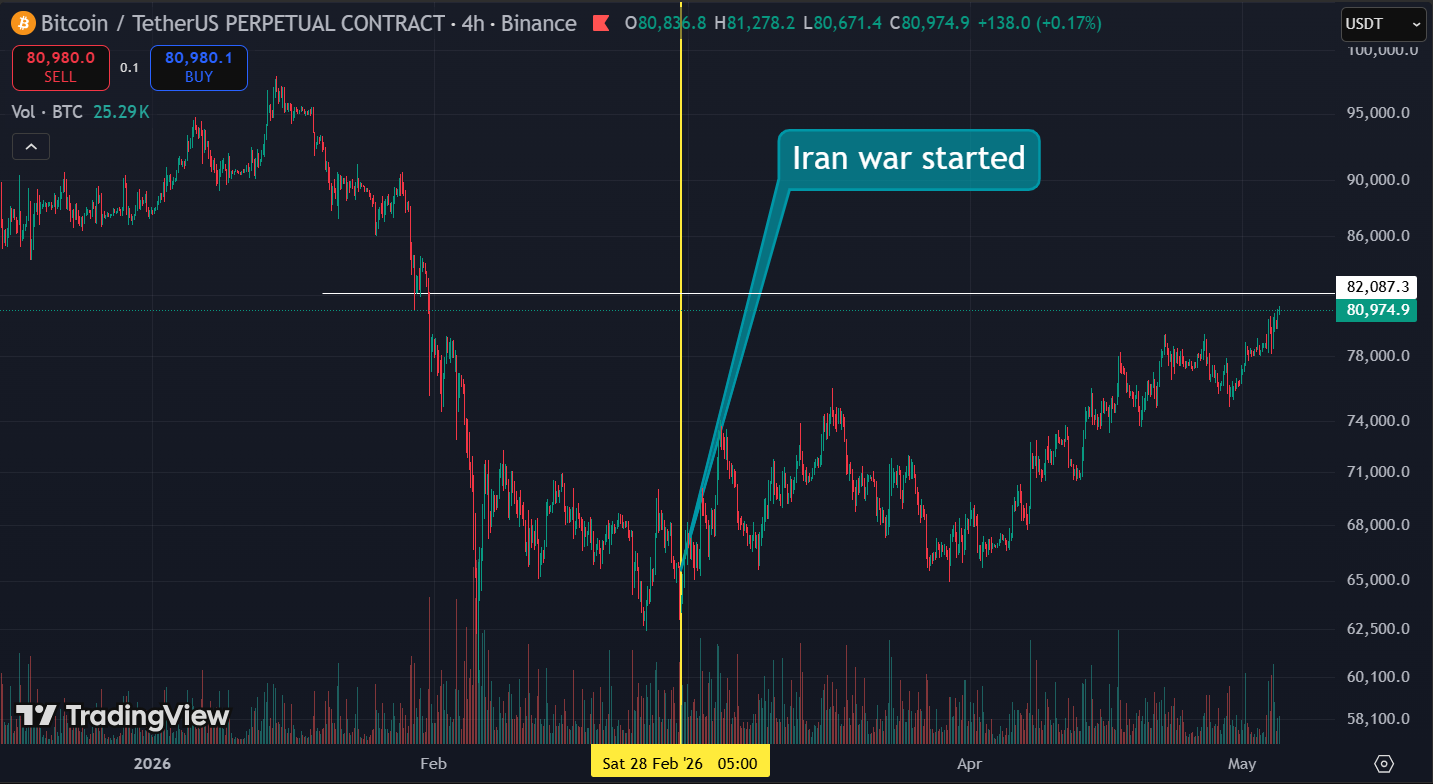
Bitcoin price chart showing recovery from the Iran war low on February 28, 2026. Source: TradingView / Binance
The chart tells a story most analysts are not telling clearly. When the Iran war started on February 28, Bitcoin was already in a severe downtrend, falling from $95,000 in January toward the $60,000 range. The war accelerated that drop. Bitcoin bottomed in early April near $60,000, roughly 53% below the October 2025 all-time high of $126,198.
What happened next is the actual story. From that April bottom, Bitcoin recovered 33% to reclaim $80,000 without the all-clear signal most retail investors were waiting for. The war is still active. The Fed has not cut rates. Macro uncertainty has not resolved. Bitcoin went up anyway.
Three Things That Actually Drove This Move
The first and most important driver is ETF inflows. April recorded $1.97 billion in spot Bitcoin ETF net inflows, the strongest single month of 2026. BlackRock’s IBIT was responsible for roughly 75% of all capital entering the category, and cumulative net inflows have now reached $58.72 billion with total ETF assets crossing $100 billion. On May 1 alone, $630 million entered in a single session. That is institutional money, not retail traders, and it creates consistent buying pressure that did not exist in previous cycles.
The second driver is the CLARITY Act. The Senate Banking Committee is moving toward a markup in May, and a stablecoin yield compromise last week removed the last major legislative roadblock. Senator Tim Scott confirmed bipartisan support and Circle and Coinbase both rallied sharply as markets started pricing in which companies benefit most from regulatory clarity. The crypto industry has been waiting for this legislation for three years. The market is pricing in the probability it finally passes.
The third driver is geopolitical, which is counterintuitive. The Iran war initially crushed Bitcoin from $95,000 to below $65,000 when it started February 28. It has paradoxically become a tailwind as Trump’s Project Freedom operation improved risk sentiment and reduced the immediate escalation fear that had been suppressing prices. Oil edged lower on ceasefire talks. Risk appetite returned. Bitcoin moved with it.
What Is Working Against This Rally
The honest analysis requires saying what the bulls are not saying.
CryptoQuant noted the April rally was driven by ETF inflows and leveraged longs, not broad-based spot buying, a pattern historically linked to fragile gains. The ETF recovery is real but incomplete. The $6.38 billion in outflows between November 2025 and February 2026 have not been fully offset. Cumulative inflows are still below the $61.19 billion peak reached in October 2025. The recovery in institutional appetite is happening but it is not back to where it was at the all-time high.
Stablecoin reserves on exchanges are also falling, which signals that dry powder available for spot buying is shrinking. When prices rise on declining stablecoin reserves it means fewer buyers are waiting on the sidelines to push prices higher. That is not a reversal signal on its own but it is a reason to treat $80,000 as a test rather than a confirmed breakout.
Strategy, the largest corporate Bitcoin holder, paused its weekly purchases ahead of its May 5 earnings report. That pause is temporary but notable. When the single largest buyer in the market steps back even briefly it removes a consistent floor bid.
Polymarket puts the probability of Bitcoin reaching $90,000 in May at just 23%. The market is not pricing a breakout. It is pricing a consolidation.
The Fed Transition Adds a Wild Card
Jerome Powell’s term ends May 15. Kevin Warsh, his nominated replacement, has a hawkish track record and has never run a central bank. The macro calendar for May is stacked, with Warsh’s confirmation imminent and the US jobs report on Friday as the main near-term catalyst.
We covered the Powell transition and what it means for Bitcoin in detail here. The short version is that a Warsh Fed is likely to be tighter than a Powell Fed, which is a headwind for risk assets including Bitcoin. If Warsh signals a hawkish posture in his first public appearances the $80,000 reclaim becomes harder to hold.
What Needs to Happen for $80,000 to Become Support
Three things would confirm this is a genuine breakout rather than a third rejection.
A daily close above $82,000 would clear the 200-day exponential moving average, which is the technical threshold most institutional algorithms watch as a trend confirmation signal. ETF inflows need to continue at or above April’s pace into May. A single week of net outflows at this level would accelerate selling from leveraged long positions that built up during the rally. And the CLARITY Act needs to visibly advance toward a Senate vote. If the markup stalls or gets delayed the legislative premium baked into current prices unwinds.
Bitcoin has survived every war, every regulatory threat, and every exchange collapse since 2009. The supply schedule has not changed. The institutional infrastructure built around ETFs did not exist in any previous cycle. Those are real structural differences from 2021 or 2022.
Whether they are enough to hold $80,000 as support through a Fed transition, an active war, and an unresolved legislative process is the open question. The answer arrives in the next two to three weeks.