


- Bitcoin dropped 52% this cycle versus 77% to 90% in every previous cycle, with Fidelity confirming the trend of shrinking drawdowns is structural, driven by institutional holders who do not panic-sell
- The tradeoff nobody mentions: compressing crashes mean compressing upside. The asymmetric returns that made early Bitcoin holders wealthy came directly from the volatility that is now disappearing
- Bloomberg’s McGlone still sees $10,000 as possible, and cycle timing data points to a potential bottom in late September or October 2026, meaning the current drawdown may not be over
Bitcoin peaked at $126,000 on October 6, 2025. It bottomed at $60,000 on February 6, 2026. That is a 52% drawdown over four months.
In every previous cycle, that number was 80% to 90%. The 2022 bear market took Bitcoin from $69,000 to $15,500. That is a 77% collapse. The 2018 cycle wiped out more than 83%. The 2014 cycle cut 86% from peak to trough.
This cycle, Bitcoin lost roughly half its value and stopped. Something is different. The question nobody can fully answer yet is whether that difference is structural or temporary.
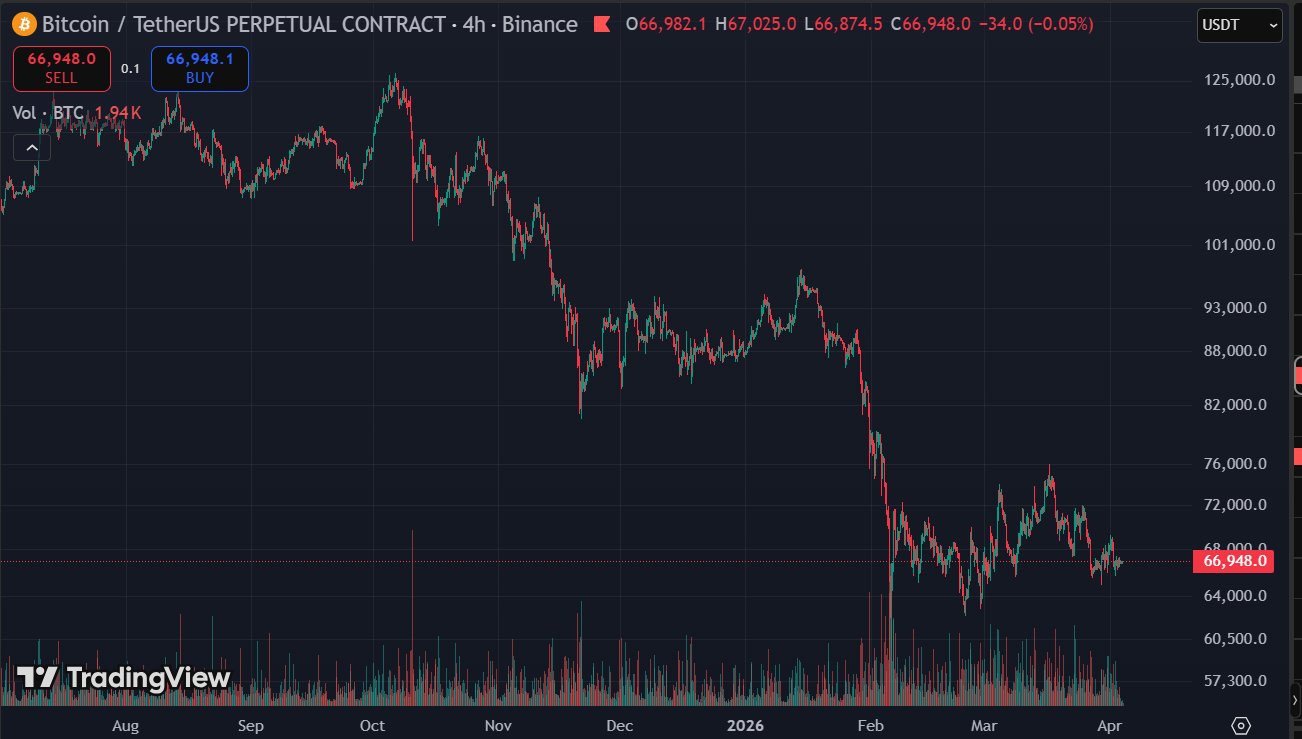
Bitcoin 4-hour chart showing the full drawdown from the October 2025 all-time high of $126,000 to the February 2026 cycle low near $60,000. Source: TradingView
What Fidelity Actually Said
Fidelity Digital Assets analyst Zack Wainwright put the data plainly in a post this week. Each Bitcoin cycle has been less dramatic than the one before it, both on the upside and the downside. The gains are compressing. The crashes are compressing. The asset is behaving differently.
The broader Fidelity Digital Assets research team has been making this case for months. Bitcoin has been the top performing asset in 11 of the last 15 years, delivering roughly 20,000% returns over a decade, outpacing equities, gold, and bonds on both nominal and risk-adjusted measures. The firm’s latest research frames zero Bitcoin allocation not as a conservative default but as a position that now requires active justification. “The central question is no longer whether bitcoin deserves consideration in a portfolio, but rather: What is your current bitcoin allocation, and why?”
That is a significant statement from a company managing trillions in assets. It reflects a shift in how institutional capital is thinking about Bitcoin that did not exist three cycles ago.
The mechanism behind the shrinking drawdowns is not complicated. Short-term retail holders, those who buy during euphoria and panic-sell during crashes, now account for less than 4% of Bitcoin’s market supply. They have been replaced by ETF investors, corporate treasuries, pension funds, and sovereign wealth vehicles. Whales accumulated $23 billion during the worst fear readings of the cycle.
As Fidelity notes, Bitcoin’s market cap is now two times larger than at the 2021 cycle peak, nearly ten times larger than the 2017 peak, and over 200 times larger than at the 2013 peak. At this scale, the capital required to drive an 85% collapse simply does not exist in the same way it did when Bitcoin was a retail-dominated speculative instrument.
The Tradeoff Nobody Wants to Acknowledge
Here is the part the bull case tends to skip over.
Compressing drawdowns come with compressing upside. The same institutional participation that cushioned the fall from $126,000 also dampens the next parabolic run. The asymmetric returns that made early Bitcoin holders wealthy came directly from the volatility that made Bitcoin terrifying to hold. You cannot have one without the other.
Jason Fernandes, market analyst at AdLunam, put it clearly to CoinDesk: “As bitcoin matures and volatility compresses, you should also expect returns to normalize. The asymmetric upside of the early cycles came with extreme drawdowns, but as those drawdowns shrink, the asset increasingly behaves like a macro allocation rather than a venture-style bet.”
A venture-style bet returning 10,000% in a cycle is a different asset from a macro allocation returning 15% annually with lower volatility. Both can be valuable. They are not the same thing. Investors who bought Bitcoin in 2020 for venture-style returns and are still holding it may be holding something that now behaves more like a commodity than a lottery ticket. The price of admission got cheaper. So did the potential jackpot.
McGlone’s $10,000 and Why It Cannot Be Dismissed
Bloomberg Intelligence strategist Mike McGlone has been one of the most consistent voices arguing that Bitcoin’s worst is not behind it. His current forecast calls for a potential slide toward $10,000, which he frames as a “normal reversion” for an asset that ran too far too fast.
The argument is macro rather than crypto-specific. McGlone’s view is that the crypto bubble is over and that any significant downturn could coincide with broader declines across equities, commodities, and risk assets. In an environment where oil is at $113, the Iran conflict is unresolved, the Fear and Greed Index is sitting at 9, and the Federal Reserve has no room to cut rates aggressively, risk assets face real headwinds. Bitcoin is still a risk asset regardless of how much institutional capital it has attracted.
The bear case does not require Bitcoin to fail as an asset class. It only requires the macro environment to deteriorate far enough that institutional holders reduce risk across their entire portfolio. ETF investors can sell IBIT just as easily as they can sell SPY. The cushion that institutional money provides is real but it is not infinite.
McGlone’s $10,000 target implies an additional 85% decline from current levels. That would put this cycle’s total drawdown at roughly 92%, in line with the worst historical crashes. It would require Bitcoin to behave exactly as it always has, suggesting that the maturation thesis is premature.
The cycle data from Alphractal founder Joao Wedson adds a precise and uncomfortable data point to this debate. Bitcoin’s top occurred 534 days after the last halving, a shorter span than in the previous cycle. The decaying pattern across cycles suggests the historical bottom may occur between 912 and 922 days after the halving, pointing to late September or early October 2026. If that projection holds, the current drawdown is not over. It is approximately halfway through its expected duration.
What the Data Actually Tells You
The honest read of all this information is that both sides have legitimate evidence.
Fidelity’s data is real. The drawdown compression is real. Institutional participation is structural and not going away. A Bitcoin that has been the top performing asset in 11 of the last 15 years deserves serious consideration in any portfolio construction conversation, and Fidelity is right to say that zero allocation now requires a specific argument rather than being the default.
McGlone’s macro concerns are also real. Oil at $113, extreme fear at 9, a war with no exit, a Fed that cannot cut, and a market that has been wrong about the bottom before. The 200-day moving average is sitting at approximately $68,000 and Bitcoin is trading around it, not above it. That is not the chart of an asset that has definitively found its floor.
The most honest answer is that Bitcoin is probably maturing. The 80-90% crashes of previous cycles are probably less likely than they once were. And that probably still leaves room for another 20-30% decline from here before the next cycle begins in earnest.
52% down is historically mild for Bitcoin. It is still 52% down.