


The ceasefire window Trump announced Monday was never going to close in five days. It officially stopped pretending to on Wednesday.
Iran rejected the US proposal in full. Not partially. Not with counteroffers designed to meet somewhere in the middle. The response, in plain terms, was that Iran will end the war when Iran decides to end the war, on Iran’s conditions, and that Trump does not get to set the timeline.
That is not a negotiating position. That is a door closing.
BREAKING: A preliminary list of Iran’s demands for a potential ceasefire with the US and Israel has been compiled, per Reuters.
Terms include:
1. Reparations and compensation for wartime losses
2. Iran obtains formal control of the Strait of Hormuz
3. Security guarantees…
— The Kobeissi Letter (@KobeissiLetter) March 25, 2026
What Was Actually On The Table
The US sent a 15-point ceasefire plan. The demands were significant: dismantle nuclear capabilities, halt uranium enrichment, stop funding regional proxy forces, keep the Strait of Hormuz open. In exchange, Washington offered full sanctions relief and support for civilian nuclear energy. It was a serious offer. It was also a complete ask — the kind of demand you make when you believe the other side is broken enough to accept terms.
Iran’s counter was not a counteroffer. It was a separate document from a different negotiation entirely. Reparations. Formal sovereignty over the Strait of Hormuz, meaning Iran collects fees from ships passing through 20% of the world’s oil supply. Closure of all US military bases in the Gulf. No restrictions on ballistic missiles.
The IRGC, which has consolidated power inside what remains of the Iranian government, is not making these demands because they expect to receive them. They are making them because they have decided the war continues, and these are the terms under which it eventually ends, on their schedule, not Trump’s.
The gap between these two frameworks is not a negotiating gap. It is a gap between two sides who are not currently negotiating.
What Bitcoin Is Pricing Right Now
When the war started on February 28, Bitcoin dropped to $63,106. It recovered. It held above $70,000 for most of March. Every successive escalation produced a smaller selloff and a higher recovery floor. Institutional buyers absorbed the pressure. ETF inflows held.
The market built a framework: strikes happen, oil spikes, Bitcoin dips, Bitcoin recovers. That pattern repeated enough times to become tradeable.
Iran’s rejection today does not break the framework. It confirms that the conflict is not ending this week, which the market had already largely priced. Bitcoin is currently rangebound in the $68,000 to $73,000 corridor and Wednesday’s news keeps it there.
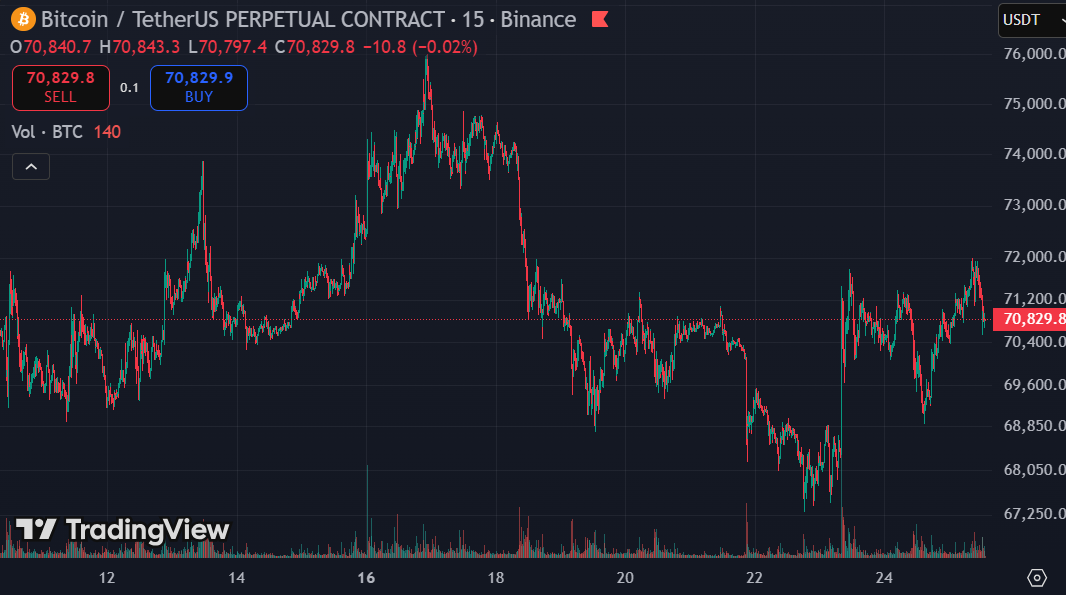
Bitcoin struggles to hold ground as Iran’s rejection of the US ceasefire proposal eliminates any near-term deal. (Source: TradingView)
Three scenarios remain, and the probabilities just shifted.
- Talks collapse entirely and strikes resume. Bitcoin tests $63,000 again. Oil moves above $115. This was always the tail risk. Iran’s rejection makes it a slightly fatter tail.
- Negotiations drag on for weeks through intermediaries — Pakistan and Turkey are the most likely channels — with no resolution in sight. Bitcoin stays rangebound. Every headline produces a spike or a dip, nothing more. This is what the market is pricing today.
- A surprise deal closes the gap overnight. Bitcoin breaks $75,000 resistance immediately as oil collapses and risk appetite returns. Iran’s counter-demands make this scenario functionally impossible this week. It remains theoretically available sometime in the future, under different conditions, with a different Iranian power structure at the table.
The Risk Nobody Is Talking About
Scenario one is the real exposure. Not because it is the most likely outcome, but because it is the least priced.
Markets have normalized the war. That normalization is doing a lot of work. It is built on a series of escalations that all followed the same pattern: strike, spike, recover. What it has not been tested against is a genuine breakdown, not a deadline extension or a softened ultimatum, but actual resumed military operations after a failed ceasefire attempt.
Iran’s rejection of a formal 15-point proposal is a different category than Iran ignoring a Truth Social deadline. One is rhetoric. The other is a documented diplomatic failure with a paper trail.
If strikes resume now, markets cannot frame it as routine escalation. The ceasefire attempt was public. The rejection was public. The resumed conflict would be a deliberate continuation, not a misunderstanding, and markets would price it accordingly.
What The Numbers Say
Bitcoin is holding near $68,000 to $70,000. Oil above $100. The five-day window Trump announced is gone. Iran has consolidated under IRGC leadership, which does not negotiate the way a civilian government negotiates.
The Pakistan and Turkey intermediary channels are real. They will likely produce something eventually. Eventually is not this week.
Bitcoin has survived every deadline in this conflict. The honest question is not whether it survives Iran’s rejection. It is whether the market’s normalization of this war holds if the next escalation does not follow the pattern.
So far it has held every time. That is the thesis. Wednesday did nothing to change it and nothing to confirm it.