

Thirty-one days into the Iran war and the map just got redrawn.
This morning Trump posted on Truth Social that the US is in “serious discussions with a new, and more reasonable, regime” in Iran — the first public acknowledgment of regime change since the conflict began. In the same post, he threatened to obliterate Iran’s electric grid, oil wells, and Kharg Island if a deal isn’t reached shortly. He mentioned desalination plants too, as a bonus.
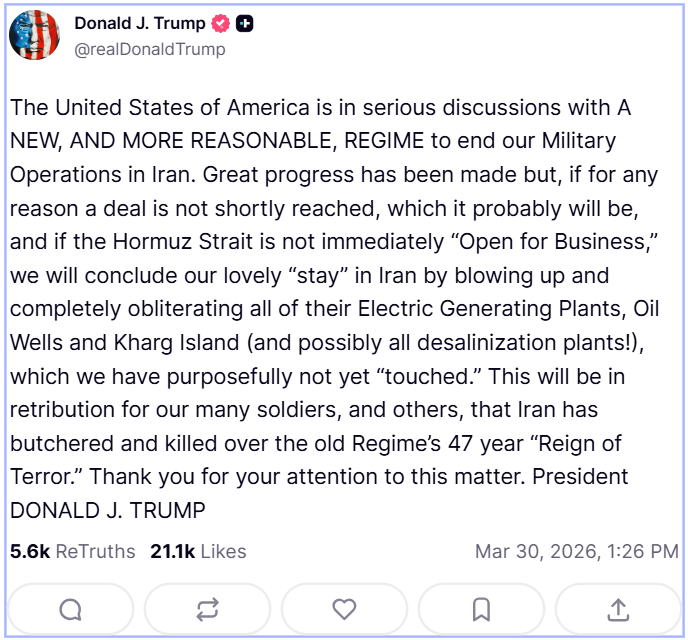
Then he told the Financial Times he was thinking about seizing the island outright. “Maybe we take Kharg Island, maybe we don’t. We have a lot of options,” he said. “It would also mean we had to be there for a while.”
Oil hit $116 a barrel on Monday after those comments. Brent crude has now jumped more than 50% since the start of March — surpassing the record set during Saddam Hussein’s 1990 invasion of Kuwait. Asian stock markets tumbled. Bitcoin bounced.
This is the most consequential twenty-four hours of the war for markets, and the reason is simple: Kharg Island handles roughly 90% of Iran’s crude oil exports. Every previous strike in this conflict has avoided oil infrastructure deliberately. Trump said so himself — he spared it “for purposes of someday rebuilding that country.” That restraint just got conditional.
What Kharg Actually Means
The strikes so far have been military targets. Kharg is different. Destroying or seizing the oil terminal doesn’t just hurt Iran — it removes a significant chunk of global oil supply from the market at a moment when Hormuz is already partially closed and the IEA has already called the current supply disruption the largest in history.
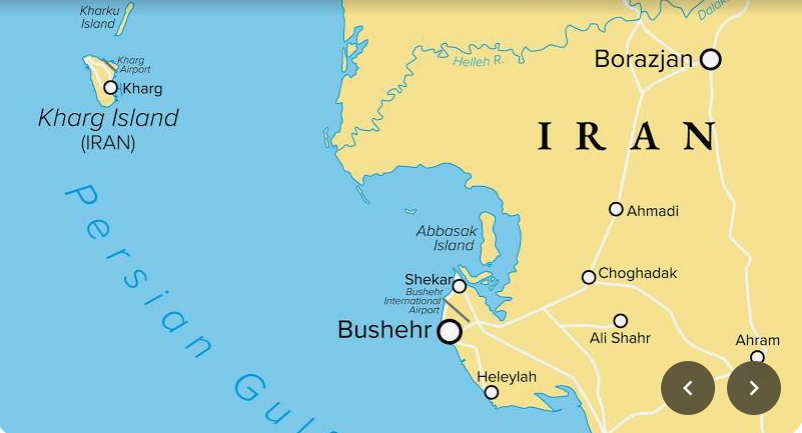
Kharg Island handles roughly 90% of Iran’s crude oil exports
Iran has been moving military personnel and air defenses to the island in preparation for a possible US operation. Iran has also warned previously that any invasion of its islands would “shatter all restraint.” A ground operation on Kharg wouldn’t be a raid. It would require troops staying “for a while,” as Trump put it, and it would almost certainly produce the most significant market shock of the war.
The prediction markets have weighed in. Over $7 million has been wagered on whether Iran loses control of Kharg Island. The current odds say it doesn’t happen. But the fact that $7 million in real money is sitting on that question tells you something about how seriously traders are taking the possibility.
Bitcoin’s Position in This
Bitcoin traded at $67,625 this morning, bouncing within a $65,112 to $67,777 range after the Truth Social post. It’s not a breakout. It’s a market that jumped on the ceasefire language, ran into resistance around $68,000, and stalled on the infrastructure threat. Both things happened in the same post, and the price reflects the confusion.
If Kharg gets hit or seized: Oil goes significantly higher from $116. Supply disruption deepens. Gulf markets, which already closed twice during this conflict, close again. Bitcoin does what it has done every time a shock hit in the past thirty-one days, it dips on the initial panic, absorbs the selling from people who need liquidity immediately, and then recovers higher than before. The floor on each selloff has risen: $64,000 on February 28, $66,000 after the first retaliation, $68,000 after sustained conflict, higher still after each subsequent shock. There’s no structural reason that pattern breaks on the next one.
If a deal gets done: Relief rally. Hormuz reopens. Oil pulls back from $116. Risk assets including Bitcoin move up together. Key resistance sits at $68,500, and a clean break above that opens the path toward $70,000 and the $73,000–$74,000 ceiling that has rejected Bitcoin four times during this conflict.
Both outcomes have a Bitcoin bid in them. That’s the position this asset has built over the course of a month of war.
The Pattern That Won’t Break
Two weeks ago, when the US bombed military targets on Kharg Island, Bitcoin gave back 3.5% on the headlines and stopped. A month ago, a comparable escalation would have triggered a much deeper sell-off. The market adapted. Traders built a framework — strikes happen, oil spikes, Bitcoin dips and recovers — and repeated it enough times that the reflexive sell-the-headline impulse faded.
That adaptation is the story of this war for crypto. Not that Bitcoin is a safe haven in the traditional sense. Not that it goes up when missiles fly. But that it keeps working, keeps trading, keeps finding buyers on every dip, while the traditional markets around it close their doors and tell investors to wait.
Dubai closed its stock exchange twice. Kuwait suspended trading. Qatar dropped 3.7% before the opening bell on a day it could even open. Bitcoin processed every transaction through all of it.
Trump has been talking about Kharg Island since 1988. He told the Guardian that year: “One bullet shot at one of our men or ships and I’d go in and take it.” Thirty-eight years later he has the ships, the soldiers, and the motive. Whether he pulls the trigger or takes the deal, the market will have to price it in real time, on a Sunday night, with no exchange to close and no regulator to call.
That’s not a pitch. That’s just where we are.