Today’s FOMC meeting was never really about rates.
Markets priced a 99.2% probability of no change, as we predicted in our FOMC preview. The federal funds rate stays at 3.5% to 3.75%. Nobody is surprised. Nobody moves much. The decision itself is not the story.
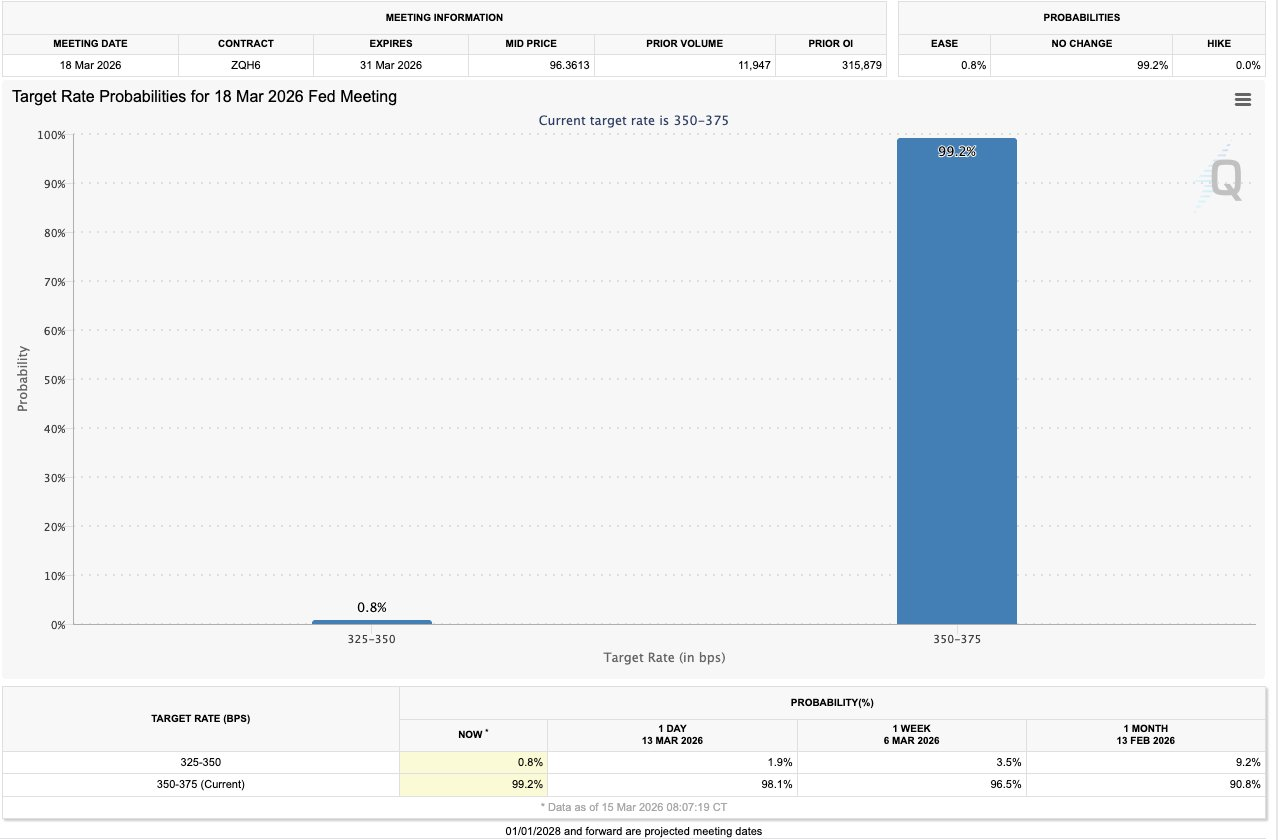
CME FedWatch Tool showing 99.2% probability of no rate change at today’s March 18 FOMC meeting
The story is that Jerome Powell is running out of meetings.
His term as Fed Chair expires May 15. Kevin Warsh, nominated by Trump on January 30 and formally sent to the Senate on March 4, is waiting in the wings pending confirmation. Today’s press conference is one of Powell’s last opportunities to speak as the most powerful financial official in the world. And the economy he is preparing to hand over is considerably more complicated than the one he inherited.
What Powell Inherited and What He Built
Powell took the chair in February 2018. Bitcoin was trading around $6,000 to $10,000. The economy was in year nine of the post-financial crisis recovery, interest rates were normalizing, and the biggest monetary policy debate was whether to keep raising rates gradually or pause.
Then the pandemic arrived.
Powell made the decision to cut rates to zero and expand the Fed’s balance sheet from $4 trillion to nearly $9 trillion in a matter of months. It was the most aggressive monetary intervention in American history, executed in weeks rather than years. It worked, in the sense that the economy did not collapse. It also seeded the 2021 to 2022 inflation surge that cost millions of Americans real purchasing power and triggered the fastest rate hiking cycle in four decades.
Powell raised rates from zero to 5.25% to 5.50% between March 2022 and July 2023. Eleven consecutive hikes. The kind of tightening that historically causes recessions. The recession did not come, which became known as the soft landing. Whether that was skill, luck, or the delayed consequences of unprecedented fiscal stimulus is a debate economists will continue for decades.
Bitcoin went from around $46,000 when the first hike landed in March 2022 to $15,000 by November 2022. It then ran to $126,000 by October 2025 as rate cuts began and institutional demand through spot ETFs created a new buyer category. It now sits around $74,000, down 40% from its peak, navigating a world where oil is above $100 and the Iran conflict has complicated every assumption about inflation trajectory.
That is the economy Powell hands to his successor.
The Warsh Question
Kevin Warsh is not a straightforward story for Bitcoin, which is part of what makes the transition interesting.
On paper, he is the hawkish nightmare scenario. He was the only Fed official to oppose the central bank’s $600 billion Treasury bond purchase program in 2011. He resigned that year, joined Stanford’s Hoover Institution, and spent the following years criticizing the direction the Fed took under Bernanke, Yellen, and eventually Powell, arguing consistently that the central bank intervenes too often, keeps rates too low for too long, and inflates its balance sheet beyond what the economy needs.
Bitcoin dropped 6% the day Trump mentioned his name. XRP fell over 15% in the same week. Markets read hawkish and sold risk assets.
But Warsh is more complicated than the initial reaction priced. He has invested in Bitwise Asset Management, the firm behind a spot Bitcoin ETF, and has called Bitcoin “the new gold” in public remarks. He described Bitcoin as a “policeman” that keeps central banks honest. He is not an ideological opponent of crypto. He is a monetary disciplinarian who happens to have made crypto investments and holds what might be described as respectful skepticism rather than hostility.
The approach most analysts expect from Warsh combines quantitative tightening with front-loaded rate cuts. Tighter balance sheet, lower short-term rates, a combination designed to rebuild Fed credibility without triggering a recession. If that sequencing plays out, the macro environment for Bitcoin is not obviously worse than it is under Powell. It is different. Less predictable. More sensitive to Warsh’s communication style, which is known to be less scripted and more willing to deviate from the consensus than Powell’s careful data-dependent framing.
The Confirmation Problem Nobody Is Watching Closely Enough
There is a scenario that markets have not fully priced and that most coverage glosses over.
Senator Thom Tillis, who sits on the Senate Banking Committee, has said he will block all Fed nominees until the DOJ resolves its investigation into Powell over alleged false statements about the Fed’s $2.5 billion headquarters renovation. All 11 Democrats on the committee want the process delayed. The 13-11 Republican majority means a single defection kills the vote before it reaches the Senate floor.
If confirmation stalls past May 15, Powell does not simply disappear. He remains on the Fed’s Board of Governors until January 2028. He could stay on as acting chair. It would be the first time that had happened since the 1940s.
That scenario, Powell as a lame duck acting chair while Warsh waits for confirmation and markets reprice expectations weekly based on Senate procedural updates, is arguably more disruptive for Bitcoin than either a clean Powell exit or a clean Warsh confirmation. Uncertainty about who is actually running monetary policy for the world’s reserve currency is not a stable backdrop for risk assets.
What the Dot Plot Said Today
The Fed’s Summary of Economic Projections, the dot plot, released at today’s meeting reflects something Powell cannot ignore in his final months. Oil above $100. Core inflation still above target. Tariff-driven goods price pressures that were not in any model a year ago. The Iran conflict has complicated every assumption about energy costs for 2026.
The dot plot likely shows fewer rate cuts expected this year than the market was pricing in January. That is the honest read of an economy where the last mile of inflation is proving more stubborn than the models predicted and where external shocks, oil, tariffs, geopolitical risk, are adding cost pressures that monetary policy cannot address directly.
Powell cannot fix oil prices by raising rates. He cannot offset tariff inflation without causing a recession. He is managing the economy with the tools he has against problems his tools were not designed for. That is the situation he hands to Warsh in 57 days.
The Bitcoin Lens
When Powell took the chair, Bitcoin’s market cap was roughly $100 billion. Today it is approximately $1.5 trillion despite being 40% below its peak. The spot ETF infrastructure did not exist. Institutional custody was embryonic. Corporate treasury adoption was a niche strategy practiced by one company.
Powell’s tenure, through no intention of his own, coincided with Bitcoin’s transformation from a speculative asset held by enthusiasts into institutional infrastructure held by BlackRock, Fidelity, pension funds, and corporate treasuries. That transformation happened partly because of the monetary environment his policies created. Zero interest rates made yield-seeking capital look everywhere for returns. The post-pandemic inflation proved Bitcoin’s store-of-value thesis to a generation of investors who had never seen real inflation.
Now Warsh inherits a Bitcoin that is embedded in mainstream finance in ways that make simple hawkish-bad, dovish-good frameworks inadequate. Bitcoin as an institutional asset responds differently to monetary policy than Bitcoin as a retail speculation. Institutions with long time horizons and Bitcoin ETF allocations do not sell on a 25 basis point surprise the way leveraged retail traders did in 2022.
The next four years of monetary policy will be written by someone who called Bitcoin a policeman for central bank accountability, invested in the firms behind Bitcoin ETFs, and simultaneously believes the Fed has been too loose for too long. That combination has never held the Fed chair before.
Today’s meeting is a formality. Markets have priced 99.2% probability of no change. Rates will almost certainly not move. Powell will read from his script.
What matters is the 57 days until May 15 and what the economy looks like when the baton passes.