- Iran officially confirmed Bitcoin as payment for Strait of Hormuz transit at $1 per barrel, making this the first time a sovereign state has used Bitcoin as a national revenue mechanism at a critical global chokepoint
- The toll system could generate up to $20 million per day from oil tankers alone, with $600 to $800 million per month possible if LNG vessels are included, all settled outside SWIFT and beyond OFAC’s reach
- Iran chose Bitcoin over USDT and over the Trump-affiliated USD1 stablecoin specifically because Bitcoin has no issuer to pressure and no president to compromise, a functional rather than ideological adoption that reframes what Bitcoin actually is
 When we wrote about the IRGC’s crypto toll system in March, it was still being treated as a rumor. Ships paying Bitcoin and USDT to pass through the world’s most important oil chokepoint sounded like something from a financial thriller, not a news briefing. The numbers suggested it was real. The confirmation had not arrived yet.
It arrived this week.
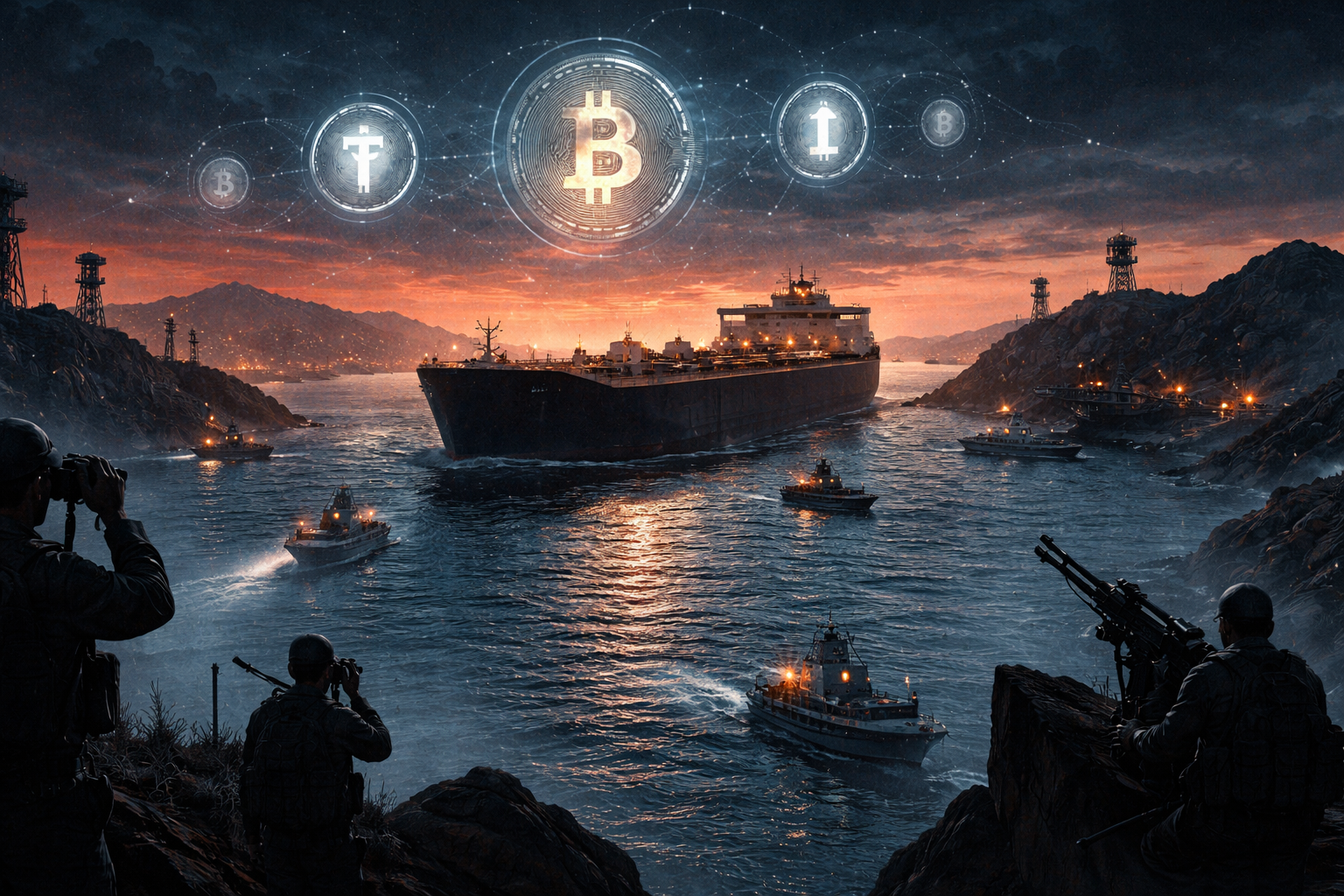
A spokesperson for Iran’s Oil, Gas and Petrochemical Products Exporters’ Union confirmed that Bitcoin is being accepted as payment for transit through the Strait of Hormuz. The Financial Times reported the structure: tankers submit cargo details by email, Iranian authorities calculate a toll of approximately one dollar per barrel of crude, and crews receive instructions on how to settle in digital assets. A fully loaded supertanker carrying two million barrels pays roughly two million dollars. In Bitcoin. To pass through a strait that carries a fifth of the world’s oil supply.
Iran’s parliament formalized this in the Strait of Hormuz Management Plan, approved March 30 and 31. The system that was already operating now has legislative backing. This is no longer a rumor or an improvised workaround. It is Iranian state policy.
The Numbers Behind the Toll Booth
TRM Labs has built the most detailed picture of what this system generates. At current traffic levels the toll system could produce up to twenty million dollars per day from oil tankers alone. If liquefied natural gas vessels are included the monthly figure reaches six hundred to eight hundred million dollars. The IRGC charges up to two million dollars per vessel depending on type, cargo, and nationality tier.
Iran applies a five-tier nationality ranking system to determine who pays what. Nations deemed friendlier receive lower rates. Vessels linked to the United States or Israel are denied transit entirely. Ships from aligned nations pay a negotiated rate and receive safe passage. Everyone else pays the Bitcoin toll or finds another route.
The system accepts Bitcoin and Chinese yuan routed through Kunlun Bank via CIPS, the Chinese interbank payments system that operates entirely outside SWIFT. Two parallel rails, both designed to settle value without touching the US correspondent banking system, both in operation simultaneously. The operational architecture of Iranian sanctions evasion has graduated from informal workarounds to sovereign infrastructure.
What We Called in March and What Just Got Confirmed
The original Hormuz piece identified three things that have now been confirmed in sequence.
First, that the toll system was real and operational before anyone in Western media was treating it seriously. Confirmed by Iranian state officials and reported by the Financial Times.
Second, that Bitcoin’s properties, specifically its ability to settle value across borders without passing through any institution that OFAC can pressure, made it the logical choice for exactly this application. Confirmed by the structure of the payment system itself, which instructs crews to pay in seconds to prevent tracing or confiscation.
Third, that this represented something qualitatively different from previous crypto sanctions evasion. Not a criminal network routing stolen funds. A sovereign government using Bitcoin as the collection mechanism for a national revenue stream tied to critical global infrastructure.
That third point is the one the tweet from Mario Nawfal captures. And it is the one that most Bitcoin analysis is still not fully processing.
The Geopolitical Argument for Bitcoin That Nobody Expected
The standard Bitcoin reserve currency argument runs through the United States. Pro-Bitcoin legislation, the Strategic Bitcoin Reserve, institutional ETF adoption, Coinbase regulatory wins. The path to Bitcoin as a global reserve asset was supposed to run through Washington.
What happened at Hormuz is a different argument entirely.
Iran is not a marginal actor in global energy markets. The Strait of Hormuz handles approximately twenty percent of the world’s oil and liquefied natural gas in peacetime. The toll system Iran has built is not denominated in dollars. It is not processed through SWIFT. It is not freezable by OFAC with a phone call. A sovereign state controlling a critical global chokepoint has chosen Bitcoin as its settlement currency, not because it believes in decentralization as a philosophy, but because Bitcoin is the only asset that settles international value without passing through any institution the United States controls.
That is a different kind of Bitcoin adoption. Not ideological. Functional.
The commentator cited in the CoinDesk piece made an observation worth sitting with. If Iran had demanded payment in USD1, the Trump family-affiliated stablecoin, the President of the United States would have a financial incentive to lift sanctions and allow Iran to charge whatever tolls it wanted. The fact that Iran chose Bitcoin instead of making that offer tells you something about the strategic calculation. They chose the asset with no issuer to pressure and no president to compromise.
What Shipping Companies Are Actually Doing
The compliance calculation for shipping firms is not simple. Paying a Bitcoin toll to the IRGC creates potential secondary sanctions exposure for any company subject to US jurisdiction. Not paying means finding an alternative route, which adds days and significant fuel costs to voyages that previously transited in hours.
Several large shipping operators have already signaled they will avoid the northern route close to Iranian coastline regardless of ceasefire status. Others are calculating whether the toll is cheaper than the alternative routing. The practical outcome is that ships with minimal US exposure are paying, ships with significant US exposure are rerouting, and the IRGC is collecting from everyone willing to pay.
The ceasefire that opened this window runs for two weeks. It may be extended. It may collapse. But the toll system itself was operational before the ceasefire and will continue after it regardless of what happens in negotiations. Iran has built permanent infrastructure around a temporary conflict.
Bitcoin at $72,000 and What the Market Is Pricing
Bitcoin crossed $72,000 following the ceasefire announcement and has held above $71,000 as the toll confirmation spread. The six-week range of $65,000 to $73,000 that we identified as the Iran conflict’s price cage is now being tested at the upper bound for the first time with genuine fundamental support behind it.
The market is pricing something specific. Not just ceasefire relief. The realization that the conflict has produced a use case for Bitcoin that no amount of ETF approval or legislative progress could have generated. A sovereign state has confirmed Bitcoin as the settlement currency for access to twenty percent of global oil supply.
That is not a narrative. That is a contract.
Whether this becomes a durable part of Bitcoin’s global role depends on whether the toll system persists beyond the ceasefire, whether other sanctioned actors adopt the same model, and whether Bitcoin’s price stability improves enough that operators can settle large transactions without significant slippage risk. All of those are open questions.
What is not open is what happened. Iran confirmed Bitcoin. The strait is the toll booth. The invoice arrives in seconds. Payment is in Bitcoin.
The decentralized global currency argument just got its first sovereign proof of concept, from the last place anyone expected.