
Every day, hundreds of blockchain projects compete for the same limited attention from crypto journalists, investors, and traders. Most press releases get ignored. A small number generate real coverage, drive traffic, attract investors, and build lasting credibility. The difference almost never comes down to budget — it comes down to knowing exactly how the process works.
This guide covers everything you need to submit a crypto press release that actually gets read: what to write, how to format it, where to submit it, how much it costs, and what separates releases that get picked up from ones that disappear into the void.
What Is a Crypto Press Release and When Do You Need One?
A crypto press release is an official announcement distributed to media outlets, journalists, and news aggregators about a development in your blockchain project or company. Unlike a blog post or social media update, a press release follows a specific format that journalists and editors expect — and it’s distributed through channels that reach audiences you can’t access organically.
You need a press release when you have genuinely newsworthy information. The rule of thumb is simple: if a neutral journalist who doesn’t work for you would find it interesting, it’s worth a press release. If it’s purely promotional with no actual news value, it won’t get picked up no matter how well it’s written or how much you spend on distribution.
The types of announcements that perform consistently well in crypto are token launches and presales, exchange listings (especially tier-1 exchanges), funding rounds and investment announcements, major partnerships with established companies, protocol upgrades or mainnet launches, and significant milestones like user numbers or total value locked. Research reports and market data releases also perform well because they give journalists something to cite, which dramatically increases the chance of earning editorial coverage rather than just syndicated placement.
Step 1: Write a Press Release That Editors Won’t Ignore
The writing quality of your press release determines everything that follows. A poorly written release will be rejected by editors, ignored by journalists, and skipped by readers even if you spend thousands on distribution.
The Structure Every Crypto Press Release Needs
Headline — Your headline needs to communicate the actual news in under 100 characters. Be specific and factual. “DeFi Protocol X Raises $15M Series A Led by Andreessen Horowitz” will always outperform “DeFi Protocol X Announces Exciting New Milestone.” Editors read hundreds of headlines daily and have no patience for vague ones.
Dateline — Start the body with the city and date: “NEW YORK, February 26, 2026 —” This is standard press release format and signals professionalism immediately.
Lead paragraph — The first paragraph must answer who, what, when, where, and why in two to three sentences. Assume the reader will only read this paragraph. Everything important needs to be here. Journalists decide whether to read further based on the lead alone.
Body paragraphs — Expand on the news with context, data, and detail. Use short paragraphs of two to three sentences. Avoid jargon where possible — not every reader is a blockchain developer. If you need to use technical terms, explain them briefly.
Quote — Include one or two quotes from a founder, CEO, or relevant executive. Quotes should add perspective or emotion that the factual paragraphs can’t — not just restate the facts in quote form. “We are excited to announce this partnership” is a wasted quote. “This integration solves a problem that has prevented mainstream adoption for three years” gives journalists something usable.
Boilerplate — End with a short “About” paragraph describing your company or project. Two to four sentences covering what you do, when you launched, and where to find more information. This appears at the bottom of every press release you publish, so write it carefully and keep it updated.
Contact information — Include a name, email address, and optionally a Telegram or Twitter handle for journalists who want to follow up. Press releases without contact information signal that you don’t actually want coverage.
What to Avoid
Avoid making price predictions or return on investment claims — these create legal liability and will cause most reputable outlets to reject the release outright. Avoid superlatives like “revolutionary,” “world’s first,” or “game-changing” without evidence — they’re overused in crypto and immediately signal low quality. Keep the length between 400 and 700 words for most announcements. Longer is not better unless you have substantial detail to add.
Step 2: Choose the Right Distribution Method
Once your press release is written, you have three main options for getting it in front of audiences: submitting directly to individual publications, using a crypto-specific distribution service, or a combination of both.
Direct Submission to Crypto Publications
Submitting directly to publications gives you the best chance of genuine editorial coverage — a real journalist reading your release and choosing to write about it independently. This is the most valuable outcome because editorial articles carry far more credibility than syndicated placements.
The major crypto publications that accept direct press release submissions include CoinDesk, CoinTelegraph, Decrypt, The Block, BeInCrypto, CryptoSlate, and Bitcoinist. Each has its own submission guidelines and editorial standards. Research each outlet’s audience and recent coverage before submitting — a press release about a new NFT marketplace is unlikely to get picked up by Bitcoin Magazine.
Smaller, niche publications are often underrated for direct submission. A focused crypto news site with 50,000 monthly readers who are specifically interested in your sector is often more valuable than a syndicated placement on a general-audience site with millions of visitors who aren’t your target audience.
Crypto Press Release Distribution Services
Distribution services maintain networks of partnered publications and automatically syndicate your release across them once you submit. The main advantage is speed and breadth — your announcement can appear across dozens of sites within 24 to 48 hours. The main disadvantage is cost and variable quality — some services distribute to low-traffic or low-credibility sites that provide little real value.
The leading crypto-specific distribution platforms in 2026 are Chainwire, BTCWire, and Coinbound. Chainwire is widely considered the premium option, with guaranteed placements on major outlets including CoinTelegraph and BeInCrypto. Their pricing starts at around $1,400 for basic packages and scales to over $10,000 for comprehensive distribution. BTCWire offers similar reach at slightly lower price points with a broader focus that extends beyond pure crypto into blockchain and fintech. Coinbound combines distribution with PR strategy and influencer marketing, making it better suited for projects running full campaigns rather than one-off announcements.
For projects on tighter budgets, smaller independent crypto news sites — including dailycoinpost.com — offer direct press release publication at significantly lower price points while still providing genuine audience reach and SEO-valuable backlinks. These are particularly effective for early-stage projects building initial awareness before committing to larger distribution budgets.
General Newswires
Traditional newswires like PR Newswire and Business Wire reach mainstream financial media including Yahoo Finance, MarketWatch, and Bloomberg terminals. These are worth considering for funding announcements or news with mainstream financial relevance, but they rarely deliver meaningful crypto community engagement on their own. Use them alongside crypto-specific distribution rather than instead of it.
Step 3: Understand What You’re Paying For
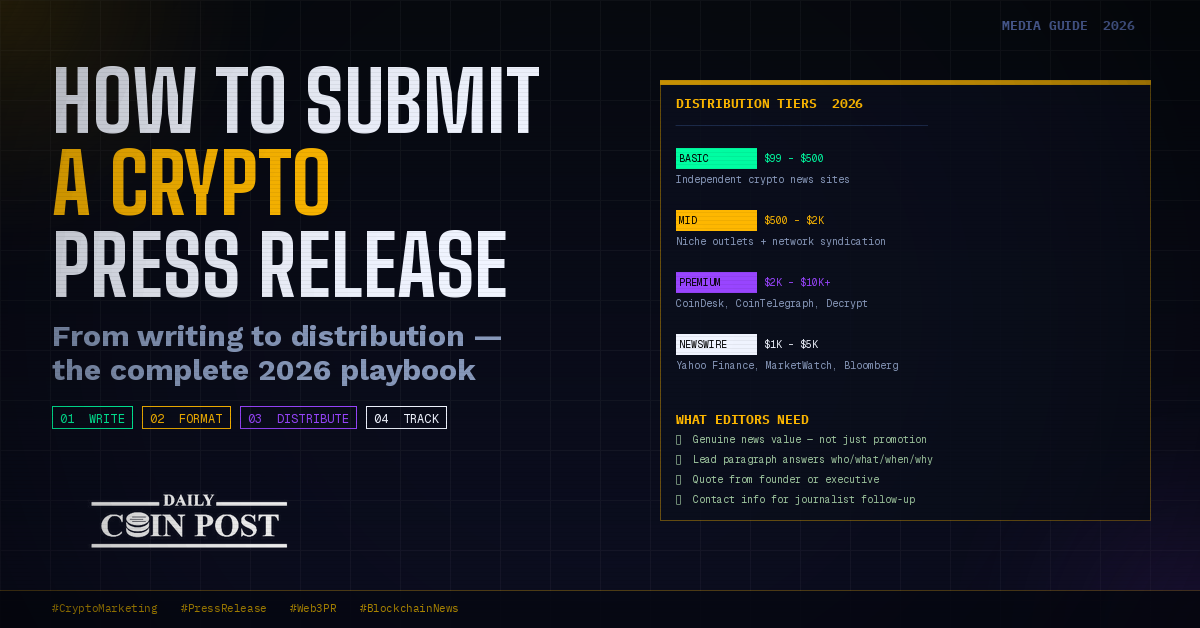
Pricing across the crypto press release industry varies enormously and the relationship between price and value is not always straightforward. Here’s what the market looks like in 2026:
Entry-level packages from crypto distribution services typically start between $200 and $500 and deliver placement on the distribution platform’s own site plus a small network of partner sites. These are appropriate for minor updates or projects in very early stages.
Mid-tier packages ranging from $500 to $2,000 typically include guaranteed placements on several recognisable crypto publications alongside broader network distribution. This is the most common price range for token launches and partnership announcements.
Premium packages above $2,000 — and up to $10,000 or more from top-tier services — include guaranteed placement on the largest crypto outlets, translation into multiple languages, social media amplification, and detailed analytics reporting. These make sense for major funding announcements, mainnet launches, or projects with significant marketing budgets.
Independent crypto news sites offer a cost-effective middle ground, typically charging between $99 and $500 for direct publication. While the individual audience reach is smaller than premium services, a package of placements across several respected niche sites can deliver comparable SEO value and targeted audience engagement at a fraction of the cost.
One factor that dramatically affects value at any price point: timing. Releases published Tuesday through Thursday morning consistently outperform weekend publications because editors are active, social media audiences are engaged, and the news cycle has room to pick up the story before being displaced by weekend content.
Step 4: Submit and Track Your Results
Once you’ve chosen your distribution method, the submission process itself is straightforward. Most distribution services have online portals where you upload your press release text, add any images or media assets, select your package and target outlets, choose your publication date, and complete payment.
After publication, tracking your results tells you what worked and what to improve for next time. The metrics worth monitoring are pickup count (how many sites published the release), referral traffic from those publications to your website or project, backlink quality (domain authority of the sites that published it), and social engagement on the published articles.
Most distribution services provide a report of publication URLs within 48 to 72 hours of distribution. Build a spreadsheet tracking these for every release — over time you’ll identify which outlets drive actual traffic versus which are pure syndication with no engaged audience.
Getting the Most From Every Press Release
A press release is the beginning of a media strategy, not the end of it. Projects that extract maximum value from their releases do several things beyond just submitting and waiting.
They prepare supporting assets in advance — a press kit with high-resolution logos, founder photos, and a one-page project overview that journalists can reference without asking. They identify two or three journalists who regularly cover their sector and reach out directly after distribution with a personalised note. They share the published coverage immediately across all their own channels — Telegram community, Twitter, Discord — which drives additional traffic to the articles and signals to Google that the coverage is valuable.
They also plan their release calendar strategically. A sequence of three well-timed press releases over a launch period — introducing the project, announcing the main milestone, then reporting early results — builds narrative momentum that a single release never achieves.
Submitting to DailyCoinPost
DailyCoinPost accepts crypto press releases and sponsored content from blockchain projects, token launches, DeFi protocols, and Web3 companies. Published releases reach an engaged crypto-native audience and are distributed across our social channels. Submissions are reviewed for factual accuracy and relevance before publication.
To submit a press release or enquire about packages, visit our Submit Press Release page or contact us directly. We offer competitive rates for single releases and bundle packages for projects planning multiple announcements.
Disclaimer: This article is for informational purposes only and does not constitute financial or investment advice. Always conduct your own research before making investment decisions.